

Maths also enables sustainable action
01/20/2026Researchers from the Universities of Würzburg and Braunschweig have provided empirical evidence for the first time: Maths lessons are a suitable place to promote skills for sustainable development.
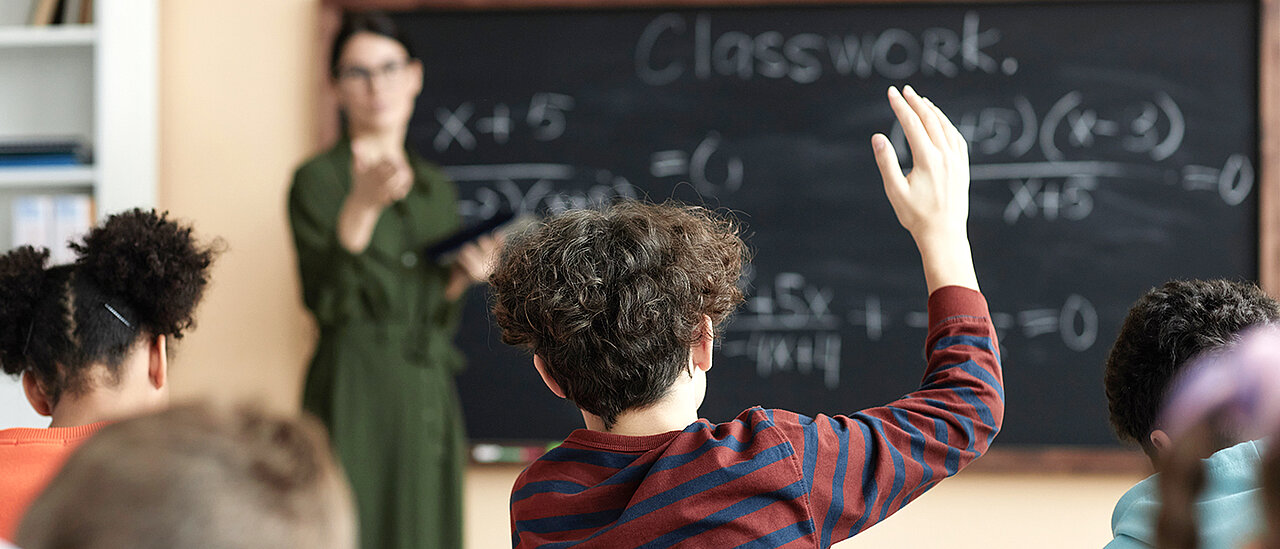
Although education for sustainable development (ESD) is a core objective in the German school system, its implementation remains a challenge - especially in a subject that is often considered abstract: maths. Yet ESD should enable young people to understand the 17 global sustainability goals of the United Nations and actively participate in shaping a future worth living.
A new study has now empirically analysed for the first time the extent to which these skills are already being promoted in maths lessons. Professor Katrin Vorhölter, Head of the Institute of Mathematics Education and Elementary Mathematics at TU Braunschweig, and Professor Hans-Stefan Siller, Chair of Mathematics V (Mathematics Education) at the University of Würzburg, were responsible for the study. They have now published the results of their study in the journal Environmental Education Research .
Three central areas of expertise
"In order to make education for sustainable development tangible in the classroom, an orientation framework is used in Germany that distinguishes between three central areas of competence," says Hans-Stefan Siller, explaining the background to the study.
Recognising is one area. Pupils should, for example, obtain and analyse information on global topics such as climate change or poverty and understand the connections between them.
Recognising is followed by evaluating: pupils must learn to adopt different perspectives, critically question arguments and form their own well-founded opinion.
The final step is action. Pupils should derive options for action from the knowledge gained and develop the willingness to commit themselves to sustainable development.
From calculation to responsible action
In order to investigate the extent to which these skills come into play in maths lessons, the research team examined the work processes of 116 pupils in years 9 to 11. In small groups, they solved real-life, open-ended tasks on topics such as climate change, combating poverty and corporate responsibility.
For example, a task on the topic of "protecting the rainforest": here, the young people analysed the advertising campaign of a brewery that promised to protect one square metre of rainforest for every crate of beer sold. Using publicly available data on beer consumption and deforestation rates, the groups calculated that the actual effect of the campaign was almost negligible. "Mathematics thus became a tool for exposing greenwashing and critically evaluating the effectiveness of advertising promises," says Katrin Vorhölter.
The evaluation of the recorded discussions provides the first empirical evidence that pupils demonstrate skills in all three sustainability competences in maths lessons:
- The area of recognition was the most pronounced, accounting for 78 to 95 per cent of the time observed. The young people researched facts, analysed data from diagrams and made well-founded assumptions in order to solve the tasks.
- Evaluation skills came in second place with a share of 4 to 12 per cent. Here, the groups assessed the validity of models, scrutinised the effectiveness of measures and discussed different points of view.
- The aspect of action accounted for 1.5 per cent of the time observed. The pupils recognised their shared responsibility and discussed possible solutions to the problems presented.
Shaping the future of maths lessons
"Our study shows that maths can be much more than just applying abstract formulae. It enables young people to understand complex problems, develop data-based arguments and make informed decisions as responsible citizens," says Katrin Vorhölter, summarising the key findings. For teachers and the development of curricula, this means that they should utilise the potential of socially relevant tasks even more.
"The results, in particular the lowest proportion of only around 1.5 per cent for the competence area 'action', precisely show the need for future research and development," adds Hans-Stefan Siller. Research therefore needs to focus on developing targeted teaching materials that encourage pupils to find their own solutions and engage in responsible behaviour.
Original publication
Education for sustainable development in mathematics classrooms, Katrin Vorhölter, Hans-Stefan Siller, Janina Just, Anna Barbara Orschulik, Catharina Zieriacks, Environmental Education Research, https://doi.org/10.1080/13504622.2025.2565461
Contribution to the orientation framework for grammar schools
Katrin Vorhölter and Hans-Stefan Siller are not only investigating the role of education for sustainable development in maths lessons; they are also heavily involved when it comes to concrete implementation. Together, they are responsible for the mathematics subject chapter in the "Orientierungsrahmen Globale Entwicklung - Bildung für nachhaltige Entwicklung in der gymnasialen Oberstufe", which was adopted by the Conference of Ministers of Education and Cultural Affairs (KMK) on 16 October 2025.
The new edition of the orientation framework is the result of a six-year work process. In accordance with the KMK's mandate, it relates to the upper secondary school level and fulfils the desire to anchor ESD in as many subjects as possible and to provide impetus for the transition to academic studies and professional life.
Contact
Prof. Dr Hans-Stefan Siller Chair of Mathematics Education, University of Würzburg,
Phone: +49 931 31-81234 E-mail: hans-stefan.siller@uni-wuerzburg.de
Prof. Dr Katrin Vorhölter, Institute of Mathematics Education and Elementary Mathematics, Technische Universität Braunschweig
Phone: +49 531 / 391 - 8851, katrin.vorhoelter@tu-braunschweig.de