
Teaching maths with a global perspective
01/13/2026The aim of the new research project at the Chair of Mathematics Education is to link maths lessons with global issues of the future. Tasks with a connection to reality play an important role here.
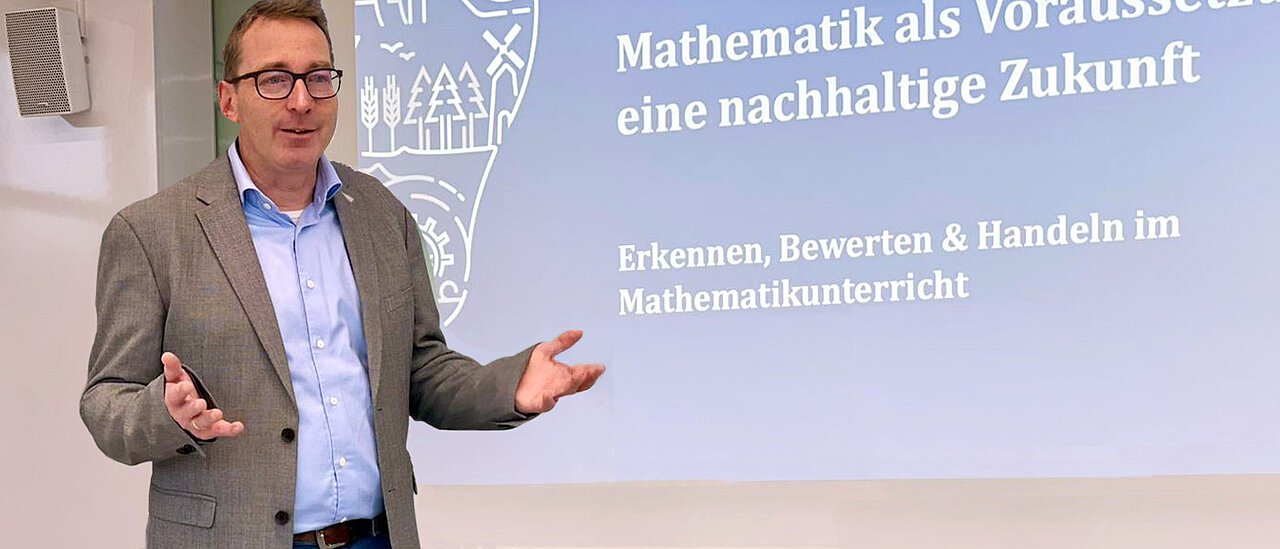
In a rapidly changing world, it is crucial that schools equip the next generations not only with mathematical knowledge, but also with a strong awareness of global challenges. This is precisely where the new project of the Chair of Mathematics Education headed by Professor Hans-Stefan Siller in collaboration with the TU Braunschweig and Professor Katrin Vorhölter's team comes in.
This has now been officially approved by the Federal Ministry for Economic Cooperation and Development and "Engagement global GmbH"; the project will run for three years. The aim is to "raise maths lessons to a new, inspiring level by focussing on the topic of 'Education for Sustainable Development' (ESD)", as those responsible write.
Raising awareness of key global issues
"The project focuses on the curricular design of maths lessons in order to raise awareness of key global problems," explains Hans-Stefan Siller. It is geared towards the core competencies of recognising, evaluating and acting, which, according to a study by the project leaders, learners can actually develop through reality-based mathematical tasks.
Two concrete implementations show how this claim can be realised in the classroom: Firstly, learners work with "real" climate data sets, on the basis of which they develop their own mathematical questions - for example, to determine temperature trends, to categorise uncertainties using confidence intervals or to smooth data using moving averages. Secondly, pupils learn to critically scrutinise media statements using large data sets - a key basic skill for democratic participation.
"Both examples illustrate how project-oriented, authentic and open tasks can usefully complement traditional textbook formats, concretise complex social issues in the classroom and promote independent mathematical thinking," explains Hans-Stefan Siller.
"This provides an evidence-based foundation for the fact that ESD can not only be anchored in the maths curriculum, but is also demonstrably present," adds Katrin Vorhölter. The team is therefore planning to systematically investigate the effectiveness of ESD contexts as part of the accompanying research in the project, in particular how the tasks developed are effective.
The phases of the project
The project is divided into three consecutive phases: The first project phase focuses on the design and revision of tasks. In a multi-stage development process, at least five tasks are to be created for secondary levels I and II, addressing various ESD sub-competences and sustainability goals. In addition, accompanying didactic material will be developed, with several revision loops ensuring quality for use in schools.
"We are convinced that teachers should not only impart precise knowledge, but also help to prepare learners for the challenges of a complex world," says Professor Katrin Vorhölter. For this reason, the second phase is dedicated to the further training and support of teachers. Practical teacher training courses will be designed and carried out at both locations to provide teachers with the necessary tools to use the new materials effectively in the classroom.
The third phase of the project focuses on transfer and dissemination: the materials developed are prepared in such a way that they can be used easily and in many different ways. A handout for Bavaria and Lower Saxony ensures that the results reach the classroom directly via the state institutes, where they can provide long-term impetus. At the same time, the research results are actively disseminated to the outside world - in dialogue formats with the public and experts that open up new perspectives and reveal further potential applications.
A contribution to the structural anchoring of ESD
The joint project creates a close link between education policy strategies and concrete teaching activities, particularly in view of the innovation of a cross-state initiative. It strengthens prospective teachers and increases the visibility of maths education in the context of global challenges. It thus makes an important contribution to anchoring ESD in maths lessons. "If we want to empower learners to understand the world of tomorrow and help shape it responsibly, then we need to show them how closely mathematics and sustainability are intertwined," emphasises Professor Siller. This is precisely where the project comes in.
The project application for the cross-state initiative "Think sustainably - act mathematically: Tasks for Education for Sustainable Development" emerged from many years of close cooperation between Prof Siller and Prof Vorhölter: The joint work on the sub-chapter of the Orientierungsrahmen Gymnasiale Oberstufe, central publications and jointly organised teacher training courses were able to create a solid professional foundation for this step by step.