

Double Stitched is Better
12/02/2025Björn Gerer had an undetected heart attack. Following an operation at the University Hospital, a special "double patch" is now closing the hole in his heart.
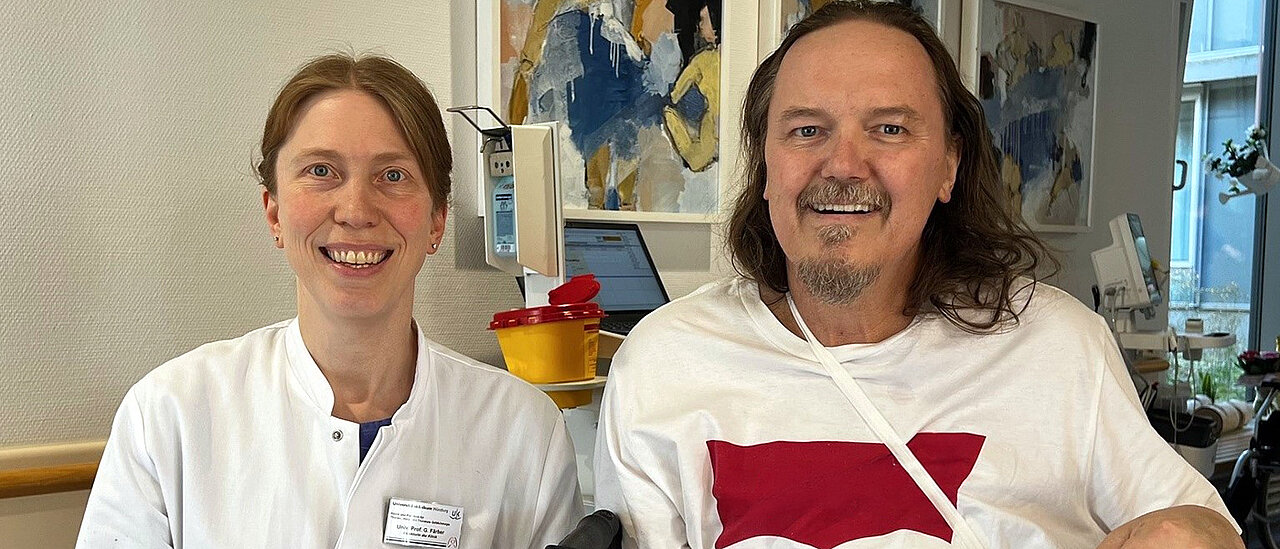
Björn Gerer normaly enjoys gardening at home, but this Saturday was different: "I felt totally exhausted, everything was exhausting, even just a few steps. I was just totally exhausted." The 56-year-old from Boxberg in the Main-Tauber district didn't initially think about a heart attack this spring. He had no particular chest pains.
Two days later, his wife took him to hospital. There he was diagnosed with a heart attack with a tear in the heart's septum. There was a hole about two centimetres in size in his septum, which separates the left and right ventricles. As a result, the blood does not flow from the left ventricle into the systemic circulation as it normally would, but instead flows backwards, causing a backflow. A life-threatening situation, Björn Gerer was then transferred to the University Hospital of Würzburg (UKW) as an emergency.
Complex Operation Lasting Several Hours
Such a course of events is absolutely critical, explains Professor Gloria Färber, Director of the Clinic for Thoracic, Cardiac and Thoracic Vascular Surgery at the UKW: "A heart attack leads to an interruption of the blood supply in the heart muscle. Due to the lack of blood and oxygen supply, the tissue dies and can tear." That's what happened to Björn Gerer.
In a complex operation lasting several hours, Färber and her team were able to close the hole using a so-called "double patch". The heart specialist explains: "Put simply, it's like a patch that is sewn onto a hole in clothing. However, the damaged tissue in a heart attack is so fragile that we sew in two patches to be on the safe side: a smaller one that primarily closes the hole and a second larger one that reduces the tension on the first row of stitches. This creates a more stable seal - double stitched is better."
Close Collaboration for a Complex Clinical Picture
With such a complex clinical picture, many areas and professional groups are involved in patient care and work closely together. Cardiac surgery, cardiology, anaesthesia, perfusionists, intensive care and nursing all work hand in hand. "I can only thank everyone involved, even if I didn't realise much during the time after the operation," says Björn Gerer, who was finally able to start his rehabilitation programme in August.
Now, in November 2025, he regularly attends rehabilitation sports to regain his full resilience: "I hope that I can return to work next year. That's my firm goal." Another goal for him: he also wants to be back on stage with his guitar, together with his hard rock and heavy metal cover band "Edelstahl", to play songs by bands such as Iron Maiden and Metallica. Gerer: "But I still need to get back into shape for that too. But it will work out!"
For Gloria Färber, one thing is particularly important: "A heart attack is not always accompanied by the typical symptoms such as a feeling of tightness in the chest and radiating pain. Fatigue or a reduction in performance for no recognisable reason can also be a sign. In women, for example, symptoms are more common in an atypical form." In such cases, an immediate clarifying examination is advisable in order to take the symptoms seriously and initiate appropriate treatment.
Risks Can Be Minimised
According to the German Heart Foundation, over 300,000 people in Germany suffer a heart attack every year. Heart attacks and their complications are not only one of the leading causes of death, but also one of the main diagnoses leading to hospitalisation. Risk factors can be minimised through a healthy lifestyle with sufficient exercise, a balanced diet and regular monitoring of blood pressure and blood values. Screening examinations help to recognise and treat diseases such as high blood pressure, cardiac insufficiency or vasoconstriction at an early stage and improve the prognosis.