

Astrid Freyeisen Observes China
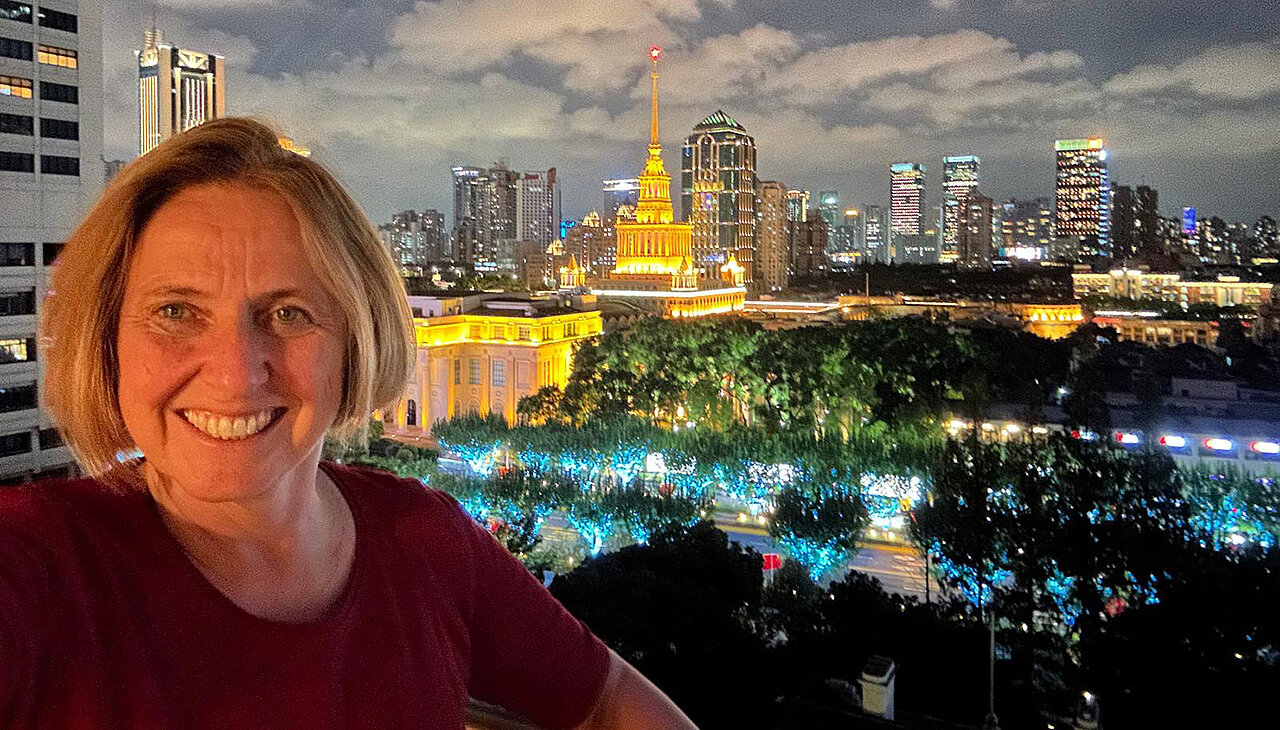
12/02/2025JMU alumna Dr Astrid Freyeisen is head of the economic and social affairs editorial team at Bayerischer Rundfunk. She deals a lot with trends and moods in China.
What do graduates of Julius-Maximilians-Universität Würzburg (JMU) do for a living? In order to introduce students to different perspectives, Michaela Thiel and her team from the central alumni network "Uni Würzburg Community" regularly interview selected alumni.
Today's interview: Dr Astrid Freyeisen. She studied Modern and Contemporary History with a minor in Sinology at JMU. She now works at Bayerischer Rundfunk in Munich as head of the economic and social affairs editorial team.
Dr Freyeisen, you are observing China. What does that mean?
Above all, it's about economics and politics: I follow the news situation and important scientific publications, maintain contacts with China experts and my ARD colleagues in China. Especially with my successor as ARD correspondent in Shanghai, Eva Lamby-Schmitt - she also studied Sinology at JMU. When necessary, I support Eva with analyses and other reports from Germany - modern technology makes it possible. At irregular intervals, I also go on holiday to China, which is particularly important in order to be able to assess local trends and moods. My reports on China are also in demand at BR. Especially, of course, when there is a connection to Bavaria in terms of content.
Why did you study sinology, what fascinates you about China?
My father Lothar Freyeisen, also a JMU alumnus, was one of the most successful German rowing coaches for many years. In the 1980s, he trained rowing coaches in China and always came back with lots of inspiring stories and photos. The spark caught me. So I decided to study sinology as a minor subject. Thanks to the partnership with the University of Hangzhou, I was awarded a JMU scholarship for China. On the one hand, I'm fascinated by the incredible dynamism that you can hardly escape in China and which brings with it so many surprising moments. On the other hand, I love the ancient culture, for example the temples in the bamboo forests around Hangzhou's world-famous West Lake.
What is the biggest challenge in reporting on China?
Maintaining a balance. The German government's China strategy makes it clear: on the one hand, China is an indispensable partner, for example in climate protection, but at the same time it is also a fierce competitor in global trade and a systemic rival. Our political systems could not be more different.
What is the most common misconception that laypeople make about China?
That China is a monolith. The country's size alone makes it more like a continent, its provinces like countries. Although they are governed centrally, they are very different.
What advice would you give to students who want to follow a similar career path?
Journalism has changed a lot as a result of digitalisation and will certainly change dramatically again as a result of AI. If you want to gain a foothold, you should gain practical experience as early as possible to see whether media is actually the right career choice.
What is your favourite memory of your time at university?
Working on my dissertation "Shanghai and the politics of the Third Reich". My supervisor was Professor Wolfgang Altgeld. He gave me the suggestion to write my master's thesis and then my dissertation from a paragraph in the travel guide that I had bought for my year of study in China. It was a unique experience because back then in the 90s there were still quite a few contemporary witnesses living, Jewish refugees and long-established German merchant families. Talking to them was like travelling back in time to the 1930s and 40s, to a war-torn Shanghai. There were also many exciting discoveries in archives in Germany, the USA and China. It was an incredibly exciting time, for which I am very grateful to my university, the DAAD and especially Professor Altgeld, who has sadly passed away.
Thank you very much for the interview!
Are you not yet a member of the alumni network "Uni Wü Community" or Alumni & Friends e.V.? Then you are cordially invited to register! You can do so on the Community website. There you will also find the interviews with JMU alumni and alumnae published so far.