Environmental sustainability
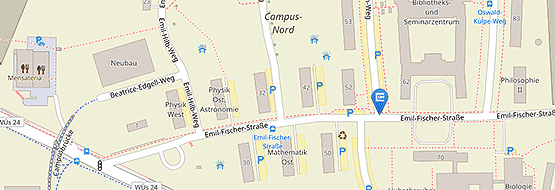
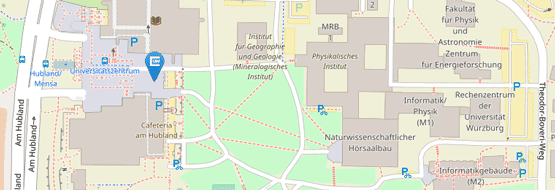
Since the 1960s, the JMU campus "Am Hubland" has offered the university the opportunity to expand beyond the city centre, which was urgently needed in view of rising student numbers. At the same time, university institutes could be concentrated on this site and travelling times for students and staff were (partially) shortened. A stroke of luck for JMU was the site of the former Leighton Barracks in the immediate vicinity of the "Hubland Campus", which became vacant when the American armed forces moved out. A significant part of the site has been available to the university as an expansion area ("Hubland Campus North") since 2011.
This significant expansion of the university's Hubland Campus has led to intensive construction activity on the new site for almost 10 years now and has enabled the university to concentrate new locations in many areas. At the same time, in addition to new buildings or buildings to be modernised, the site also offers large open spaces in some areas. Even if considerable parts of these areas are planned as locations for future buildings and other areas are used in the course of ongoing construction work (e.g. as "construction site areas", access roads, etc.), JMU is endeavouring, together with the responsible building authorities, to take ecological concerns into account. The legally required ecological compensation area corresponding to the extent of the construction work is planned in the east of the campus grounds.
In addition, JMU has agreed to designate "ecologically enhanced areas" in 2019/20, which are to be connected via a "diversity path". Further extensively managed areas on the Hubland Campus site are a prominent goal in ecologically oriented campus management.
Implementation has been taking place since 2019 in consultation between the Technical Operations Service Centre, the Ecology Department of the Student's Representation and the JMU Biocentre under the moderation of the JMU Sustainability Commission. As part of the "ArtZeiten" research project of the Chair of European Ethnology (Prof. Fenske), the design of "Wuselflächen" is accompanied by the Chair of Animal Ecology and Tropical Biology (Dr Biedermann).
From summer 2020, green space management adapted to the location will be carried out on campus by Technical Operations and with the support of non-university contractual partners. This includes, for example, the sowing of bee pasture (carried out on some areas since 2018), an extensive mowing regime to increase biodiversity with a preference for native species, especially on rough pastures or fruit tree plantations. The "Lebendiger Campus" initiative was responsible for recording the areas with a differentiated mowing concept in each case. As far as compatible with the construction progress on the Hubland Campus and taking into account the requirements for securing paths, access to technical infrastructure facilities, etc., the first steps towards implementing the mowing concept have been taken since May 2020.
As far as possible under the above-mentioned restrictions, green space maintenance is thus aligned with the requirements of species protection.
The use of broad-spectrum herbicides has been completely avoided for several years. Instead, only mechanical or thermal methods are used to control weeds.
The university has a programme in place to manage pigeon populations on its properties in line with animal welfare requirements (e.g. supervision of pigeon houses, advice on construction measures, etc.).
Since 2020, nesting aids for birds and bats have been installed as part of new construction or construction work on existing buildings (currently in the trial phase).
In order to create or maintain permanent refuges for native wildlife on the areas that are increasingly managed from an ecological perspective, more attention will be paid in future to the mandatory use of dog leads on the entire campus site, which has been in force since 2017 and is signposted accordingly.
When Prince-Bishop Julius Echter founded the JMU in 1582, he also endowed his university with forests and other land. The forest estate near Sailershausen (Haßberge district), which Julius-Maximilians-Universität (JMU) still owns today, dates back to this time.
Under the management of Hans Stark, seven foresters and two trainees look after the 2,300-hectare operation in the Sailershausen university forestry (office). The university's forest management is consistently sustainable and has been certified by the Forest Stewardship Council (FSC) since 2005. Since this time, no herbicides, fungicides, insecticides or fertilisers have been used in the forest.
Since 2003, increased efforts have been made to ensure that the commercial forests are also more valuable from a nature conservation perspective. To this end, the utilisation of wood is being partially dispensed with and biotope trees (woodpecker cavities, mulch trees, nest trees, etc.) are being left in place. The proportion of larger deadwood (>20 cm diameter) increased from 3.5 fm/ha in 2004 to 9 fm/ha in 2014 and there is an average of around 9 biotope trees per hectare.
In 2018, a large-scale biodiversity trial was set up in the Sailershausen University Forest. Under the direction of Prof Dr Jörg Müller, Chair of Zoology III - Animal Ecology and Tropical Biology at the University of Würzburg, the effects of different types of forest management on the biodiversity of commercial forests are being researched on 75 experimental plots, each 50 x 50 m in size. To this end, around 600 cubic metres of standing and lying deadwood were left in the forest and habitat trees were artificially created.
In future, the University Botanic Garden will use peat-free substrates for the cultivation of plants (with the exception of peat-dependent special crops, e.g. carnivorous bog plants).
The voluntary initiative "Lebendiger Campus" (Living Campus) by staff and students of the Faculty of Biology and the Faculty of Arts as well as the Ecology Department of the student's representation at JMU has set itself the goal of systematically recording the diversity of animals and plants (including fungi) on the Hubland Campus, promoting this diversity and determining which areas on campus are particularly suitable for promoting valuable populations. The initiative is currently financially supported by the university's UniBund and the Würzburg Environmental Foundation (exclusively for material resources). The activities of all members take place in addition to the regular work at the Institute.
The following measures have been carried out since the initiative was founded (selection): Creation of a website, mapping of animal, plant and fungal species, science communication and concrete actions on campus. The realisation of Bachelor's and Master's theses in the project is supported by specialist supervision from the fields of biology and physical geography.
The following measures were initiated in 2019
Monitoring: The systematic and scientifically sound recording of the animal and plant species present (depending on the species, either on the entire campus, in selected areas or along transects).
Contact: Dr Biedermann, Department of Animal Ecology & Tropical Biology
Action: The promotion of existing diversity through the establishment of 10 small biotopes ("Wuselflächen"). These are areas of around 10 m2 in size that are spread across the campus, mowed only once a year and enriched with various structural elements (e.g. nesting aids for insects, open soil, piles of stones and dead wood). 2 scurrying areas were implemented in 2019.
Contact: Dr Redlich, Department of Animal Ecology & Tropical Biology
Public relations and citizen science
Installation of information boards at the small biotopes or at special biotope types to explain the value of biodiversity, the current biodiversity crisis and measures to increase biodiversity on the Hubland Campus. In addition, the public should be encouraged to observe animals and plants on campus themselves and report them to the "Living Campus".
Contact: Dr Requier, Department of Animal Ecology & Tropical Biology
One problem that emerged in 2019 was that the information boards at various locations were unfortunately repeatedly knocked over or destroyed.
The voluntary Department for Ecology and Sustainability of the Julius-Maximilians-Universität student's representation was set up to draw the attention of students and the university management to issues of ecological sustainability and to actively work towards greater sustainability at Julius-Maximilians-Universität. Together with other JMU members, the participating students want to make the university more sustainable, especially in the areas of teaching, operations, research, networking and sustainability: Teaching, operations, research, networking and student life.
In addition to the opportunity to work in the CampusGarten, the Department of Ecology also offers workshops on sustainability, organises the lecture series "Can we still be saved? - Aspects of sustainability" and provides guidelines for sustainable studying and working at Julius-Maximilians-Universität.
The sustainability commitment of the Ecology Department of the student's representation has already been recognised several times:
- 2012 + 2013/14 - Official project of the UN Decade of Education for Sustainable Development
- 2016/17 and 2018 - Award for the CampusGarden project as an official project of the UN Decade on Biodiversity
- November 2017 - The CampusGarden project was awarded the first Castell-Castell Prize of the University of Würzburg for sustainable action.