
A window into Oman’s past
07/14/2026Stephanie Döpper is an expert in Near Eastern archaeology at the University of Würzburg. During a field trip to Oman, she stumbled across a 4,000-year-old artefact.
Sometimes luck plays a part too. Stephanie Döpper is a junior lecturer in Digital Humanities for Near Eastern Archaeology and Ancient Near Eastern Studies at the University of Würzburg. This means, for example, that she analyses satellite images of Oman in search of previously unknown archaeological structures. During one such analysis, she and her team had suspected the presence of graves in a particular region and had therefore travelled to the site to examine the area more closely. Their suspicions were confirmed: “There are around 4,000 graves in the region,” said the professor.
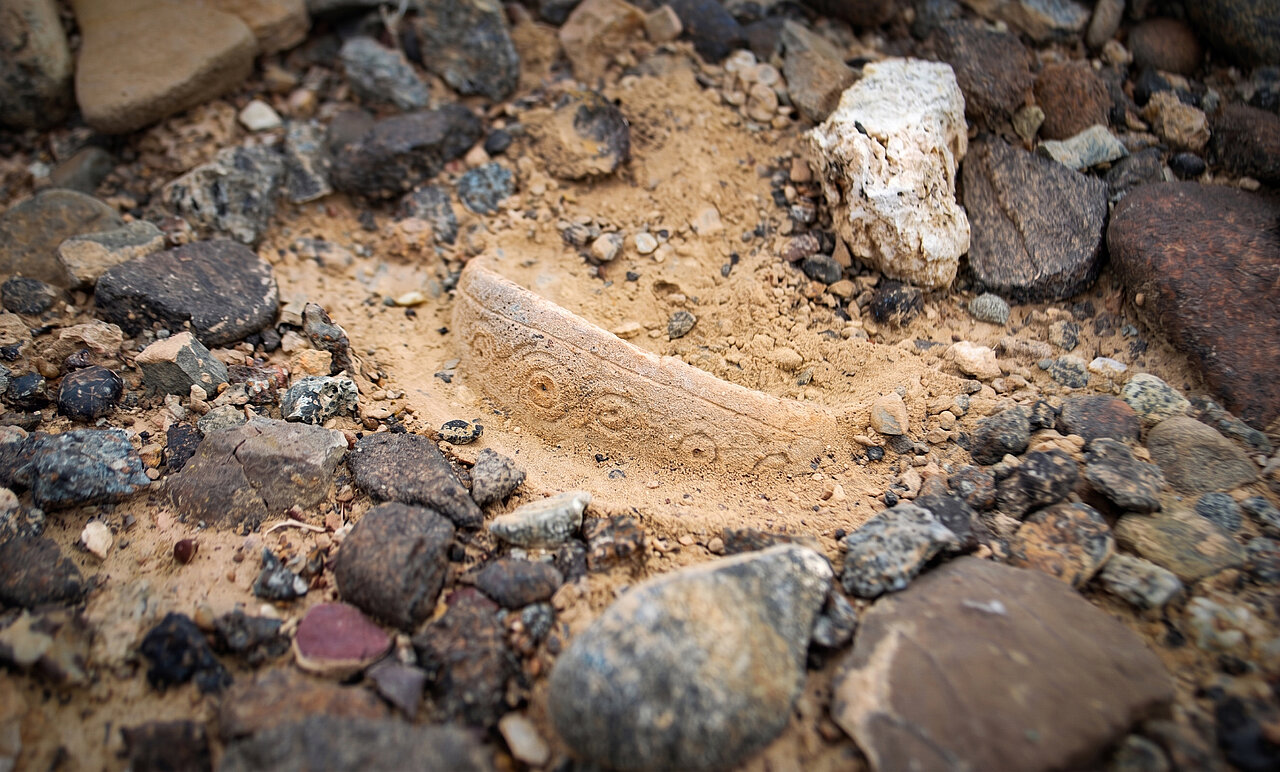
What the scientist hadn’t expected was that a grave offering was protruding from the ground in the middle of the steppe – a soapstone bowl about 15 centimetres wide. The bowl is thought to be a good 4,000 years old. “The graves date from the Middle Bronze Age, that is, from the period between 2000 and 1600 BC,” explains Döpper.
It is unclear who is buried there. As there are no written records of this culture, its name and language remain a mystery. All the more, the grave goods reveal details about the lives of these people. “The objects are closely linked to everyday life, which suggests a lifelike conception of the afterlife,” says Döpper. As soapstone vessels were used to store valuable items, they stand out from the usual finds made of clay.
Stephanie Döpper had not planned any excavations in the burial ground in the hope of perhaps learning more about this enigmatic people. She made an exception in the case of the bowl. To ensure it did not fall into the wrong hands, the team packed it away and handed it over to the Omani authorities.
Stephanie Döpper’s aim is to map archaeological sites in Oman. This makes it possible to trace social developments over millennia. This work also has a practical benefit: the inventories she compiles show the Omani authorities exactly where historically significant sites are located. Stephanie Döpper hopes that this will spare them from one day disappearing beneath a new housing development. Perhaps one day a research team will come along that has the time and money to investigate the 4,000 graves in more detail.