
50 meetings, 12 archives
04/28/2026Just over 30 years ago, university archives were virtually unknown in Bavaria. The working group of these institutions now has twelve members. They met on 23 April for the 50th working session in Augsburg.
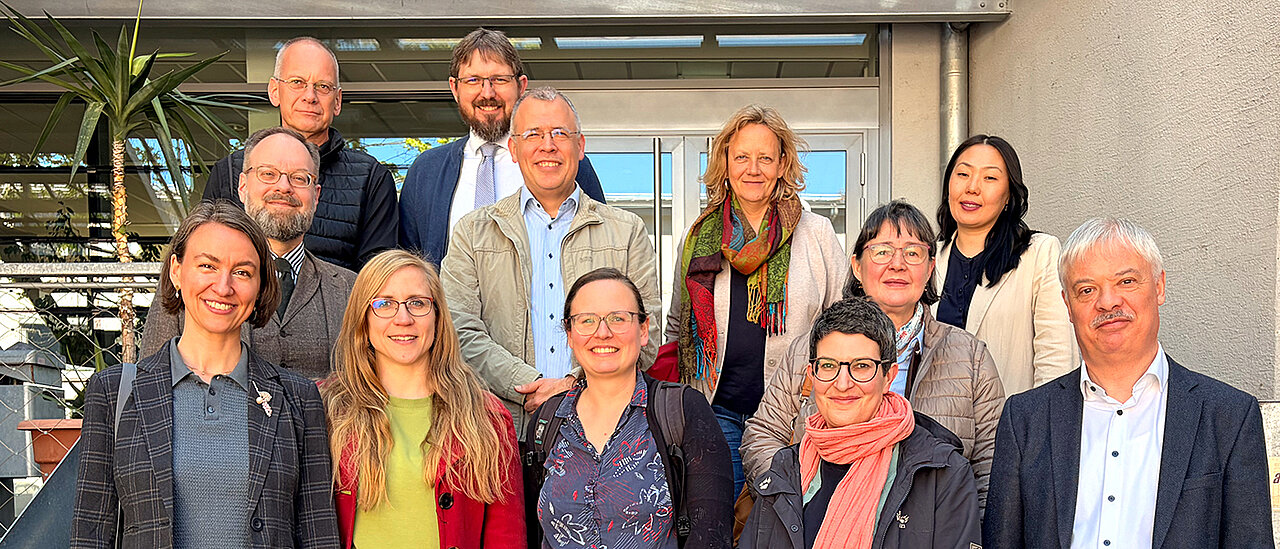
Officially opened 25 years ago, the Würzburg University Archive is one of the founding members of the Bavarian University Archives working group alongside representatives from Erlangen, Munich and Augsburg. While the spokesperson was initially based in Augsburg, this position was later transferred to the Würzburg University Archives. Today, Mareile Mansky is the spokesperson for the working group; she works at the Würzburg University Archives.
Since the first working meeting in Augsburg in 2002, the members have usually met every six months. At their meetings, they discuss current topics in archiving and university policy, develop joint strategies, draw up handouts, draft catalogues of measures and support each other in the further development of the archives.
"It is not least thanks to this working group that all Bavarian universities now have their own archives and can rely on local professional support in all matters relating to archiving, records management and university historiography," says Dr Marcus Holtz, Head of the Würzburg University Archive. From the very beginning, it has been a particular concern of the members to promote the establishment of archives and the provision of the necessary resources at the universities and at the same time to provide advice and support.
Today, the working group sees itself as a representative of the interests of Bavarian university archives vis-à-vis university management, ministries and other third parties, in order to bundle and optimally prioritise common concerns.
From the document to the e-file
And what is it all about when the members of university archives exchange information with each other? "The variety of topics discussed reflects the heterogeneity of the university landscape," says Mareile Mansky. Initially, the focus was on archival basics - for example, segregation periods, user regulations and legal issues relating to the storage and submission of archive material. This was quickly followed by more specialised topics, such as the processing of personal and patient data and the indexing of files from student registries and examination offices.
The change to digital file management also kept the archivists busy. In 2006, the necessary archival preparatory work for the introduction of a document management system (also known as an e-file, or DMS for short) at the universities was on the agenda for the first time. In addition to a sample file plan for university administrations, an evaluation catalogue for digital documents was subsequently developed.
"The successful involvement of the university archives in the introduction of DMS at the universities is also due to these intensive discussions," says Mareile Mansky. Ultimately, the efforts in digital archiving culminated in the creation of a digital repository (DIMAG) used jointly by the university archives throughout Bavaria, which was also accompanied by the "hotly debated and initially vehemently rejected standardisation" of the specialist archive information systems used in each case. "Last but not least, this milestone with the establishment of a dedicated coordination centre for digital archiving in Regensburg ensured even closer networking of the Bavarian university archives, which has set an example throughout Germany," says Marcus Holtz.
Everyday help and coping strategies
Other topics of the regular meetings are in the area of historical mediation. They deal with questions of exhibition management, the maintenance of memorial sites and the many opportunities for cooperation with regional associations and organisations.
And, of course, the archives support each other, for example by working groups producing work-reducing handouts and aids for everyday use. Examples of this include a guide to archiving websites and a comprehensive and practical description of various digital archiving tools.
Today, all members of the working group can access training documents, statutes, regulations, key figures, file plans and other aids via a shared platform, create their own materials from them or retrace minutes of meetings and information letters. In the event of statements requested by the ministry at short notice or other challenges, unscheduled online meetings are convened via the central coordination of the working group; issues are discussed in a widely used mailing list.
Finding viable solutions together
In the future, the working group will continue to develop solutions for the challenges of archival work, especially within the heterogeneous university cosmos, and make them available both throughout Bavaria and beyond. The appropriate platform for this is provided by the Association of German Archivists and its Section 8 of the Archives of Universities and Scientific Institutions.
In any case, there is no shortage of challenges: "The members of the working group are currently working on developing new standards for university archives," explains Marcus Holtz. Among other things, this involves the cataloguing of special, university-specific holdings - specifically, the metadata required for long-term archiving and Germany-wide networking via corresponding archive portals.
Other projects include
- The extensive standardisation of key figures for university archives in Bavaria,
- the development of a joint strategy for the evaluation and processing of digital data such as student and research data as well as course catalogues,
- the close-meshed exchange of ideas on formats of historical communication online, within the universities and in the region.
Contact
Mareile Mansky M.A., spokesperson for the working group of Bavarian university archives, mareile.mansky@uni-wuerzburg.de