
Robotics research: How machines navigate safely in storms and fog
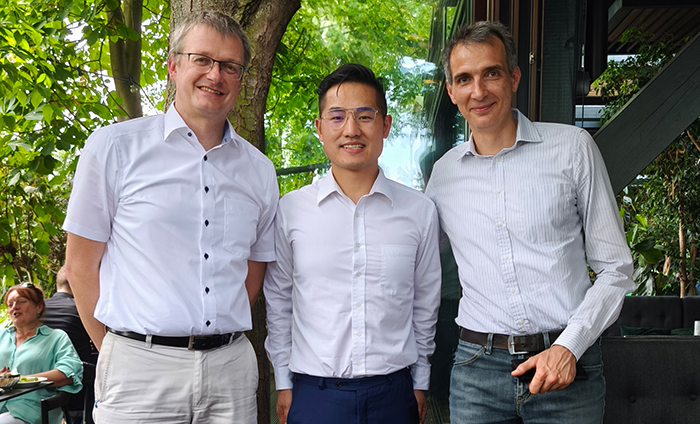
11/17/2026Dr Dong Wang from the Chair of Robotics at the University of Würzburg has been awarded a DFG grant of 230,000 euros to develop reliable navigation algorithms for mobile robots.
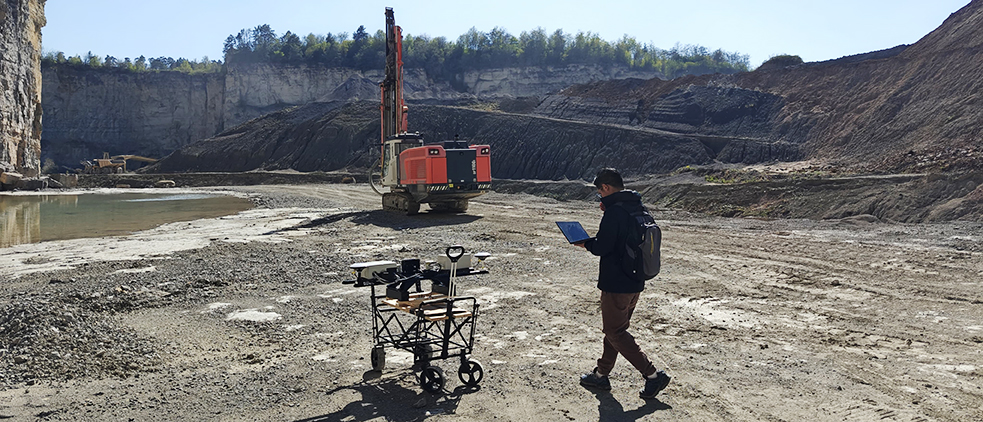
Self-driving vehicles and autonomous robots must know where they are, even in adverse conditions. But what if snow blinds the cameras, fog obscures the laser sensor, or darkness limits visual perception?
Under such conditions, conventional SLAM methods can become significantly less reliable or even fail entirely – these are the methods by which robots simultaneously estimate their own position and create a map of their surroundings.
System assesses the reliability of estimates
To prevent SLAM from failing, Dr Dong Wang from the Chair of Robotics at the University of Würzburg is pursuing a promising approach: he aims to solve the problem from within.
The Würzburg-based researcher is working on a system that continuously assesses how reliable its own estimation results are at any given moment. Rather than continuing to rely on potentially inaccurate estimates, the robot recognises when the sensor situation becomes critical and switches to conservative navigation strategies.
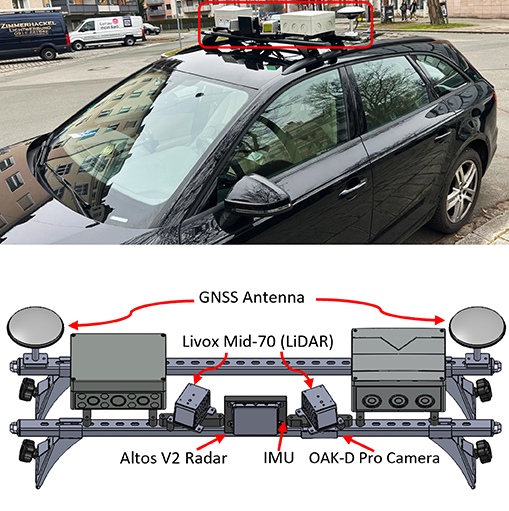
To achieve this, Wang integrates four complementary sensor types – ranging from a conventional camera to thermal imaging and radar, right through to modern FMCW LiDAR. He also employs generative AI models to virtually simulate dangerous scenarios.
Project leader with a remarkable career
To fund the development and scientific investigation of this approach, the German Research Foundation (DFG) is providing around 230,000 euros for Wang’s project ‘Reliability-Aware Multimodal SLAM for Long-Term Autonomy in Harsh Environments’.
The project is based on a hybrid sensor system developed in Nuremberg, which Dr Wang helped to develop during his time there as a researcher. The two-year project begins on 1 January 2027 and was applied for jointly with the Technische Hochschule Nürnberg Georg Simon Ohm.
DFG funding marks the culmination so far of a remarkable academic journey:
Dong Wang was awarded his PhD with the highest distinction, ‘summa cum laude’, from the Graduate School of Science and Technology (GSST) at the University of Würzburg as recently as the summer of 2026. He was supervised by Professors Stefan May (Technische Hochschule Nürnberg Georg Simon Ohm) and Andreas Nüchter (University of Würzburg) as part of the BayWISS Collaborative Research Centre ‘Digitalisation’. BayWISS, the Bavarian Science Forum, promotes collaboration between universities and universities of applied sciences in Bavaria.
Dr Wang has received a number of honours: he was awarded the BayWISS Award 2025 for outstanding research contributions and a fellowship from the Bavarian Institute for Digital Transformation (BIDT). He also achieved several top placings at the RoboCup, the world’s most important robotics competition.
Co-founder of the start-up Harsher UG
Alongside his research, Dong Wang founded Harsher UG with a former PhD student from the University of Bonn. The start-up is exploring how modern navigation technologies can be applied in practice – for example, for autonomous field robots or inspection drones in hazardous environments.
“The DFG funding enables me to conduct methodologically sound basic research at the university. At the same time, my independent entrepreneurial activities help me to keep the practical challenges of autonomous systems in mind,” explains the scientist.
Sharing research software with the community
Once Dong Wang has developed his system, he intends to publish the research software and datasets in accordance with the FAIR principles. This will allow other researchers to replicate the results and build on them.
Additional images