
Measures to prevent flooding and heavy rainfall in the Main Valley
10/28/2026How can local authorities in rural areas protect themselves against the risks posed by flooding and heavy rainfall? Experts from academia, public administration and the field discussed this issue at the University of Würzburg.
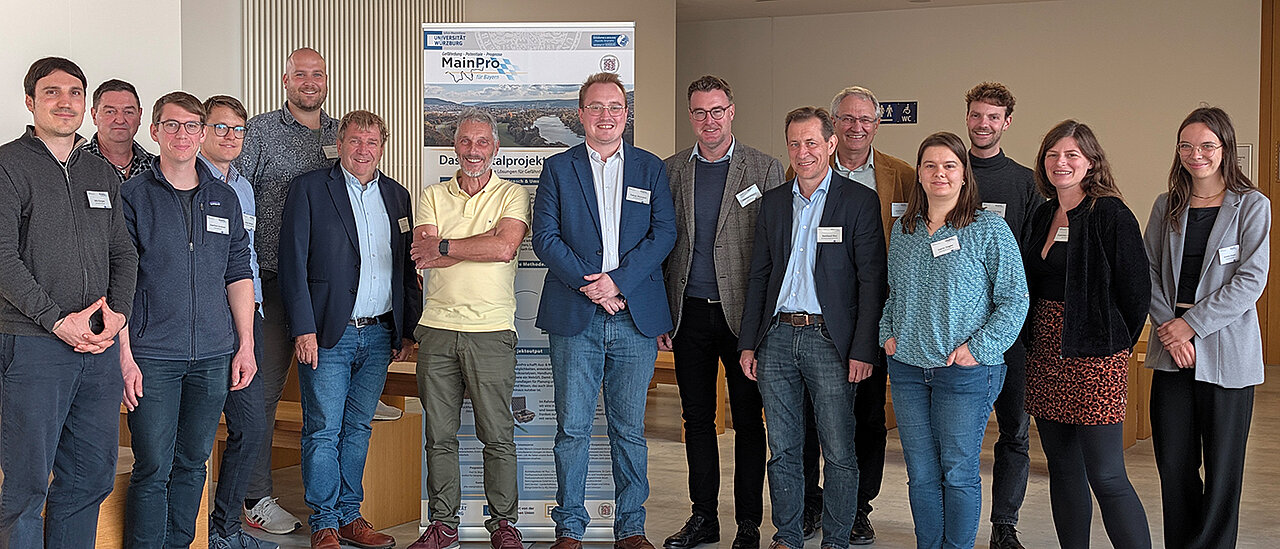
Flooding and heavy rainfall are posing increasing challenges for towns and local authorities. Particularly in the rural areas of the Lower Franconian Main Valley, local authorities must, due to the specific topography of the area, consider how land can be sensibly designated or further developed without exposing people and buildings to additional risks. A workshop held at the University of Würzburg on 15 October 2026 addressed these and other issues. It brought together experts from academia, local authorities, government bodies and regional networks.
The workshop was organised by the Social Geography Working Group. It was led by Professor Jürgen Rauh and his research assistant and PhD student Tobias Riemann. The event took place as part of the collaborative project ‘MainPro: Ecosystem-based solutions for hazard scenarios in the Franconian Main Valley’, for which Professor Birgit Terhorst is the overall project leader. The European Regional Development Fund (ERDF) is funding the project.
Creating housing, mitigating risks
The workshop focused on a situation with which many local authorities are familiar: on the one hand, land is needed for new residential areas; on the other hand, this must not increase the risk of flooding or heavy rainfall for existing town centres and new development areas.
The participants discussed various ways in which local authorities can take precautionary measures right from the planning stage of development areas. The approaches ranged from measures implemented exclusively by the public sector to concepts in which property owners also play an active role in risk prevention.
Particular attention was paid to the so-called ‘sponge city’ principle. The aim of this approach is to retain rainwater as far as possible where it falls, rather than draining it away quickly. This helps to slow down water runoff during heavy rainfall and reduce the strain on residential areas.
Challenges, particularly for small local authorities
It became clear during the discussion that effective protective measures often require additional investment. At the same time, they can help to better protect buildings and infrastructure from damage in the long term.
The experts largely agreed that local authorities should take greater account of long-term impacts in their planning. However, challenges are particularly acute in smaller local authorities. These often lack the human and financial resources to comprehensively support the implementation and ongoing compliance with regulations.
Established town centres require tailored solutions
In established town centres, new protective measures often cannot be implemented straight away because existing buildings, ownership structures or heritage protection requirements must be taken into account.
Consequently, alongside formal planning procedures, advice, collaboration with residents and voluntary measures are becoming increasingly important. Furthermore, the participants discussed how funding schemes and approval procedures could be structured to better support local authorities in implementing adaptation measures. Uncomplicated administrative procedures and sufficient scope for location-specific solutions were identified as key priorities.
The results of the workshop will be incorporated into the ongoing research of the ‘MainPro’ project. On this basis, the Social Geography working group is developing recommendations designed to support local authorities in the Main Valley in preparing for floods and heavy rainfall.
Contact
Tobias Riemann, Chair of Social Geography,
University of Würzburg,
T +49 931 31-81969, tobias.riemann@uni-wuerzburg.de