
Teacher training students put media education to the test in the classroom
08/04/2026Digital media play a major role in young people’s everyday lives. This makes it all the more important for schools to teach pupils how to use them thoughtfully. At the University of Würzburg, teacher training students have developed and tested teaching strategies for this purpose.
Virtual reality headsets, augmented reality and other digital applications fascinate many children and young people. It is no wonder that teachers are increasingly turning to these technologies in the classroom. However, media education involves more than simply using modern technologies. It should also enable pupils to understand digital media, recognise their possibilities and limitations, and use them responsibly.
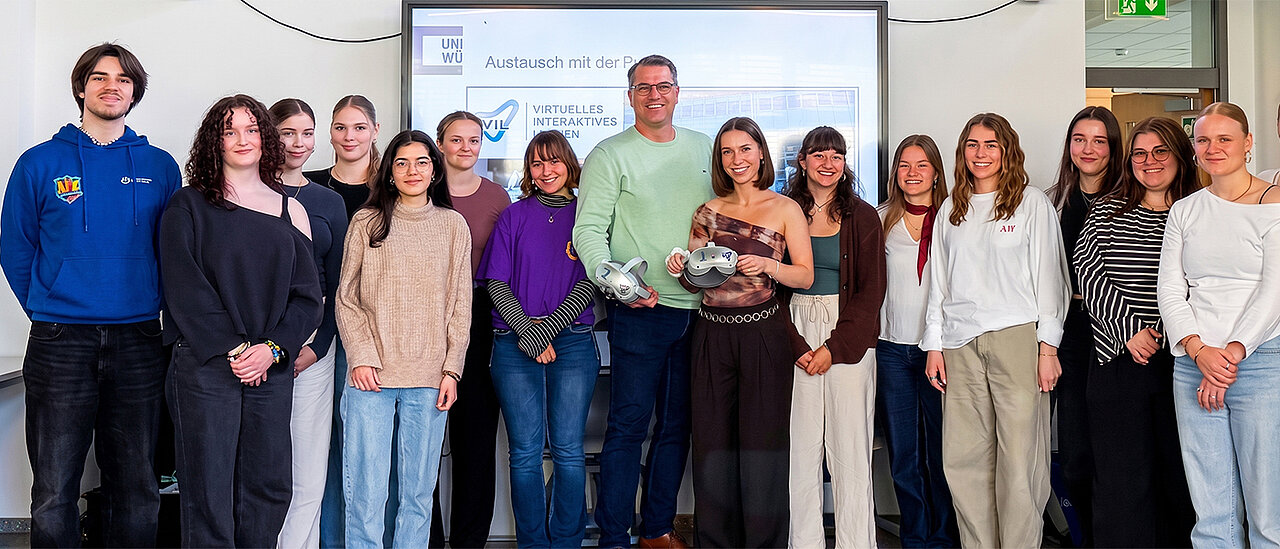
Teacher training students at the University of Würzburg have now had the opportunity to explore how this objective can be put into practice in schools during a practical seminar organised by the Chair of School Pedagogy. Under the guidance of research assistant Tamara Baumann, they spent three semesters developing teaching units on the topic of media education and then implemented these together with pupils at the David-Schuster Secondary School, the Jakob-Stoll Secondary School and the Eichendorff Middle School in Gerbrunn.
Designing critical lessons using virtual reality
The seminar focused on applications using virtual reality (VR) and augmented reality (AR). With VR, users are fully immersed in a digital environment with the aid of special glasses. AR, on the other hand, supplements the real environment with digital content, for example via a tablet.
For Silke Grafe, holder of the Chair of School Pedagogy, these technologies offer significant added value: “You can bring content to life that, for example, lies in the past or is not visible – such as in chemistry lessons, where you can examine molecular structures in detail.” At the same time, the headsets block out distractions from the classroom. “Pupils wearing VR headsets are therefore highly concentrated and focused on the learning content,” says Grafe.
However, students should not simply use these technologies in the classroom, but should reflect, together with the pupils, on how such media work and what impact they can have on people and society. To this end, they developed teaching units on various topics. Specifically, the pupils explored the Anne Frank House in a fully immersive application or placed themselves within the historical context of Martin Luther King’s speeches.
“We train trainee teachers in media literacy so that they can later support pupils in using media competently and questioning it critically,” says Tamara Baumann, explaining the rationale behind this seminar. After all: “Unfortunately, using media does not automatically mean using it competently.” The school education specialist is convinced that teacher training students, teachers and pupils alike should possess the relevant skills to use digital technologies appropriately, in a socially responsible manner and creatively.
Theory is put to the test in everyday school life
An important part of the project was the practical testing of the teaching concepts. The trainee teachers took charge of lessons themselves and gained experience under real-world conditions. The lessons were then evaluated together with teachers, trainee teachers and other participants.
“It was very helpful for the students not only to develop their ideas in theory, but also to experience the challenges that actually arise in the classroom and how flexibly one needs to respond to them,” says Baumann. It is precisely these experiences that could not be conveyed in the seminar room alone.
Admittedly, the Chair of School Pedagogy does have a room equipped with the latest digital technology: the Media Education and Educational Technology Lab (MEET@JMU). This laboratory for research and teaching at the University of Würzburg is dedicated to exploring issues relating to teaching and learning with and about digital media in schools and the classroom, as well as in teacher training, from pedagogical, technical, interdisciplinary and international comparative perspectives. However, external support is still required to teach entire school classes.
Through collaboration with Roman Kruse, the IT adviser for digital education (iBdB) for secondary schools in Lower Franconia, and Andreas Sandweger, the media education adviser for digital education (mBdB) for the city and district of Würzburg, the students gained access to the necessary professional hardware and received direct feedback from experienced practitioners.
Media literacy remains a shared responsibility
Although the seminar has concluded with the students’ visits to the three schools, the project is set to continue and be further developed. “In future, other technologies such as robotics or applications of artificial intelligence could also be incorporated into the courses,” explains Silke Grafe.
What is crucial here is not the specific technology itself, but the question of how schools can support children and young people in using digital developments critically, responsibly and competently.
Contact and information
Prof. Dr Silke Grafe, Chair of School Pedagogy, T +49 931 31-81535, silke.grafe@uni-wuerzburg.de
Tamara Baumann, Chair of School Pedagogy, T +49 931 31-81001, tamara.baumann@uni-wuerzburg.de