
Medal of Merit for Gerhard Sextl
05/12/2026Chemistry professor and materials researcher Gerhard Sextl received the University's Julius-Maximilians Medal of Merit for his outstanding achievements at the 2026 Foundation Festival.
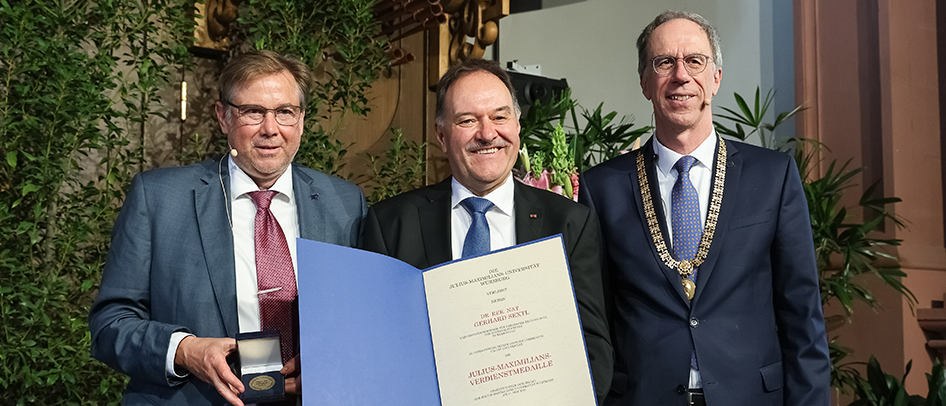
Gerhard Sextl, born on 31 March 1958, is an outstanding personality in modern materials research who has had an extraordinary impact on science, industry and society over the decades. His work is based on a deep understanding of the interactions between basic research and practical application, as well as on the aspiration to utilise scientific findings in a targeted manner to tackle key issues of the future.
Gerhard Sextl studied chemistry at the Ludwig-Maximilians-Universität in Munich, where he also gained his doctorate after graduating with honours. From an early stage, his scientific career was characterised by a consistent combination of excellent basic research and application-oriented research.
This also characterised his subsequent many years of work in industry, in which he held positions of responsibility - including at Degussa, OMG, Umicore and ZEOCHEM - particularly in the areas of research and development and strategic corporate management. He also regularly lectured on industrial inorganic chemistry at the University of Hanover. In 2002, he was appointed honorary professor in Hanover.
JMU and Fraunhofer: dual function in Würzburg
In 2006, Gerhard Sextl was appointed Chair of Chemical Technology of Material Synthesis at the University of Würzburg. At the same time, he took over responsibility for the Fraunhofer Institute for Silicate Research ISC in Würzburg as Institute Director.
In this dual role, he succeeded in an outstanding way in shaping and sustainably strengthening the close intermeshing of university research and application-orientated development. In this context, he was particularly keen to help shape new study programmes: For example, he played a key role in the conception, organisation and implementation of the "Functional Materials" degree course introduced in 2006, which was launched as a new technological degree course in Würzburg with the aim of combining basic materials science research and application in an innovative way.
Addressing important topics at an early stage
Under his leadership, the Fraunhofer ISC developed into an important centre for materials research with a particular focus on energy and resource efficiency. Starting with innovative silicon-oxygen compounds, Gerhard Sextl initiated and shaped numerous fields of research and development that are now central topics of our time.
These include, in particular, the development of innovative materials for energy storage and conversion, climate and environmental protection, progress in the field of electromobility and new approaches to sustainable resource utilisation and the circular economy.
He also provided important impetus in the field of health research, for example by establishing corresponding research structures in close collaboration with the University of Würzburg.
Committed far beyond Würzburg
His work went far beyond the scientific field. With great strategic foresight, Gerhard Sextl advocated the establishment of new research centres, thereby strengthening not only Würzburg as a centre of science, but also other regions, with the focus always being on Bavaria.
His commitment to the establishment and consolidation of new institutes, for example in Bayreuth to promote the ceramics industry in northern Bavaria or on the Lower Main on sustainable resource utilisation and recycling, should be highlighted.
Gerhard Sextl is a scientist with vision - one who recognises the great challenges of our time and meets them with scientific excellence, innovative strength and social responsibility. His work is exemplary for the successful combination of research, application and transfer as well as for the sustainable strengthening of the centre of science and innovation.
In 2021, he was awarded the Cross of the Order of Merit (Verdienstkreuz am Bande) of the Federal Republic of Germany for his outstanding achievements. In 2024, the city of Würzburg honoured him with the "Dancing Shepherd" for his cityscape-defining initiatives.