
How signs on campus encourage people to take action
11/10/2026Nellie Schuhmann studied linguistics at the University of Würzburg. In her Master’s thesis, she researched stickers, posters and billboards relating to sustainability on campus.
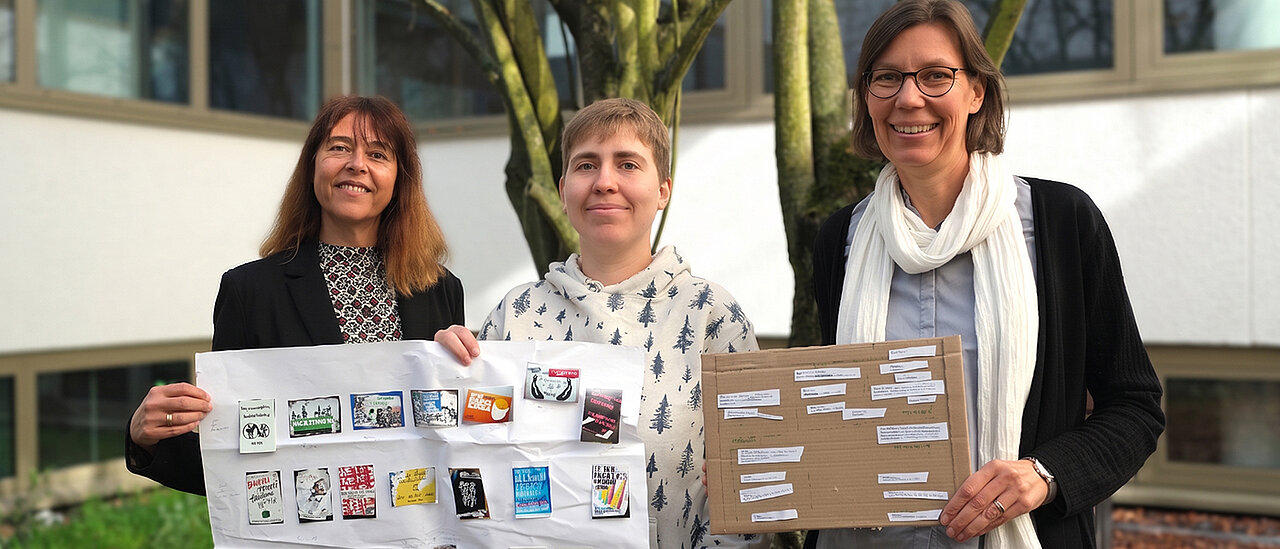
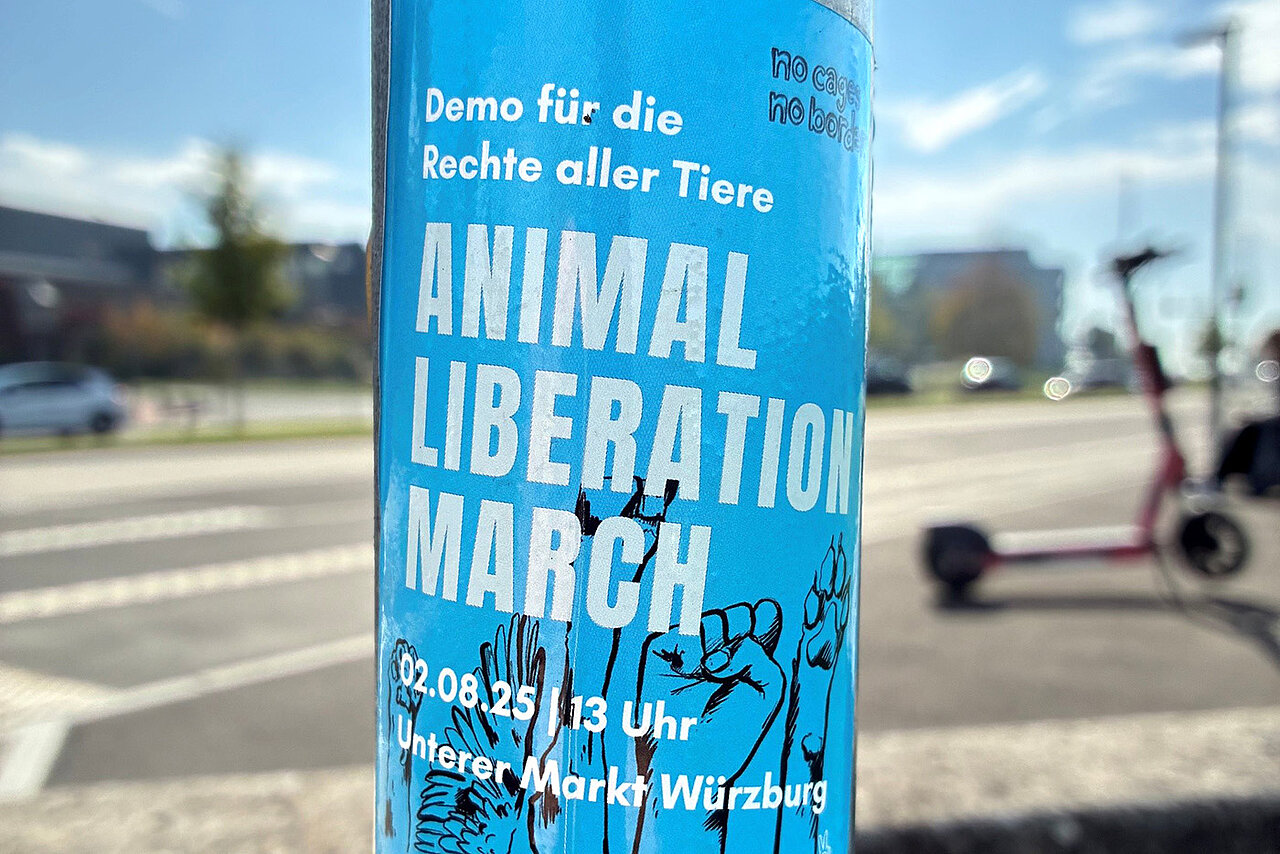
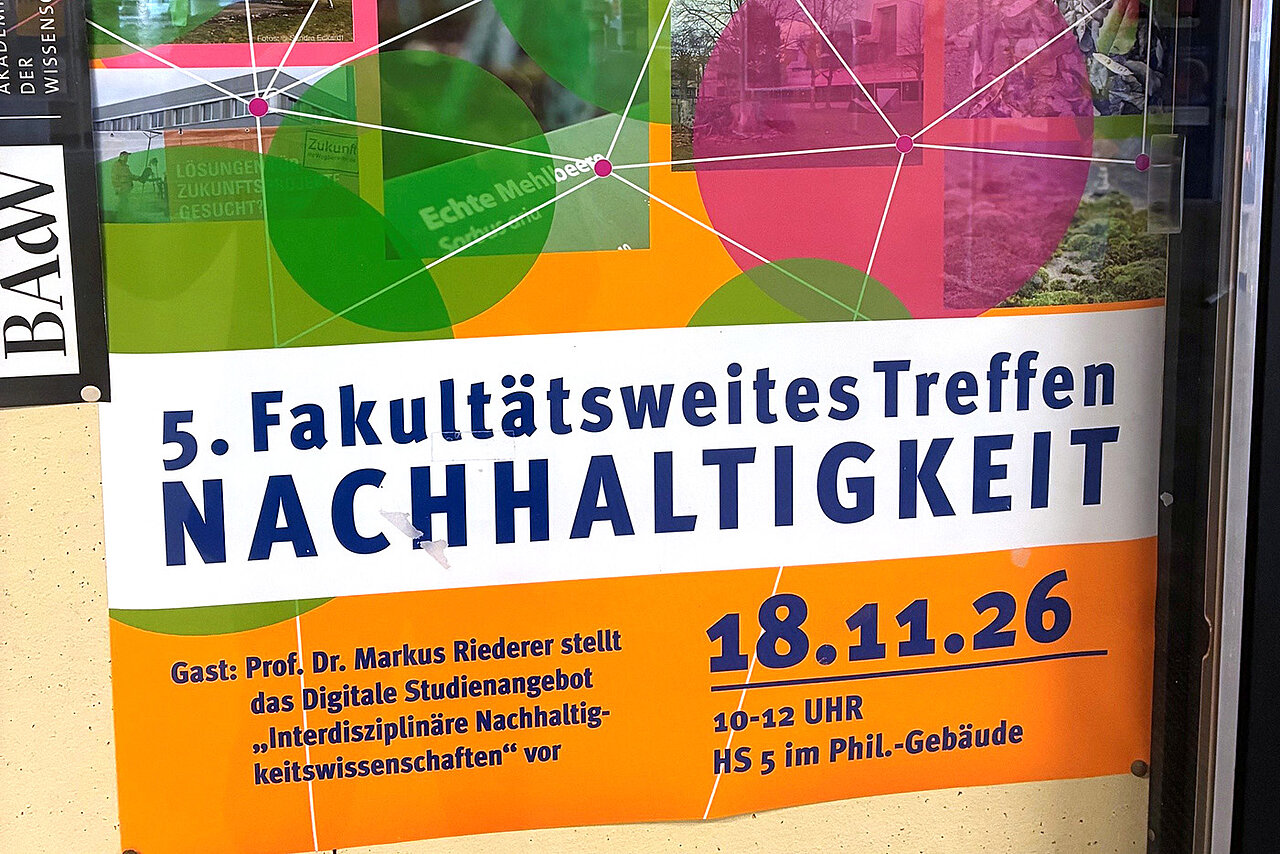
“Think global – drink local”, “Go fair trade”, “Climate strike on 13 November!” If you walk around the Hubland campus with your eyes open, you’ll find them everywhere: On lampposts, in corridors and on lockers, numerous posters, stickers and banners draw attention to environmental causes. But what exactly are they about? And how precisely do these messages in public spaces encourage sustainable behaviour?
These are among the questions Nellie Schuhmann explored in her Master’s thesis. Schuhmann is a graduate of the Master’s programme in ‘General and Applied Linguistics’ at Julius-Maximilians-Universität Würzburg; Dr Sandra Ellena and Professor Esme Winter-Froemel supervised her Master’s thesis at the Chair of Romance Linguistics.
“In public spaces, stickers and posters can tell you a great deal about what is currently being discussed and what the various stakeholders have to say on the matter,” replies Nellie Schuhmann when asked how she came up with the idea for her Master’s thesis. And she has been engaging with sustainability issues for a long time, “because it is such a pressing and relevant topic”, as she puts it.
Because sustainability is on many people’s minds and is important to everyone, as a linguist she asked herself: “Can this be seen on campus, and how is it communicated?”
A research gap at the intersection with sustainability
Her project builds on research into so-called ‘linguistic landscapes’, which examines the use of language in public spaces. This field has recently attracted a great deal of attention and forms one of the main research focuses at the Chair of Romance Linguistics at the University of Würzburg. Through her work, Nellie Schuhmann has been able to fill a gap in this area.
“Of course, within the field of linguistic landscapes, there is already some research on ‘Uniscapes’ – that is, the public landscape at universities and the question of how language shapes that space,” explains Sandra Ellena. However, the link to sustainability discourses is relatively new. At the same time, the study places particular emphasis on the action dimension by specifically highlighting calls for sustainable behaviour directed at the target audience, adds Esme Winter-Froemel.
Nellie Schuhmann’s Master’s thesis began with a great deal of theory. “She reviewed a vast amount of research literature and developed her own clear methodology to distil this vast field down to the scope of a Master’s thesis,” says Sandra Ellena. Esme Winter-Froemel also sees the added value of an academic examination of this topic in the development of a systematic framework and the subsequent analysis.
For her survey, the early-career researcher developed her own criteria protocol to enable her to objectively record indications relating to environmental protection. During site visits to four key buildings on the Hubland Süd campus – the Philosophy Building, the University Library, the Central Lecture Theatre and Seminar Building, and the Canteen Campus Hubland Süd – she subsequently identified 40 relevant signs.
From stickers to information posters: great variety in the space
Nellie Schuhmann’s analysis reveals a broad spectrum among her ‘findings’:
- Actors and formats: The examples range from official information posters from university institutions and notice boards to stickers from student initiatives.
- Range of topics: Topics covered include biodiversity, resource conservation, waste prevention, climate protection and sustainable educational programmes.
- Linguistic style: The calls to action vary greatly – from direct requests and commands to indirect statements or wordplay.
In the next step, the Master’s student carried out a linguistic analysis of the collected language material, for example with regard to sentence structures and the pronouns used for the producers and recipients of the calls to action. Examples such as ‘Tell me about the future!’, ‘I’m protecting the climate now!’ or ‘reduce, reuse, recycle’ demonstrate the diversity of linguistic style. She also examined the use of international vocabulary, such as words borrowed from English. Furthermore, the interplay between the university’s official guidelines and ‘grassroots’ initiatives – which in linguistics are contrasted as top-down and bottom-up phenomena – is particularly revealing.
Anyone familiar with university life knows that it is not uncommon for such stickers and posters to be creatively altered – through handwritten comments, being painted over, or attempts to remove a sticker. For linguistics, such language-related interventions are of particular interest. ‘For example, you see information signs in public buildings where the text does not use gender-neutral language. And then people simply add gender-neutral versions by hand,’ says Esme Winter-Froemel. A direct interaction between top-down and bottom-up processes.
However, the linguistic landscape at the University of Würzburg proved to be very stable in Nellie Schuhmann’s project: when she walked the route a second time, two months after her first tour of the campus, she found that the majority of the signs and stickers remained unchanged.
Practical insights for the campus
Nellie Schuhmann’s work provides important methodological foundations and guidance on how signage in public spaces must be designed to effectively support sustainable behaviour. The findings can now serve as a basis for practical dialogue aimed at further developing sustainability communication on campus in a targeted manner. Several meetings have already taken place with representatives from the WueLAB sustainability lab.
And what does the future hold for Nellie Schuhmann? Will she remain committed to academia and the topic of sustainability? The graduate is keeping her cards close to her chest. She says only this much: “I will definitely continue to pursue the topic of sustainability. The next steps are already being planned.”
Information on the Master’s programme: General and Applied Linguistics (MAAS)
Additional images