
The energy and climate crisis under pressure from global competition
10/13/2026The search for ways to achieve a carbon-neutral, energy-secure and competitive future raises legal, economic, political and climate-change-related issues. A new lecture series will be dedicated to these issues in the winter semester 2026/27.
Russia’s attack on Ukraine, the war in Iran, and tensions surrounding Venezuela and Greenland. Trade conflicts with the US and China. Natural disasters, terrorist attacks and cyber-attacks on energy infrastructure. The list of geopolitical upheavals is constantly growing and is having consequences for the supply of oil, gas and other raw materials. This is accompanied by a growing erosion of the rules-based order and a lack of predictability, which is having a negative impact on (European) competitiveness. At the same time, the consequences of climate change are becoming increasingly visible and are leading to further distributional and trade conflicts.
Against this backdrop, it is essential to examine the ‘triangle of objectives’ comprising climate protection, security of supply and competitiveness in order to analyse the specific challenges posed by the transformation of the energy system. A group of researchers from the Julius-Maximilians-Universität Würzburg will be addressing this topic as part of an interdisciplinary lecture series to be held at the Faculty of Law during the coming winter semester. In addition, the participants are also linked through an interdisciplinary third-party-funded project. Both projects focus on researching resilient crisis management, with the aim of making an interdisciplinary contribution to energy governance.
Interdisciplinary analysis
“The complex interplay between immediate crisis measures and strategic foresight requires an interdisciplinary analysis. It is essential to bring together insights from law, economics, political science and climate change research. I am therefore all the more delighted that we have been able to attract such a high-calibre group of academics,” said Professor Markus Ludwigs, who acts as the group’s spokesperson.
How can we secure the supply of critical raw materials, and what role does energy diplomacy play in this? To what extent can corporate social responsibility contribute to sustainable development? Are climate lawsuits a viable means of enforcing ‘greater climate protection’? What is the relationship between biodiversity and climate protection in the fight against global warming? What role can mechanisms such as the Carbon Border Adjustment Mechanism (CBAM) play in preventing carbon leakage? With this mechanism, the EU aims to prevent the relocation of greenhouse gas emissions abroad and to protect domestic industry. This and other questions will be addressed by the lecture series using an interdisciplinary approach.
The hybrid event, taking place both in person and via Zoom, offers a wide range of options for participating in the lecture and the subsequent discussion.
Time and access
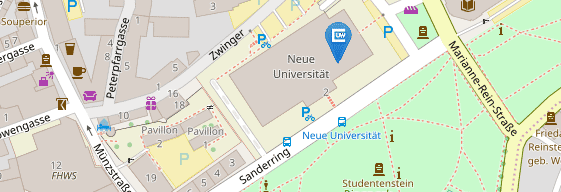
The lecture series will take place regularly on Wednesdays from 6 pm to 8 pm during the 2026/27 winter semester in Lecture Theatre II of the Old University, and will also be streamed via Zoom. Participation is free of charge. Registration for digital participation is available via the website of the Research Centre for Infrastructure Law (FoIR) at Professor Markus Ludwigs’s chair. There you will find an overview of the lecture topics and specific dates, as well as further information about the lecture series.
Contact
Prof. Dr Markus Ludwigs, Chair of Public Law and European Law
T: +49 931 31-80023, l-oer-eur@jura.uni-wuerzburg.de