
Building in the Middle Ages: A social Sphere of Activity
10/13/2026A new handbook examines the tremendous surge in innovation in architectural culture north of the Alps from the 14th to the 16th century. One of the co-editors is the Würzburg-based art historian Stefan Bürger.
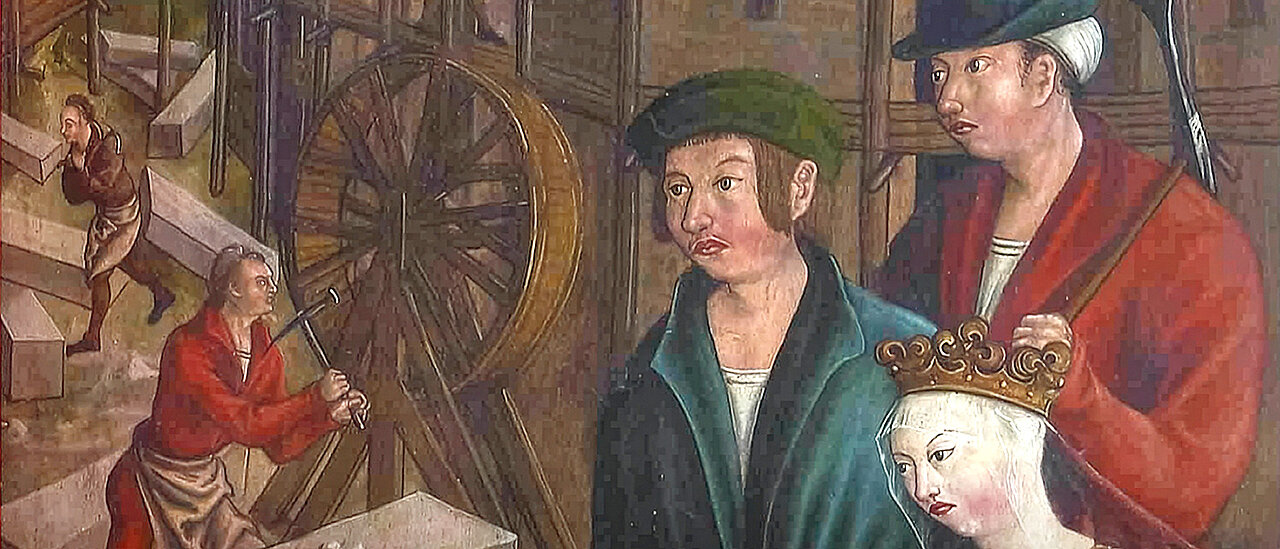
When discussing the architecture of the late Middle Ages and the early modern period, attention usually turns first to the Italian Renaissance. Yet the region north of the Alps also experienced an impressive golden age and a dynamic renewal in architecture between the 14th and 16th centuries. A new, comprehensive handbook now examines this development in detail.
Published by Schnell & Steiner, the work is edited by Prof. Dr Stefan Bürger, an art historian at the Julius-Maximilians-Universität Würzburg (JMU), together with Prof. Dr Bruno Klein (Dresden University of Technology).
Building culture as a social phenomenon
Building was, and remains, a central sphere of social activity. Technical inventions, craftsmanship and artistic ambition played just as significant a role as religious beliefs, financial resources, administrative structures and communication.
The ‘Handbuch der spätmittelalterlichen Baukultur' (Handbook of Late Medieval Building Culture) therefore by no means views building culture merely as the study of finished buildings or architectural styles. Rather, it encompasses the entire field of human shaping of the built environment – from planning, building and maintaining to altering and interpreting.
From stoneworking to accounting
An interdisciplinary team of experts explores aspects such as definitions, materials, research methods – including domestic research – construction organisation and building sites, builders’ huts, practical building knowledge – including timber construction – geometry, form and, in this way, the many facets of this building culture. The individual chapters have been written by the authors through a process of collaboration.
The range of topics is wide-ranging: it extends from traditional stone-working techniques and the construction methods of half-timbered buildings, through sophisticated planning methods, to the accounting practices on building sites of that era.
The role of the media and the self-portrayal of master builders in portraits of master craftsmen are also analysed in depth. This richly illustrated work thus offers both specialists and interested laypeople profound insights into the practice and organisation of major historical projects.
The editors and authors
Bruno Klein was Professor of Christian Art of Late Antiquity and the Middle Ages at Dresden University of Technology; Stefan Bürger was appointed to the Professorship of Art History at the Institute of Art History, University of Würzburg, in October 2014 and teaches the art history of the Middle Ages and the Early Modern period. He focuses in particular on the architectural-historical, structural, media-related and architectural-theoretical aspects of 15th- and 16th-century architecture. Both authors have established their expertise through numerous publications on architectural history.
Matthias Schulz, Professor of Linguistics at the University of Würzburg, and his colleague Larissa Then have contributed the complex chapter on communication, language and the media during this period.
Further contributions to the handbook were provided by: Maria Aranda Alonso, Friedrich Rudolf Becker, Sabine Bengel, Anne-Christine Brehm, Stefan Bürger, Thomas Eißing, Bruno Klein, Dominik Lengyel, Christian Misch, Peter Morsbach, Anke Neugebauer, Cornelia Neustadt, Arnd Reitemeier, Barbara Schedl, Katja Schröck, Dirk Schumann, Gerald Schwedler and Catherine Toulouse.
Publication
Stefan Bürger, Bruno Klein (eds.): Handbuch der spätmittelalterlichen Baukultur. Baukultur als sozialer Aktionsbereich, Schnell & Steiner Publishers, 1st edition 2026, 488 pages, ISBN: 978-3-7954-9072-0.