
Award-winning biologists
07/07/2026The Royal Entomological Society has recognised two research papers by Würzburg biologists Dr. Katharina Engelhardt and Dr. Esme Ashe-Jepson as outstanding publications of 2025. Their studies focus on butterflies and moths.
The Royal Entomological Society is a learned society dedicated to the study of insects and publishes seven scientific journals in this field. Each year, it honours particularly outstanding papers by early-career researchers published in these journals.
In 2025, two researchers from the Julius-Maximilians-Universität Würzburg (JMU) received this distinction. Dr. Katharina Engelhardt and Dr. Esme Ashe-Jepson both work at JMU’s Chair of Global Change Ecology.
Surprising findings on butterflies
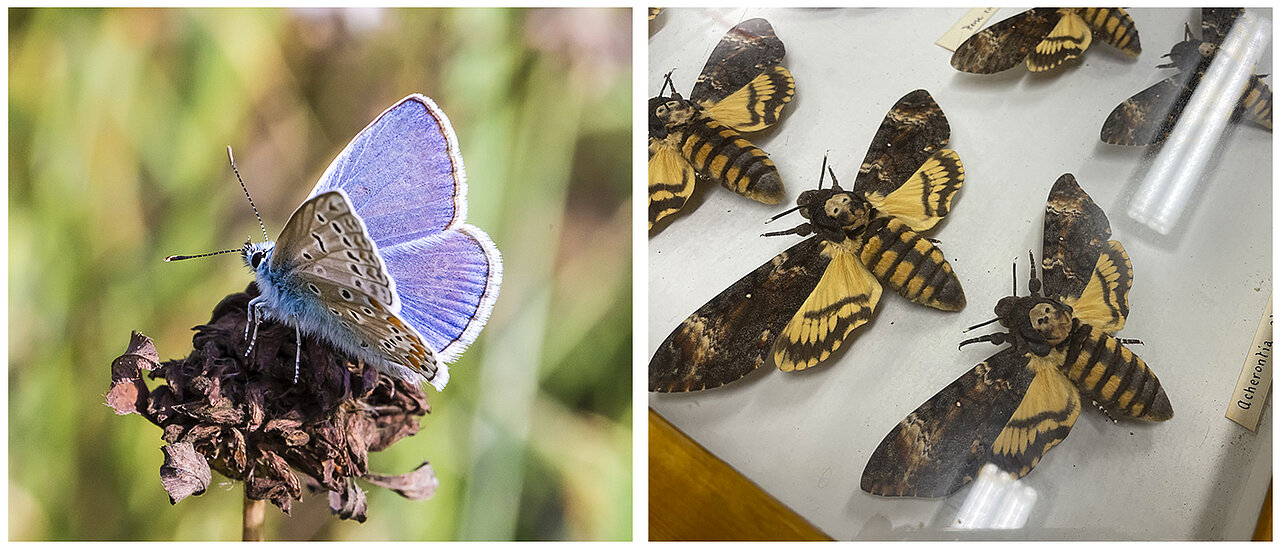
In their paper on blue butterflies (Lycaenidae), Katharina Engelhardt and colleagues investigated changes in these species’ occurrence trends over a period of 40 years. The researchers were particularly interested in the butterflies’ close dependence on ants during larval development – a high degree of specialisation that would generally be expected to be a disadvantage under global change. Surprisingly, however, they found no negative effect of ant associations on the butterflies’ long-term trends.
The paper received the award for the best publication in Insect Conservation and Diversity.
How insect enthusiasts contribute to research
In their paper, Dr. Esme Ashe-Jepson and colleagues explored how historic records collected by volunteer moth recorders can provide valuable insights for scientific research. The study analysed moth records from across Great Britain over four entomologists’ lifetime and showed how long-term recording schemes can reveal changes in the occurrence and distribution of moth species over time. The article was also recognised by Insect Conservation and Diversity as a recommended paper.