
Travelling through space-time with a disability
07/14/2026Arsim Kastrati is completing his PhD at the University of Würzburg – despite having a severe disability. He was awarded the Röntgen Prize by the Faculty of Physics in recognition of his outstanding academic achievements.
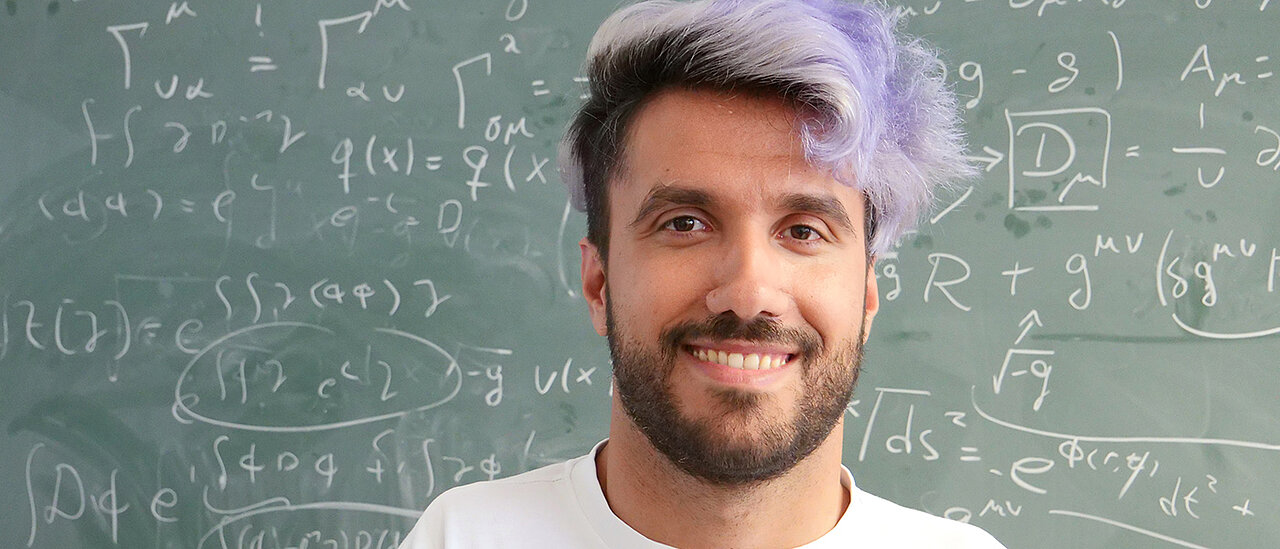
Anyone who doesn’t know Arsim Kastrati and arranges to meet him at the Institute of Physics will have no trouble spotting him in a crowd. His gait is too distinctive, the way he holds his arms and hands too unusual. Arsim Kastrati is 29 years old and a PhD student in physics at the University of Würzburg. He has lived with a severe disability since birth – arthrogryposis multiplex congenita – a condition causing joint stiffness that makes it impossible for him to live independently.
Nevertheless, Arsim has made it from a special needs school all the way to university. For his Master’s degree, which he completed with the top mark of 1.0, he was recently awarded the Röntgen Prize by the Faculty of Physics and Astronomy.
“I really enjoyed maths at school, but I felt it lacked practical application. That’s why I decided to study physics,” he says, explaining his path. “In physics, you describe complex processes in nature in a relatively simple way.” The emphasis here is on the word “relatively”. Once you’ve mastered the necessary maths, he finds it isn’t difficult.
A difficult path to university
Arsim Kastrati’s path to university was not an easy one. Born in Kosovo, he came to Germany with his family at the age of three, initially settling in Wertheim in the Main-Tauber district. Because of his disability, he attended the Centre for the Physically Disabled – now the Hans-Schöbel-Schule in the Heuchelhof district of Würzburg – and subsequently the Heuchelhof Mittelschule. This was followed by a move to the Fachoberschule, where he first obtained his vocational baccalaureate and, a year later, his general university entrance qualification.
Kastrati’s daily life requires a great deal of support. His congenital joint stiffness severely restricts the mobility of his legs and arms, meaning he relies on help when standing up, sitting down and carrying out everyday tasks. A specialist care service and a personal assistant provide him with close support – including at university.
Challenges and accommodations during his studies
“It was a ‘challenging’ time,” recalls Arsim Kastrati of his bachelor’s degree, and not just because of his disability. “Fortunately, I started before the outbreak of the coronavirus pandemic and was part of a group who have since become very good friends of mine,” he explains. Things became difficult during the lockdowns, when meetings were no longer possible. “That wasn’t nice, because physics isn’t a subject you can study on your own.”
The numerous practical sessions were also difficult when it came to carrying out experiments. He was usually an observer, telling the others what to do and playing a greater role in the analysis. During this time, he received a great deal of support from the lecturers. “For example, if we were supposed to carry out an experiment in pairs, in my case groups of three were always formed. Otherwise, it would have been a bit difficult for the other person,” he says.
Computer simulations instead of laboratory work
Having successfully completed his Bachelor’s and Master’s degrees at the University of Würzburg, Kastrati is now conducting research as a PhD student at the Chair of Theoretical Physics III. Together with his supervisor, Professor Haye Hinrichsen, he is exploring fundamental questions about the universe. This involves the mathematical description of space and time. In conventional physics, so-called spacetime is regarded as continuous – that is, as an infinite, structureless ‘soup’. Kastrati’s research, however, is based on the conviction that there must be a smallest, elementary length in the universe.
“In mathematical calculations, terms often appear that suddenly become infinitely large. This is unphysical and shows that there is something we do not yet fully understand,” says Kastrati, describing the problem. The introduction of the smallest units is intended to prevent these mathematical errors. As this research is purely theoretical, Kastrati does not work in traditional laboratories conducting experiments, but instead uses complex computer simulations to test the movement of particles in such modelled spaces. The findings of his Master’s thesis were so sound that they have already been published in an American specialist journal.
Strong networks for an academic career
Kastrati also attributes the success of his journey to the comprehensive support systems at the University of Würzburg. Throughout his studies, he was supported by the Contact and Information Centre for Students with Disabilities and Chronic Illnesses (KIS), headed by Sandra Mölter. The KIS advises students on all disability-related matters and provides particular support in organising reasonable adjustments. “I simply need more time for exams and written tests because I write more slowly. The KIS has been a great help to me in this regard,” emphasises Kastrati. From a lecturer’s perspective, too, Hinrichsen praises the cooperation with the service centre as running very smoothly.
For the forthcoming three-year PhD programme, another funding scheme applies: the PROMI+ (Inclusive PhD) programme. This project, also led by Sandra Mölter, enables talented university graduates with disabilities to pursue a PhD. Through a partnership with the Federal Employment Agency, doctoral candidates are financially secured via three-year employment contracts subject to social security contributions and are granted a statutory entitlement to necessary vocational rehabilitation services. Kastrati’s post is funded through a mixed financing arrangement, with the Employment Agency covering 70 per cent and the remaining funds contributed by the university and the chair.
For Professor Hinrichsen, disability no longer plays a role in day-to-day research anyway: “For me, what matters is that someone is committed and does good physics. When you work closely together, all that becomes second nature after a short time.” Kastrati himself would like to remain in academia even after completing his PhD: “I simply feel very much at home in this university environment and would like to stay at the university.”
Contact
Arsim Kastrati, Chair of Theoretical Physics III, T +49 931 31-80538, arsim.kastrati@uni-wuerzburg.de
Prof. Dr Haye Hinrichsen, Chair of Theoretical Physics III, T +49 931 31-84908, haye.hinrichsen@uni-wuerzburg.de