
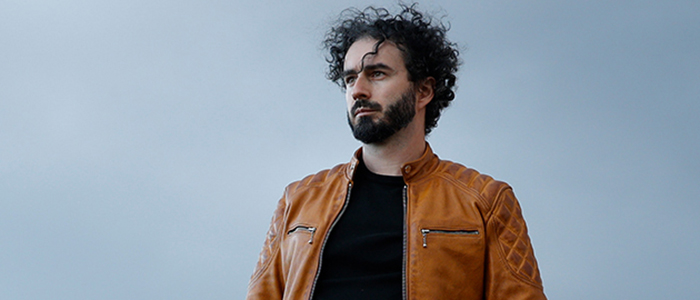
Matthias Coeler is an expert on batteries
09/01/2026JMU alumnus Matthias Coeler stumbled upon his work with batteries rather by chance. It all began at the Fraunhofer ISC in Würzburg and during his Erasmus year in Scotland.
What do graduates of the Julius-Maximilians-Universität Würzburg (Julius-Maximilians-Universität Würzburg) go on to do? To give students an insight into a range of career paths, Michaela Thiel and her team from the central alumni network ‘University of Würzburg Community’ regularly interview selected alumni.
Today’s interviewee: Matthias Coeler. He completed the Functional Materials degree programme at the University of Würzburg and is now a Senior Expert in the ‘Formation and Ageing of Lithium-Ion Batteries’ division at PowerCo SE in Salzgitter, Germany.
Mr Coeler, please tell us about your field of work!
I work on the process and the machinery that bring a battery to life – in other words, the initial charging procedure. This involves following many steps in a specific order.
Why batteries, of all things?
It just happened that way. I’d attended a lecture on batteries at the Fraunhofer ISC in Würzburg; shortly afterwards, I was in Edinburgh as an Erasmus exchange student. There, I carried out electrochemical experiments with manganese oxide for supercapacitor electrodes. After completing my Master’s degree in Würzburg, I went to the Fraunhofer THM in Freiberg, where they were looking for someone with expertise in manganese oxide and batteries – which tied in perfectly with my undergraduate thesis. There, I got involved in the field of aluminium batteries. I then worked at the Fraunhofer IKTS in Dresden in the field of lithium batteries. After seven years, I left research and joined a start-up near Dresden that wanted to print batteries. Another two years later, I moved to my current employer, PowerCo SE in Salzgitter.
What do you particularly like about your job?
The fact that I’m not just sitting in an office, but dealing with people and machines. I actually have to walk around a lot in my company and keep an eye on various things. The factory halls and projects are on a completely different scale to what I’m used to from the start-up and research worlds. I need the knowledge I gained at university, but also technical creativity and a knack for improvisation. On top of that, there’s a great deal of varied communication: many of our suppliers are based in Asia and I have colleagues all over the world.
On the subject of the energy transition: what’s the situation regarding battery lifespan?
Since I’ve been involved in this field – that is, since 2011 – there have been enormous advances in battery materials and cell designs. Depending on the charging current, modern lithium batteries can be charged and discharged up to 5,000 times before they become unusable. At the moment, the main focus is on the feasibility of large-scale production in Germany and on being able to compete on the world market in terms of cost.
What is your favourite memory from your time at university?
My top three are my Erasmus year in Edinburgh, partying at the Laby or on Sanderstraße, and the fact that I met so many people whom I often bumped into again on campus or in town. After graduating, many of those connections faded. I can only recommend choosing a university or faculty with a campus. You’ll never have another time like this in your life.
Thank you very much for talking to us!
Are you not yet a member of the ‘University of Würzburg Community’ alumni network or Alumni & Friends e.V.? If not, you’re warmly invited to register! You can do so on the Community’s website, where you’ll also find previously published interviews with JMU alumni.