
GoTEd+ Week
A cinematic retrospective of the 5th GoTEd+ Week
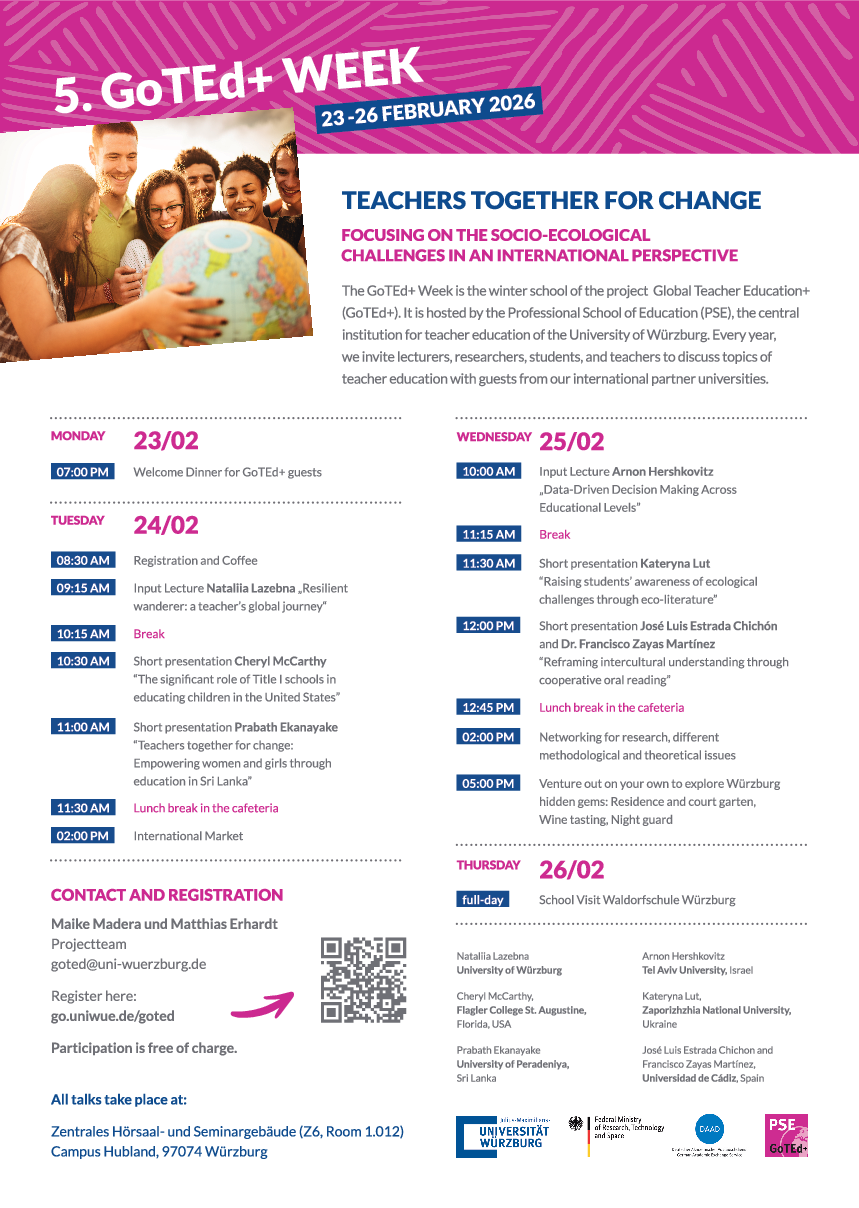
The fifth GoTEd+ Week, held from February 23–27, 2026, under the theme “Teachers Together for Change - Focusing on the Socio-Ecological Challenges in an International Perspective,” brought together GoTEd+ partners and PSE’s Erasmus+ partners in Würzburg for an inspiring week of dialogue, knowledge sharing, intercultural exchange, and valuable networking opportunities (link to the video).
Abstracts and lecturers
This plenary talk explores innovative pedagogical and research-based responses to the complex global socio‑ecological challenges of our time, including war, displacement, and cultural fragmentation. It draws on both practice and scholarship to highlight transcultural, project‑based approaches, such as Multilingualism through the Arts, that engage future foreign language teachers, particularly those working in challenging educational contexts (on the example of Ukraine).
Central to this work is a methodology that integrates art and multilingualism to foster intercultural competence, critical thinking, and linguistic development, while incorporating healing pedagogical practices. These practices provide meaningful ways to address urgent contemporary issues: confronting gender stereotypes, cultivating ecological awareness, and examining the diverse ways emotions are expressed across cultures.
The talk also situates these pedagogical innovations within a broader research agenda. It shares international experiences in implementing emerging technologies for teaching and learning, including award‑winning studies on immersive learning spaces designed for unsafe regions. The speaker will demonstrate how digital and artistic practices can open new pathways for resilience, inclusion, and creativity in education.
By positioning educators as ambassadors of social, cultural, and transformative processes, the plenary underscores their vital role in shaping inclusive and future‑oriented educational landscapes. It calls for a reimagining of teacher education that embraces multilingualism, creativity, and global solidarity as essential responses to today’s pressing challenges.
Dr.habil., Assoc. Prof. Nataliia Lazebna
Nataliia Lazebna is an associate researcher and lecturer at the TEFL Department at Julius-Maximilians-Universität Würzburg (JMU), Germany. Born in Zaporizhzhia, Ukraine, she holds both a PhD (2014) and a Habilitation (2021) in Germanic Languages. From 2007 to 2022, she served as a Lecturer and Associate Professor at Zaporizhzhia National Technical University. After relocating to Germany in March 2022 due to the war, she joined JMU in May 2022. In 2023, she was awarded the SCIENTIA Stipendienprogramm, funded through the Bayerische Gleichstellungsförderung (Bavarian Equal Opportunities Promotion), which supports early-career female researchers. She also works as an education manager for the CHARM-EU project at JMU’s Center for Teaching and Learning. Her research focuses on digital linguistics, emerging technologies in education, and transcultural studies. She is a member of TESOL (USA) and BERA (UK) international research organizations, and serves as co-convener of the International Research Network (IRN) Minority and Minoritised Teachers under the auspices of the World Education Research Association (WERA). She supports Ukrainian schoolchildren in Würzburg and leads community-based language initiatives in collaboration with local organizations and university departments.
This presentation will focus on the interaction between students, their environment, and federal policies governing Title I Schools. Specifics will be discussed on how children have access to a fair, equitable and high-quality education according to United States laws and regulations. Appropriation of funds to improve the health and well-being of students and families will be addressed in reference to several local Title I Schools in the surrounding community. The presentation will also include the status of Title I funds and the short and long-term negative effects of executive orders on marginalized and minoritized populations. Further analysis on teacher retention rates in Title I Schools as well as pre-service teacher beliefs about teaching in impoverished school settings will be shown.
A report of the significant findings from an on-site collaboration between one Title I elementary and the importance of mentorships will be discussed. Mentorship programs have demonstrated optimistic immediate and long-term effects in promoting positive youth outcomes for students who at high-risk for learning and behavioral outcomes. These programs show improved school attendance, academic achievement, self-esteem, lower drop-out rates, and healthier relationships. Reporting of data on how an after-school mentoring program between college students and elementary level public school students provides an ongoing opportunity to fully engage in tutoring where learning gaps exist, self-concept development, character building, and physical development through soccer.
Dr. Cheryl McCarthy
Dr. McCarthy is a Professor in the Education Department at Flagler College, USA. She earned her B.A. and M.S. from Purdue University and Ph.D. in Special Education from the State University of New York at Buffalo in Learning and Behavioral Disorders. For 22 years, her research and teaching in higher education has focused on students with disabilities, assessment, creativity in the classroom, and inclusion.
Dr. Edwidge Crevecoeur Bryant
Dr. Edwidge Crevecoeur Bryant is a Professor, Department Chair, and Coordinator of Accreditation and Assessment in the Education Department at Flagler College in St. Augustine, Florida. She also serves as the ESOL (English for Speakers of Other Languages) Coordinator. Her recent publication with her co-authors is the second edition of Educating English Learners, published by Harvard University Press.
"Teachers together for change: Empowering women and girls through education in Sri Lanka" is an initiative that recognizes the powerful role teachers play in shaping more equitable futures for girls, especially in underserved regions of the country. Although Sri Lanka has made notable progress toward gender parity in school enrollment, many girls particularly those in rural, estate, and post-conflict communities still face barriers that limit their participation in education. These include deep-rooted socio-cultural expectations, financial pressures, unsafe or unsupported school environments, and school-related gender-based violence. Research from Sri Lanka and beyond highlights the importance of gender-responsive teaching and community involvement in improving girls’ learning outcomes, retention, and sense of empowerment.
This project positions teachers as key drivers of change by equipping them with practical tools: gender-responsive teaching methods, strategies to prevent SRGBV, and skills to advocate for girls’ rights both inside and outside the classroom. Its approach brings together several components teacher training, girls’ leadership and academic support programs, community engagement, and policy-level advocacy. Planned activities include specialized workshops for teachers, leadership clubs for girls, reintegration support for vulnerable learners, strengthened school-community partnerships, and the use of research to inform national education policies. The project is being implemented in four high-vulnerability districts: Monaragala, Batticaloa, Nuwara Eliya, and Anuradhapura, using a participatory, evidence-based design supported by a mixed-methods monitoring and evaluation framework.
The initiative aims to train more than 500 teachers in gender-equitable practices, boost school attendance and completion rates among girls by at least 20%, improve child protection and the overall safety of learning environments, and increase community involvement in supporting girls’ education. Long-term sustainability is built into the project through the integration of training modules into national teacher education systems, collaboration with the National Institute of Education and Teacher Training Colleges, and the development of local advocates who can continue championing girls’ rights.
By strengthening the role of teachers as mentors, advocates, and community leaders, Teachers Together for Change works toward building an educational environment where every girl in Sri Lanka can learn confidently, lead proudly, and realize her full potential contributing to a more inclusive and gender-equal future for the nation.
Dr. Prabath Ekanayake
Dr. Prabath Ekanayake is a distinguished Sri Lankan educator and academic leader with over three decades of experience in teaching, educational development, and research. He holds a Doctor of Education from the University of Leicester, an MPhil from the University of Colombo, and a Master of International Education from the University of Sussex, alongside several professional qualifications in pedagogy, curriculum development, and educational technology. Dr. Ekanayake has served in multiple academic and administrative roles, culminating in his current position as Dean of the Faculty of Arts at the University of Peradeniya. His extensive research spans primary education, curriculum evaluation, online learning, and multicultural education, with numerous national and international publications. He has contributed significantly to curriculum design at undergraduate and postgraduate levels and has represented Sri Lanka in various global training and exchange programmes. Dr. Ekanayake is also an active speaker, mentor, and advocate for inclusive and innovative educational practices.
Educators at every level are surrounded by data—grades, attendance, clicks in online systems, notes in school records, municipal reports, and AI-based predictions. Yet many decisions in classrooms, schools, municipalities, and universities are still guided mainly by habit and pressure from above rather than by thoughtful use of evidence. This talk brings together findings from multiple studies to show what data-driven decision making looks like “on the ground” across the educational system, from K-12 teachers and principals to municipal officials, higher-education and MOOC instructors, and national level policy makers.
I will share how teachers used (and sometimes lost) data during routine teaching and emergency remote teaching, while caring for students’ cognitive, socio-emotional, and family realities. We will look at how teachers and school leaders enter information into school systems and dashboards, but often struggle to get back timely, meaningful pictures of individual students and classes. At the middle tier level, we will see how data are used to map needs and evaluate programs, but only partly to guide concrete action plans. In higher education and MOOCs, we will explore instructors’ interests and concerns about student data and AI-based predictions, and what happens when they are invited to co-design tools they can understand and trust.
Across these settings, a central message is that teachers’ work is 100% decision making—and good decisions do not come from data or algorithms alone. They emerge when rich data are combined with professional judgment, local knowledge, and attention to ethics, equity, and student well-being.
Assoc. Prof. Arnon Hershkovitz
Arnon Hershkovitz is an Associate Professor in Tel Aviv University's School of Education (Israel), where he is the Head of the Department of Mathematics, Science, and Technology Education, and leads the graduate program Technology & Learning. He holds a B.A. in Mathematics and Computer Science, an M.A. in Applied Mathematics (both from the Technion - Israel Institute of Technology), and a Ph.D. in Science Education (Tel Aviv University). He is mostly interested in the use of data in education, both in practice and in research.
Ecological issues have long been a recurring theme in literature; however, for centuries, they were predominantly viewed from an anthropocentric perspective, through human eyes, with humankind positioned at the center of the natural world. In recent decades, a noticeable shift from anthropocentrism to ecocentrism has taken place as a response to global climate change, which has reached an alarming scale. The focus of eco-literature, or environmental literature, therefore extends beyond the aesthetic depiction of natural beauty or its loss to an exploration of the complex ways in which human beings coexist with and impact the natural environment. As a result, such literature raises environmental awareness and may inspire readers to reconsider their attitudes and actions toward nature.
The primary objective of the talk is to demonstrate how eco-literature can be effectively integrated into foreign language teaching in order to enhance students’ ecological literacy. Reading and discussing environmentally oriented texts in a foreign language classroom allows students to combine linguistic development with ethical reflection and critical thinking.
According to Yurii Marchuk, academician and Head of the Society of Foresters in Ukraine, the level of ecological culture in Ukrainian society remains insufficiently developed, which highlights the urgency of ecological education across all disciplines and academic specializations.
The talk explores the pedagogical potential of contemporary Ukrainian literature translated into English, focusing primarily on The Flood (2025) by Yevhen Lyr, a novel documenting the destruction of the Kakhovka dam on June 6, 2023. Through close reading, discussion-based activities, and comparative analysis, students are guided to perceive ecological catastrophe not as an abstract global issue, but as a lived experience embedded in language. In this way, The Flood contributes to the formation of eco-literacy by fostering empathy, ecological responsibility, and a deeper understanding of the consequences of environmental destruction.
In this context, eco-literature becomes a means of encouraging environmentally responsible practices while learning a foreign language.
Assoc. Prof., PhD Kateryna Lut
Kateryna Lut, PhD in Philology, Associate Professor, at the Department of Foreign Philology and Translation at the National University Zaporizhzhia Polytechnic. She earned her Master's degree with honors from Zaporizhzhia National University in 2003 and completed her PhD thesis in 2014, earning her the title of Doctor of Philosophy with a specialization in Germanic languages. A result-oriented educator and researcher with over 20 years of experience in stylistics, translation studies, and language teaching methodology. Published author and co-author with more than 40 academic works in Ukrainian and international peer-reviewed journals. She has developed her professional skills through participation in international projects and internships in Germany (Wurzburg, Regensburg) and France (Vichy).
This communication explores the relationship between intercultural competence and cooperative oral reading in plurilingual and multicultural educational contexts, specifically within the training of pre-service foreign language teachers in primary education at the University of Cádiz (Spain).
Building on pedagogical research, we argue that literary texts function not only as effective resources for foreign language learning but also as powerful tools for fostering critical reflection and intercultural understanding. However, we also acknowledge that traditional conceptualizations of “interculturality” have been widely criticized for their Eurocentric or colonial underpinnings, for example, which often limit inclusive perspectives on cultural diversity. In response, the main objective of our study is to reframe intercultural competence through an educational lens aligned with the United Nations’ Sustainable Development Goals (SDG), particularly SDG 4 (Quality Education), SDG 5 (Gender Equality), SDG 10 (Reduced Inequalities), and SDG 16 (Peace, Justice, and Strong Institutions).
To achieve this goal, a selection of literary works in English, French, and German as foreign languages has been carefully chosen, focusing on themes such as identity, inclusion, or cultural diversity, and representing diverse linguistic backgrounds and age groups. These texts serve as the basis for cooperative oral reading activities facilitated by native speakers of the target languages, who act as language assistants and intercultural mediators.
Through guided discussion and collaborative dialogue, students are encouraged to reflect critically on cultural representations, challenge stereotypes, and engage with alternative narratives. The implementation phase of the study took place between October 2025 and January 2026, following a mixed-methods research design that combines questionnaires and focus groups involving both students and language assistants. The main findings, to be presented at GoTEd Week+ 2026, demonstrate that cooperative oral reading enhances linguistic competence while promoting more inclusive and socially responsible understandings of interculturality, thus reinforcing the role of foreign language education as a space for equity, dialogue, and transformative learning.
Dr. Francisco Zayas-Martínez
Dr. Francisco Zayas-Martínez is a senior lecturer in the Faculty of Education of the University of Cádiz (Spain). He founded and ruled the University Foreign Language Center (Centro Superior de Lenguas Modernas) between 2003 and 2011. He has developed and published didactic materials as well as books and articles related to Instructed Foreign Language Acquisition. He has directed different international University projects (Morocco, Russia, Cuba) and coordinates several mobility programmes with German universities. His recent research is focused on bilingual teaching in primary Education.
Dr. José Luis Estrada-Chichón
Dr. José Luis Estrada-Chichón has been a lecturer in the Department of Language and Literature Didactics at the University of Cádiz (Spain) since 2018. He currently serves as Head (2024-) of the Faculty of Education’s Language Plan, having previously been a member of its coordination team from 2019 to 2024. He is a member of the PAIDI research group HUM-485 Foreign Language Teaching: Materials for a New Curricular Design (2013-) and of the Institute of Applied Linguistics (ILA) at the University of Cádiz (2022-). His main research interests focus on Instructed Second Language Acquisition (ISLA), the CLIL approach, and teacher training.