
Würzburg-based researchers launch adaptive AI into orbit
07/07/2026Researchers at the University of Würzburg are developing an AI system that analyses satellite images whilst they are still in space. Once there, it is even intended to be able to adapt to new tasks retrospectively – for example, to provide protection against natural disasters.
It is a growing problem for Earth observation from space: satellites capture huge amounts of image data, but before this can be analysed, it must first be transmitted back to Earth in a labour-intensive process. This takes time and ties up already severely limited radio links – particularly when rapid results are needed, for example in the early detection of forest fires.
A team of computer scientists in Würzburg now aims to remedy this: as part of the ‘NOVA – FPGA-based resilient Earth observation and reconnaissance’ project, researchers at the University of Würzburg (JMU) are working on an AI system that will enable satellite images to be analysed directly in space in the future. Instead of having to send all images to a ground station first, the satellite should be able to evaluate relevant image information whilst still in orbit and forward it selectively.
“Our aim is to make satellites more flexible and efficient to use in future,” explains Professor Marco Schmidt, Chair of Embedded Systems and Sensors for Earth Observation, who is leading the project. “This will enable us to detect important events more quickly and make more effective use of radio links to Earth.”
Only important data should be sent to earth
Here’s how it works: the new system combines a satellite camera with artificial intelligence for image analysis. The software evaluates the images directly in space and decides which ones are relevant. The coordinates of a detected forest fire, the position of a ship being sought, or individual particularly important images could then be transmitted to Earth, for example.
A key focus of the project is the technology’s adaptability whilst in orbit. The AI models used and the image processing should be able to be adapted and optimised depending on the operational scenario, even whilst the satellite is still in space. This would allow the technology to be used, for example, for Earth observation, environmental monitoring, disaster management or scientific research.
A computer for changing tasks
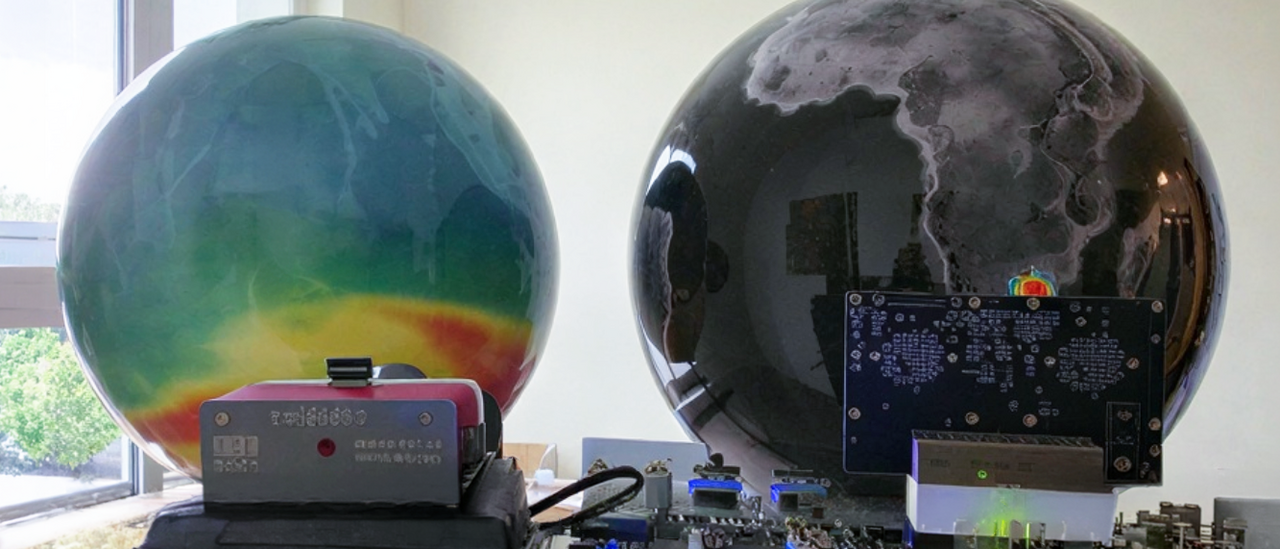
To this end, the Munich-based space technology company Engineering Minds Munich is developing a computer that controls the camera and processes its images. In the space sector, such a computer – designed specifically for a satellite’s instruments – is referred to as a ‘payload computer’. It is connected to the camera and the rest of the satellite’s technology.
The technical basis for this is a special computer chip whose internal circuits can be reprogrammed. This so-called FPGA is particularly well-suited to fast and energy-efficient AI calculations. FPGA stands for ‘Field-Programmable Gate Array’. This means that the computer in orbit can be configured, for example, to detect forest fires, ships or other objects.
“The fact that we can reconfigure the part of the computer responsible for AI image analysis whilst in orbit is not yet common practice,” explains Moritz Heimbach, a PhD student in Professor Schmidt’s department. “This gives us the opportunity to adapt satellites to new tasks during their mission and make Earth observation more flexible.”
The “NOVA – FPGA-based resilient Earth observation and reconnaissance” project is funded by the German Aerospace Centre (DLR) with funding from the Federal Ministry for Economic Affairs and Energy, following a resolution by the German Bundestag. The funding reference number is 50RY2605A.
Contact
Prof. Dr Marco Schmidt, Chair of Embedded Systems and Sensors for Earth Observation, Tel. +49 931 31-87229, marco.schmidt@uni-wuerzburg.de