
What connects Mwanza and Würzburg
06/09/2026Brückenschoppen, storks and city sounds: these and other similarities between Mwanza and Würzburg are on display in an exhibition by the University of Würzburg in the town hall until 30 June to mark 60 years of town twinning.
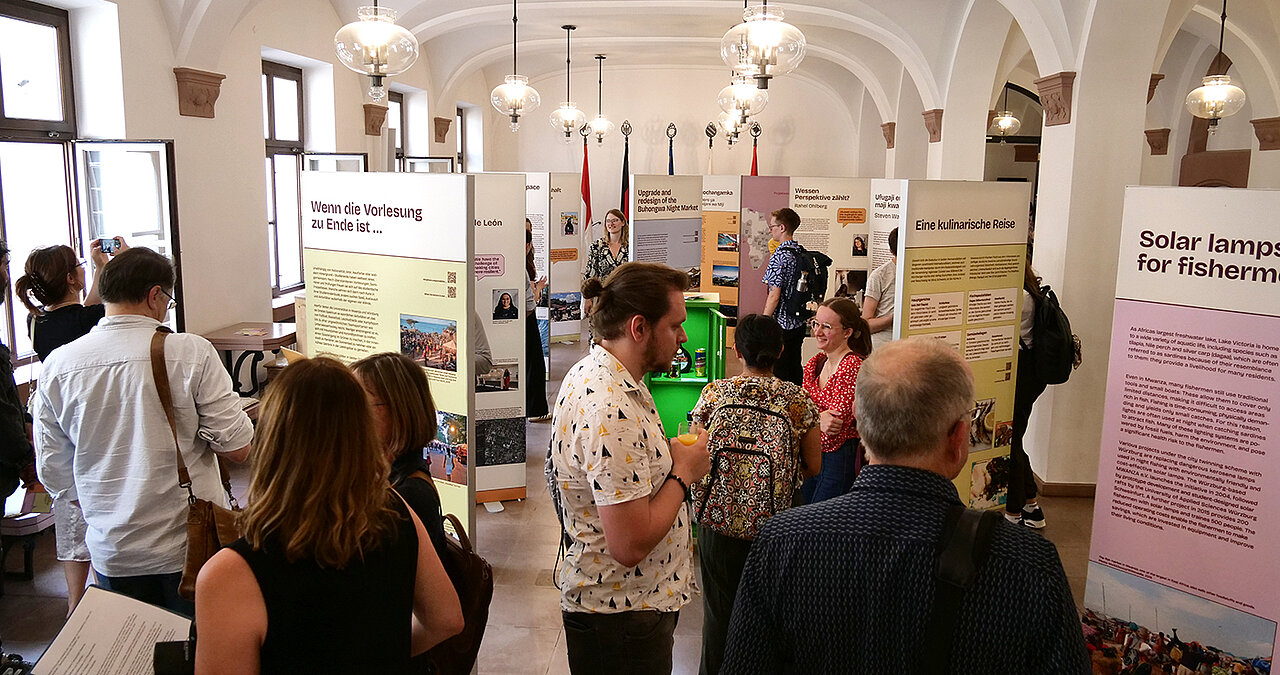
More than 6200 kilometres lie between Mwanza, the second largest city in Tanzania, and Würzburg. Despite the geographical distance, the two cities have maintained a close partnership for 60 years. To mark the anniversary, students and the Africa Competence Centre at Julius-Maximilians-Universität Würzburg (JMU) have developed an exhibition. It shows what social life is like in the cities and what connects them.
Anyone interested can visit the exhibition "Living in Science: Voices from Würzburg & Mwanza" in the foyer of Würzburg Town Hall until Tuesday, 30 June 2026. It will then move to the Gunzerthaus in Mwanza. The special thing about the exhibition is that it can be experienced in three languages: Kiswahili, English and German.
Exhibition portrays young researchers
The display panels show, among other things, the stories of eleven young researchers, nine from Würzburg and two from the University of Mwanza. Students from both universities interviewed the researchers as part of Dr Sarah Schönbrodt-Stitt 's seminar "Perspectives on innovative science communication" at the Chair of Remote Sensing in Würzburg.
One of the researchers portrayed is Dr Kim Lea Holzmann, researcher at the JMU Chair of Animal Ecology and Tropical Biology. She was pleasantly surprised at how broad the range of topics covered in the interview was: "Starting with science, it then moved on to my hobbies, Würzburg, my career and details such as favourite places in the city, favourite food and music," she lists.
In her introduction to the exhibition at the opening, Schönbrodt-Stitt emphasised that the project was intended to "make science through people accessible". This is linked to the question of what motivates the young scientists. Kim Lea Holzmann's motivation is to bring her research on climate change and biodiversity loss to society: "It's no use just writing scientific papers. Our topics need to reach the general public."
What Mwanza and Würzburg sound like
Sandro Schiepan is studying museology and is involved in the exhibition. Together with a fellow student, he introduced Elio Rauth from the JMU Chair of Remote Sensing. Sandro also focussed on another question: "What does the same or a similar environment sound like in the twin cities?"
The students collected sounds from both cities: the sound of water at Lake Victoria, the current of the River Main. The fish market in Mwanza, the green market on the market square in Würzburg. A street scene in Tanzania, the Würzburg tram. Interested parties can compare the soundscapes themselves using a QR code.
Sandro received support for the sounds of the Tanzanian city: "I regularly exchanged ideas with a student from Mwanza and developed the concept with him." Members of the M.W.A.N.Z.A Würzburg association also recorded sounds for Sandro's project while they were on a trip to the eponymous city.
What the exhibition offers
Other panels and exhibits show unexpected similarities between the twin cities: both have something positive in common with storks. In Germany, the birds symbolise the imminent arrival of the next generation, while in Tanzania they stand for a successful harvest.
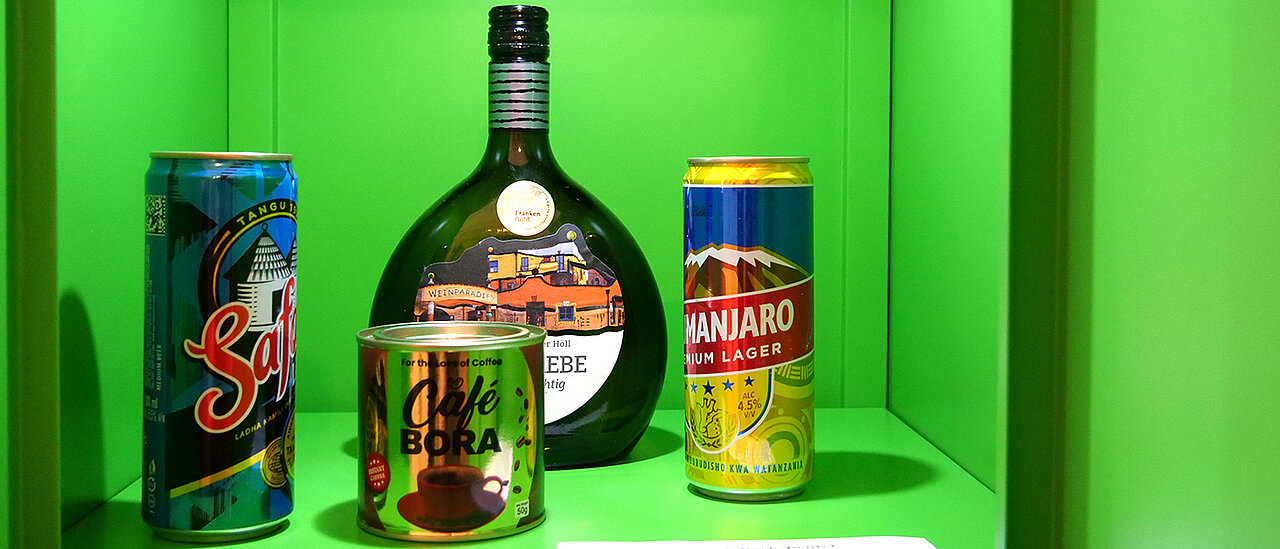
There are also similarities in everyday life: The people from Würzburg occasionally drink a glass of wine on the Old Main Bridge after work, while the people in Mwanza enjoy a Kilimanjaro beer. Also on display is an exchange of letters between two school classes, impressions of the Buhongwa night market and Mwanza's culinary specialities.
About the Africa Competence Centre
The Africa Competence Centre of the University of Würzburg is an association of researchers who have been working closely with partners in Africa for many years. The centre has set itself the goal of bundling research and cooperation, networking them with each other and making them known to the public at events.
JMU researchers from the Africa Competence Centre who were involved in the exhibition are Guido Fackler, Professor of Museology, Dr Sarah Schönbrodt-Stitt and Dr Michael Thiel, both from the Chair of Remote Sensing. Tourism researcher Dr Delphine Kessy from the University of Mwanza was also involved.
Further information on the Africa Competence Centre
JMU Funding for Science Communication
The exhibition received financial support from the JMU Funding for Science Communication. This was set up by the JMU Press and Public Relations Office. Researchers planning innovative communication formats can receive up to 1,000 euros from the funding pot to realise their project.
Further information on how to apply can be found here.
Additional images