

World premiere at the UKW
10/06/2026The University Hospital of Würzburg recently treated its first patient with fully implantable cochlear implants in both ears. The successful procedure took place at the Hearing Centre of the ENT Clinic.

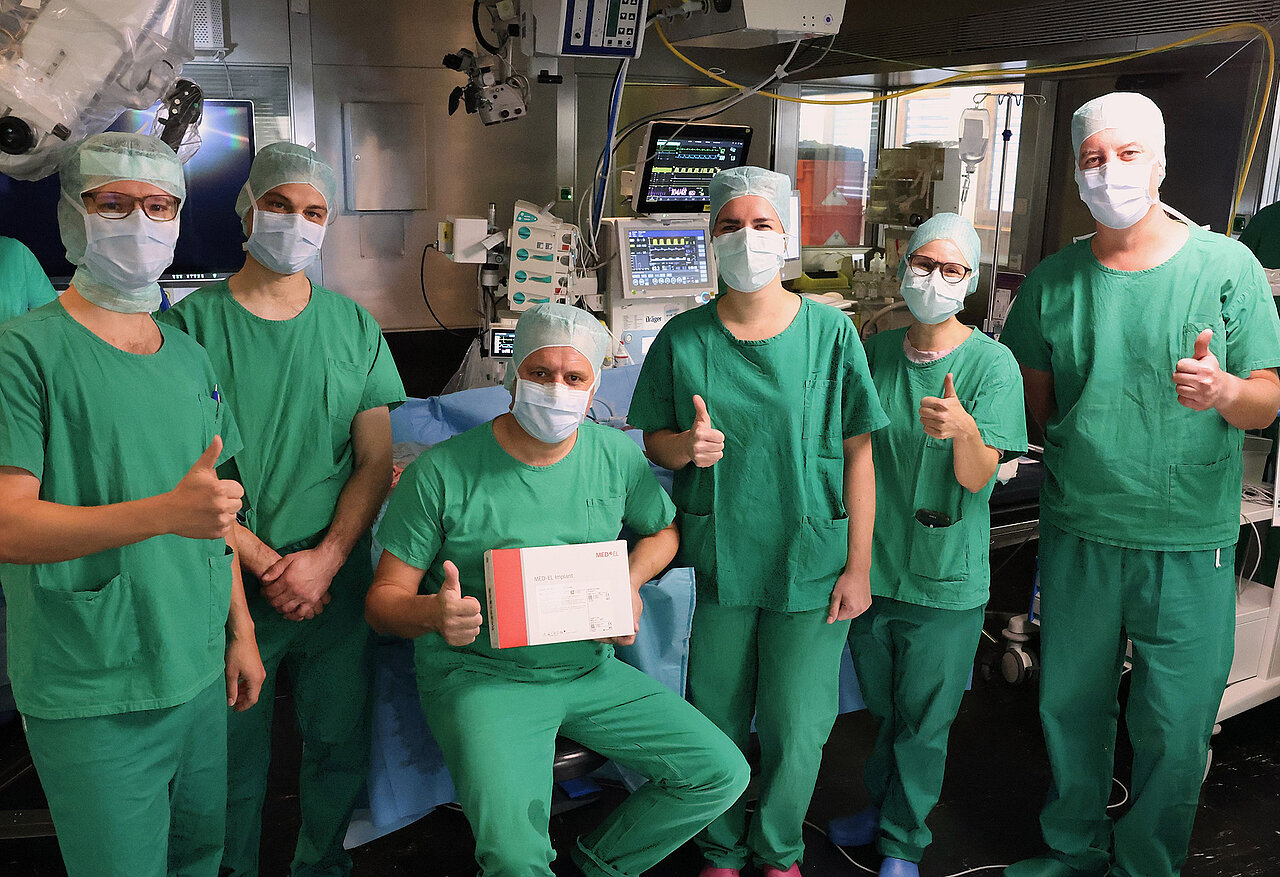
World premiere at Würzburg University Hospital (UKW): On 29 September, the team at the ENT Clinic fitted a patient with a second fully implantable cochlear implant. This makes her the first person in the world to be fitted with such a system in both ears. She had received the first implant as part of the clinical trial. The current operation involved the use of the CE-marked system, which is now available to all suitable patients. The ENT Clinic at the UKW is one of the first four clinics worldwide to use the new implant.
The patient has been receiving care at the ENT Clinic’s Comprehensive Hearing Centre (CHC) since childhood. She was so satisfied with the first implant that she wished to have the same treatment for her second ear as well.
“Until now, we have only been able to use the fully implantable system as part of clinical trials. With CE approval, it is now available to all eligible patients,” says Professor Kristen Rak, Senior Consultant at the Hearing Centre and Medical Director of the Department of Hearing Prosthetics and Implantable Hearing Systems at the UKW’s ENT Clinic. “We were the first clinic in the world to carry out a bilateral procedure using this system. This demonstrates the high quality of care and innovative strength of our specialised centre.”
What is a cochlear implant?
“Hearing aids and conventional implantable hearing systems amplify sound. They are therefore only effective as long as there are still functioning sensory cells in the inner ear – the so-called hair cells,” explains Rak. A cochlear implant (CI), on the other hand, takes over the function of the damaged hair cells and stimulates the auditory nerve directly. It is an option when the hair cells are so severely damaged that adequate speech understanding is no longer possible with other hearing aids. Extensive preliminary examinations determine whether a CI is appropriate and feasible.
All components are concealed beneath the skin
A conventional cochlear implant consists of two parts. The implant itself is anchored in the skull. The external unit, comprising a microphone, processor and power supply, is worn on the head and held in place over the implant by a magnet. With the fully implantable system, however, all components are located beneath the skin and are not visible from the outside.
“However, invisibility is only one aspect. What is far more important is that the new system brings us significantly closer to fully compensating for hearing loss. Those affected can hear all day long and in any situation, without compromise,” explains PD Dr Anja Kurz, Technical Director of the CHC. “The patients in the clinical trial emphasised precisely this point time and again. This also applies to those who already wear a conventional cochlear implant in their other ear.”
UKW Hearing Centre as a central point of contact
The UKW’s interdisciplinary Hearing Centre (CHC), founded in 2009, is the central point of contact for people with hearing impairments and their families. All specialist teams involved in the care of people with hearing loss work closely together in the same premises. The services on offer range from newborn hearing screening, through comprehensive, personalised advice on all current diagnostic and treatment options, to the provision of state-of-the-art hearing aids and implantable hearing systems. This also includes lifelong aftercare. “As a clinical development centre for new hearing systems, the centre rapidly translates innovations from research into patient care,” explains Professor Stephan Hackenberg, Director of the ENT Clinic at the UKW. Over the past 25 years, more than 4,000 cochlear implants have been fitted at the UKW.
Additional images