


Weak hands - a warning signal
03/24/2026Does depression leave lasting physical traces? A study by the Würzburg University Medical Centre suggests so. It shows that the strength of the hands remains reduced after overcoming depression.
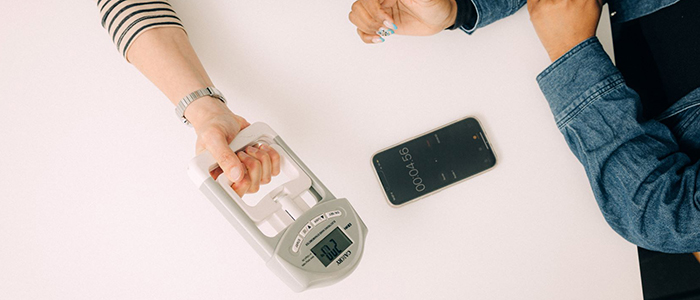
Measuring the force of a handshake: In medicine, this is a simple and inexpensive method for assessing muscle strength. Hand strength is now even regarded as a reliable biomarker for general physical performance - and increasingly also for mental health.
"Hand strength has been observed to be reduced in both schizophrenia and depression," says Professor Sebastian Walther.
The Director of the Clinic of Psychiatry, Psychosomatics and Psychotherapy at the University Hospital of Würzburg (UKW) wanted to find out more. Are there differences? What does physical fitness look like after an episode of illness? After all, mental illnesses usually progress in episodes. After acute phases of illness, those affected should actually be able to return to their previous level of performance.
Publication in JAMA Psychiatry
In a study involving 533 people, Sebastian Walther and an international team investigated hand strength in mentally healthy adults, people with schizophrenia, people in depressive phases of illness and people who had recovered from depression.
The strength of both hands was measured in several tests using electronic manometers. The study team then analysed the values for the dominant hand in each case. The results have been published in the renowned journal JAMA Psychiatry.
One result contradicted expectations
The first result was not surprising: all patients had less strength in their hands than the healthy control groups. However, there were differences between the individual disorders. People with schizophrenia had greater hand strength than people with depression. The currently depressed did not differ from the recovered.
"That really surprised us," says Sebastian Walther. "We had expected that people who had recovered from depression would have normal hand strength again."
The psychiatrist finds it worrying that hand strength does not recover in people after depression. After all, hand strength was considered a good marker for fitness and health in earlier studies on the general population.
What should be investigated next
"Further studies must now clarify whether low hand strength despite overcoming depression is due to a genuine deficit in fitness or merely a lack of motor control," says Sebastian Walther.
The current analysis incorporates data from several studies conducted by Sebastian Walther's research groups in Bern and Chicago, which were funded by the Swiss National Science Foundation (SNSF) and the National Institute of Health (NIH). The same methodology was used in all studies.
Publication
Transdiagnostic Patterns of Grip Strength in Schizophrenia, Current Depression, and Remitted Depression. JAMA Psychiatry. 18 March 2026, DOI: 10.1001/jamapsychiatry.2026.0144