
Schoolgirls went on a VR excursion to coral reefs
07/14/2026Didactics of Geography meets upper secondary education: Five teacher-training students from the University of Würzburg trialled a virtual reality-based lesson at St Ursula Grammar School.
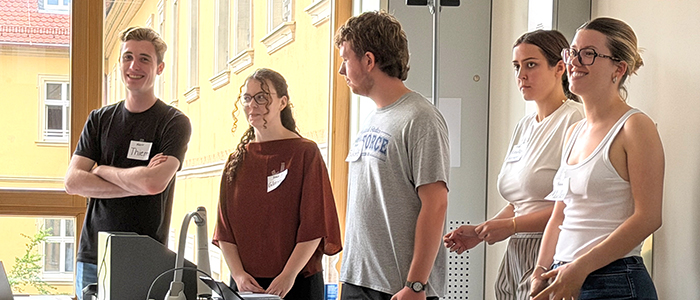
Niclas Eckert, Jenny Gleesner, Helena Kreutzberger, Kara Müller and Luis Thiem visited Year 11 pupils at St Ursula’s Grammar School in Würzburg to trial the virtual reality excursion they had developed themselves. The five geography teacher-trainee students had planned three lessons to test VR-based teaching – and were met with enthusiasm.
First, the pupils were asked to analyse the ecological, social and economic causes of global coral die-off. They then had to examine the interrelationships with tourism, fishing, pollutants and climate change.
Finally, they discussed what conservation and restoration measures could be taken to significantly reduce global coral die-off and create sustainable solutions that would breathe new life into this fascinating underwater world. To set this process in motion, a wide range of activities at various levels are required.
Sun cream and microplastics as stress factors
The pupils realised that human-induced stress factors affecting reefs include, amongst other things, the introduction of pollutants through sun cream and microplastics. Added to this is physical damage to reefs caused by careless divers and snorkellers.
It very quickly became clear to the pupils that, whilst they cannot solve the problem on their own, they can still make a contribution – for example, by using suitable sun creams, choosing their mode of travel wisely, respecting the local environment, or carefully planning their own diet.
Lecturer sees great potential for VR
Daniel Wirth, a lecturer in Didactics of Geography at JMU, sees great potential for the use of VR technology, for example in teaching geography, physics and chemistry, but also in vocational training. In his view, its strengths lie in creating three-dimensional experiences that cannot be easily replicated in the real world.
It goes without saying that this technology does not come for free. This applies both to the technical equipment and to the development of the concepts. Those who are not put off by this effort will gain another building block for effective teaching.