
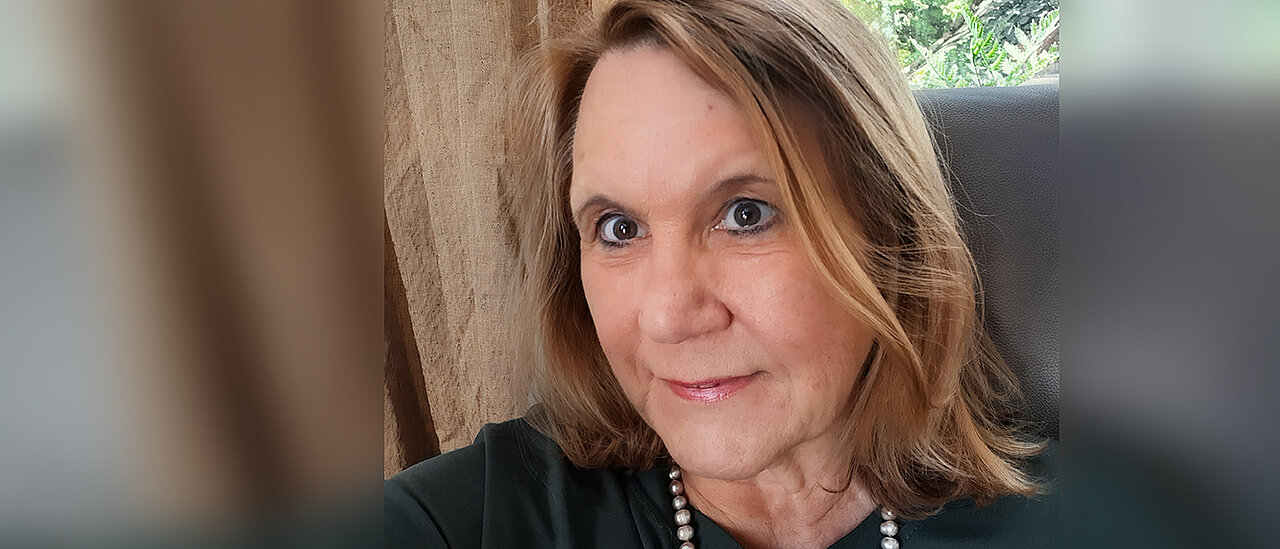
Ute Meiser combines law and psychotherapy
06/02/2026At the age of 66, psychotherapist Dr Ute Meiser has made a change of direction - towards the subject that interested her most as a high school graduate. She is now studying law at the University of Würzburg.
What do graduates of Julius-Maximilians-Universität Würzburg (JMU) do for a living? In order to introduce students to different perspectives, Michaela Thiel and her team from the central alumni network "Uni Würzburg Community" regularly interview selected personalities.
Today, the example of Dr Ute Meiser shows what unusual life paths can look like: she worked as a psychotherapist in her previous professional life and began studying Law at the University of Würzburg at the age of 66.
Mrs Meiser, how did this change of career come about?
After leaving school, I had a place to study law in Augsburg. I wanted to become a criminal lawyer. However, the emancipation of women was not yet very advanced at that time and I was addressed as Fräulein. My mother persuaded me to become a teacher instead. I enrolled at a teacher training college, but very soon switched to psychology, which I was very enthusiastic about. I trained as a psychotherapist when I was over 40 and then had a practice in Hamburg for 16 years. When I trained as a court expert about ten years ago, I realised that I wanted to study law after all. Even as an A-level student, I was interested in how manslaughter, murder and other serious criminal offences can be explained psychologically. Now I can combine my interests.
How does studying the two subjects differ?
Very different. I had to learn to think very differently. While psychoanalysis and depth psychology lie in the realm of the subjective and we have to work very much with our perception, law requires systematic and sharp thinking and is comprehensively structured. Today, the study of psychology is also more structured: Back then you only had to write exams in statistics, all other certificates were for papers, assignments or presentations, which we were free to build up. It's certainly different today.
What do you like, where did you have different expectations?
What caused me problems were the different schemes that had to be applied depending on the area of law. What I really like is the in-depth consideration of the language and the precise definitions as well as the involvement of the students in thinking about the legal treatment of the cases. Lectures are also lively and interesting and you can always contribute your own reflections. An extraordinary amount is done for the students at the University of Würzburg, I feel well looked after and very well trained here. However, the demands are sometimes gigantic. It was very difficult for me to prepare well for the three intermediate examinations. In addition, I suffer from a chronic inner ear and eye condition, which often makes learning difficult for me. But I don't let that stop me.
What do you want to do after your studies?
I would like to become a defence lawyer for juvenile criminal law. I am also very interested in fundamental rights and family and inheritance law. In the area of family law, I have written expert opinions for courts when it came to custody or abuse cases. I have sometimes carried out treatment with juvenile offenders and gained very interesting insights into the psychological background.
Other people want to retire at 66.
If I stay healthy and able to work, I hope to have another 20 good years and follow my own role models when it comes to working in old age: one of my psychotherapy trainers still had a full practice at the age of 92 and gave seminars for students. And the American lawyer Ruth Bader-Ginsburg worked as a judge until her death at the age of 87.
What advice would you give to alumni who want to change careers?
Don't base your career choice on rational criteria! Choose the subject or switch to the field you are passionate about, where your passion leads you! And don't wait as long as I did. When I was preparing for my philosophy of law exam, I found a wonderful quote from Hegel: "Nothing great has been achieved without passion".
Thank you very much for the interview!
Are you not yet a member of the alumni network "Uni Würzburg Community" or Alumni & Friends e.V.? Then you are cordially invited to register! You can do so on the Community website. There you will also find the interviews with JMU alumni and alumnae published so far.