


A genetic defect in a pain pathway acts differently than expected
10/06/2026A new study published in the journal PAIN on genetic alterations to the TRPA1 pain channel shows that, despite the channel’s reduced function, severe pain still occurs.
Pain is triggered by the body’s sophisticated alarm system, which serves to warn us of danger. Specialised nerve cells, known as nociceptors, detect stimuli such as extreme heat or intense pressure and transmit these as electrical signals to the brain. They are aided in this by pain channels, which are proteins located on their surface and function like a molecular gate. When the pain channel is activated by a stimulus, charged particles – known as ions – can flow through the membrane, thereby generating the electrical signal. Pain channels therefore also determine when a pain stimulus arises and how strongly the signal is transmitted. One of these channels is TRPA1 (Transient Receptor Potential Ankyrin 1).
Severe pain despite reduced function of the pain channel
Professor Nurcan Üçeyler, Senior Consultant in Neurology at Würzburg University Hospital (UKW), and her ‘Translational Somatosensory’ research group have investigated a rare genetic mutation in the TRPA1 channel in greater detail and made a surprising discovery: Although the patient in the study suffers from severe pain, it emerged that this altered pain channel is less active.
“What is surprising is the apparent contradiction,” explains the professor of neuromuscular neurology and pain. “Contrary to what one might initially assume, the TRPA1 variant under investigation does not cause the pain channel to become overactive; on the contrary, its function is impaired. Nevertheless, the genetic variant is associated with severe pain and small-fibre neuropathy,” says Üçeyler.
In small-fibre neuropathy, the body’s thin nerve fibres – at the ends of which the nociceptors are located – are damaged. Damage to these fibres leads to extreme misregulation of pain signals. Common symptoms include, for example, burning or stabbing pain, hypersensitivity to touch, and an altered perception of temperature.
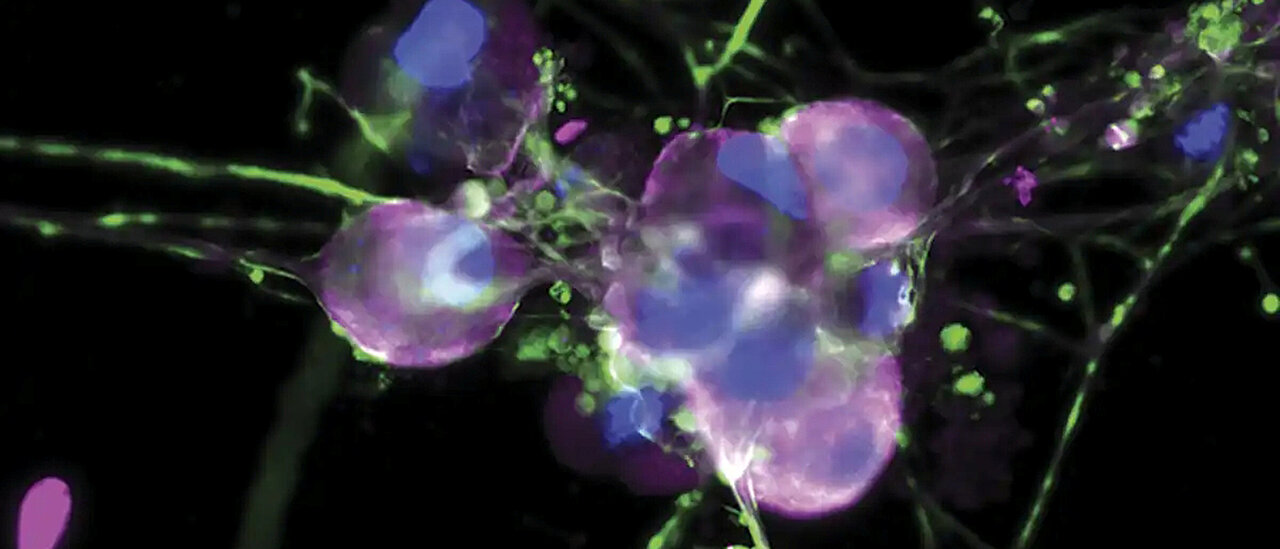
Cover image of the October issue of PAIN
To investigate the effects of the genetic mutation on pain in greater detail, Dr Nicole Michelle Schottmann, a research assistant working with Nurcan Üçeyler, cultivated nerve cells in the laboratory from the patient’s own cells. These patient-derived nerve cells were also compared with another cell model. Nicole Schottmann has now published the results as first author in the renowned journal PAIN. The official journal of the International Association for the Study of Pain even selected an image of the patient’s own nerve cells as the cover image for the October issue.
Pain channel fails to reach the surface of the nerve cells
What are the findings? “Our results suggest that the channel does not reach the surface of the nerve cells properly and is therefore impaired in its function,” explains Schottmann. “We are thus demonstrating that the link between a genetic mutation and the development of pain can be significantly more complex than previously assumed.”
Interpreting genetic findings with caution
Even if a genetic mutation does not enhance but rather impairs the direct function of the affected protein, it may still be linked to a disease. “Our work highlights just how multifaceted the link between genetic changes and pain is, and emphasises that genetic findings must be interpreted with caution in clinical practice,” says Nurcan Üçeyler.
In search of new therapeutic approaches
As a next step, the research group intends to focus on investigating the mechanisms that link genetic findings in pain-associated genes to the clinical phenotype. A better understanding of these mechanisms could provide new avenues for the development of targeted drugs and, consequently, better treatment options. However, further research is needed before these can be translated into concrete therapies.
Funding and collaborations
The study was supported by the German Research Foundation (DFG). In addition to the UKW, the Department of Anaesthesiology and Intensive Care Medicine at Hannover Medical School and the Institute of Human Genetics at the Faculty of Medicine, RWTH Aachen University, were also involved.
Publication
Schottmann, N. M., Eberhardt, M. J., Wehmeyer, S., Medala, V. K., Meyer zu Altenschildesche, C., Grüner, J., Eggermann, K., Kurth, I., Leffler, A., & Üçeyler, N. (2026). Functional impact of the TRPA1 H560D variant on neuropathic pain. Pain, 167(10), 2375–2390. https://doi.org/10.1097/j.pain.0000000000004078