
AI-based patient simulation in teaching
02/17/2026Würzburg University Hospital has launched a new teaching project. Medical students are given the opportunity to practise their communication skills and train clinical decision-making at the same time.
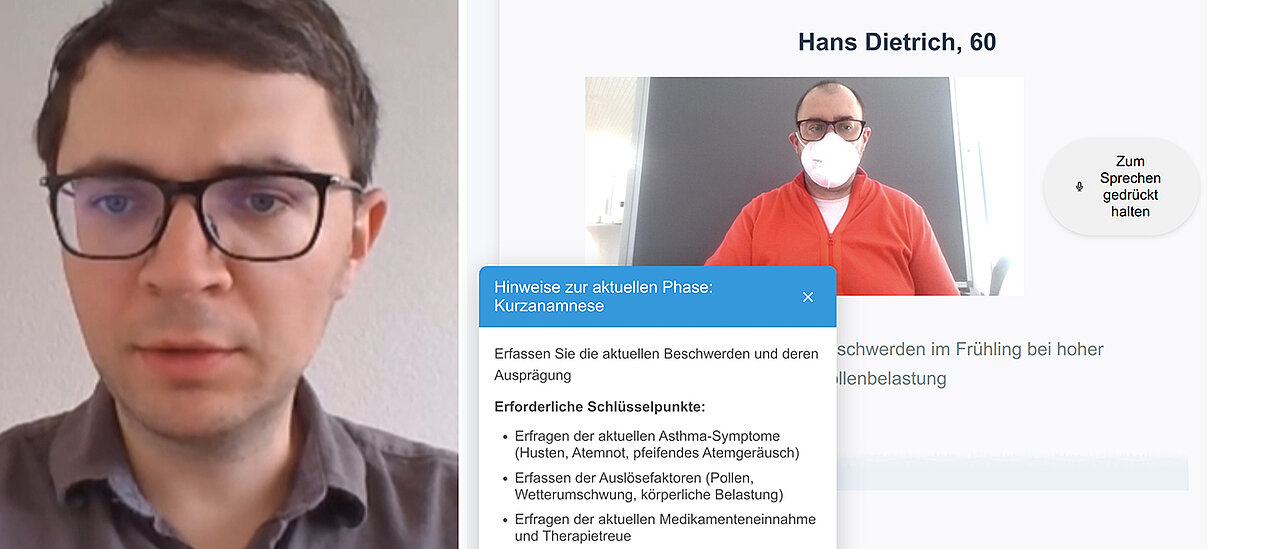
Simulated patient consultations are an integral part of medical training. In the process, actors slip into the role of patients and conduct consultations with medical students. In addition to conducting medical consultations, students learn to show empathy, listen actively and interpret non-verbal signals. They practise responding to different personalities, emotions and cultural backgrounds and learn how to deal professionally with difficult situations such as breaking bad news, uncertainty or conflicts.
They also receive structured feedback that helps them to reflect on and continuously improve their own demeanour. However, training with human actors is cost-intensive and difficult to scale.
From hackathon to research project
The Institute for Medical Teaching and Training Research at the UKW therefore asked itself the question: "Can AI train the doctor-patient conversation?" Hackers who gathered in Würzburg in March 2025 for the second Healthcare Hackathon were looking for an answer.
Within 24 hours, an interdisciplinary team at the Centre for Digital Innovation (ZDI) developed a proof of concept that demonstrated the potential of generative AI for medical consultations. Using advanced methods of speech recognition and playback as well as a specially modified Large Language Model (LLM ), the team came very close to a doctor-patient conversation on a verbal level.
The formalised project KIPS (AI-based patient simulation) is now transferring this prototype into a scientifically validated teaching application for the systematic teaching of medical conversation.
Cooperation with Heilbronn and Bern
"Simulation in medical training needs new ideas and modern tools. Until now, it has not been possible for students to have real conversations with virtual patients. This is exactly where our project comes in," says Professor Sarah König, Head of the Institute for Medical Teaching and Training Research.
At the University Hospital Würzburg (UKW), the Institute for Medical Teaching and Training Research is responsible for the project. Other participants include the Technical University of Munich (TUM) at the Heilbronn campus and experts in medical AI from Inselspital Bern (Switzerland). Together, they want to develop a scalable training platform based on large language models.
Objective feedback is a unique selling point
A large language model is an artificial intelligence system that is trained to understand, process and generate language. As part of KIPS, it can therefore simulate realistic doctor-patient dialogues in real time. The AI takes on the role of the patient, reacts to verbal input from the students and then generates objective, metrics-based feedback on empathy, professional accuracy and dialogue structure. This is a unique selling point.
The longitudinal structure is also new: students can accompany the virtual patients over several visits during an inpatient stay and recognise and reflect on the effects of measures, such as ordering a new medication.
"The aim of KIPS is not to replace conversations with real or acted patients in medical training - these will always remain the most important pillar of anamnesis training. However, we want to show what additional possibilities the technology offers, especially in terms of scalability, structured dialogue feedback and awareness of the effects of one's own actions," says Alexander Zamzow, medical project manager of KIPS at the Würzburg Teaching Clinic, explaining the didactic innovation.
Expansion of the training for additional professional groups
However, the relevance of competent dialogue skills extends not only to the medical profession, but to all academic and non-academic health and medical professions. It is therefore planned to expand the training programme for additional professional groups as the project progresses. For example, the system is to be adapted to the needs of midwifery in order to develop interprofessional synergies in this area at an early stage.
Supported by the Vogel Foundation Dr Eckernkamp
This pioneering project at the Würzburg site has been made possible by funding from the Vogel Foundation Dr Eckernkamp. "We support the effective use of AI in medical applications and, above all, in education, because we see great opportunities here to realise significant progress quickly and across the board. KIPS in particular is a prime example of speed and competent innovation," explains Dr Gunther Schunk, Chairman of the Board of the Vogel Foundation Dr Eckernkamp.
At the same time, the project arm at the Heilbronn campus is being supported by the TUM Incentive Fund. This support underlines the relevance of the project for medical qualifications beyond the region. The project started in January 2026 with the further development of the prototype; a pilot study to evaluate the usability and success of the training is to follow in autumn 2026.