
High-tech for accurate diagnoses
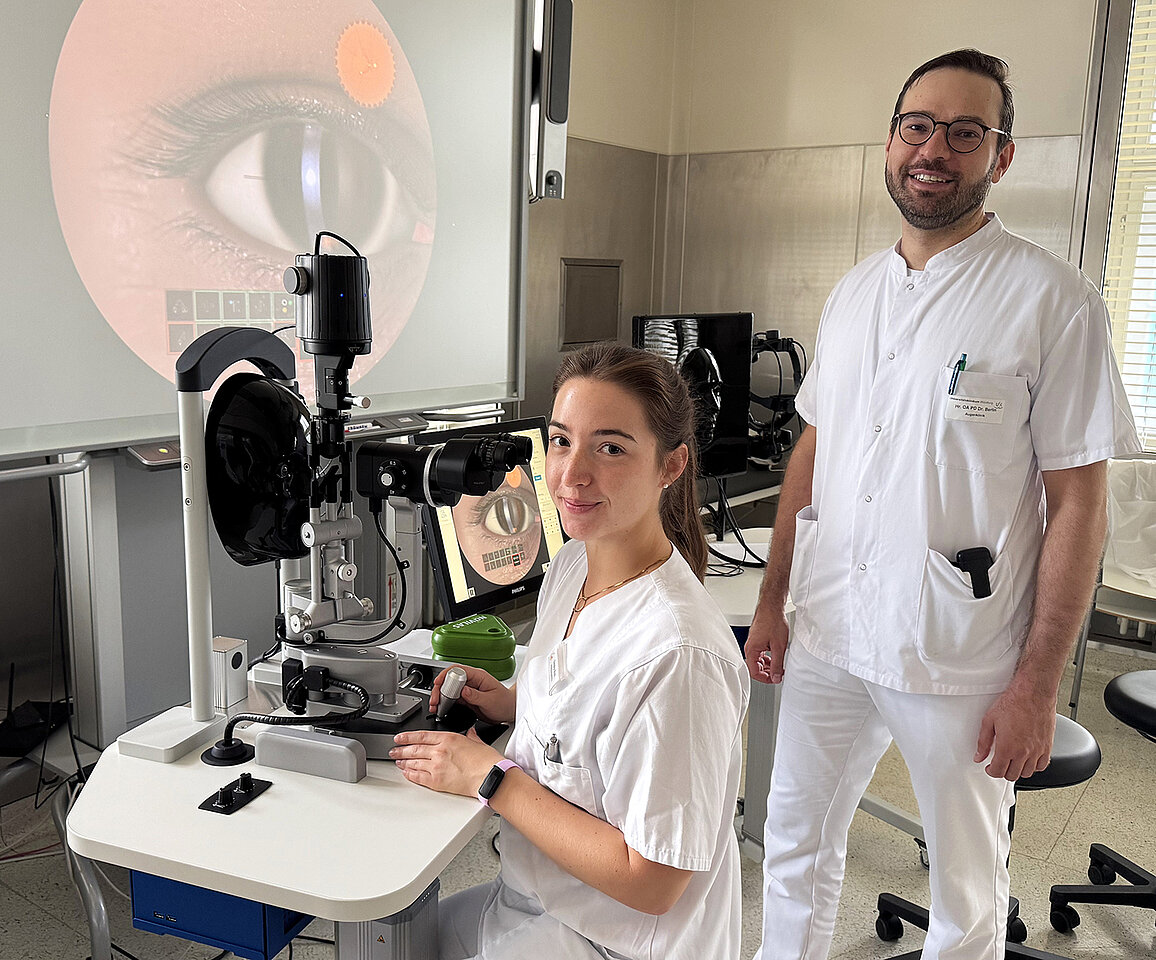
07/14/2026Two state-of-the-art EyeSi simulators are revolutionising teaching and ophthalmology training at the UKW. The simulators for slit-lamp examination and indirect fundoscopy combine real hardware with virtual reality.
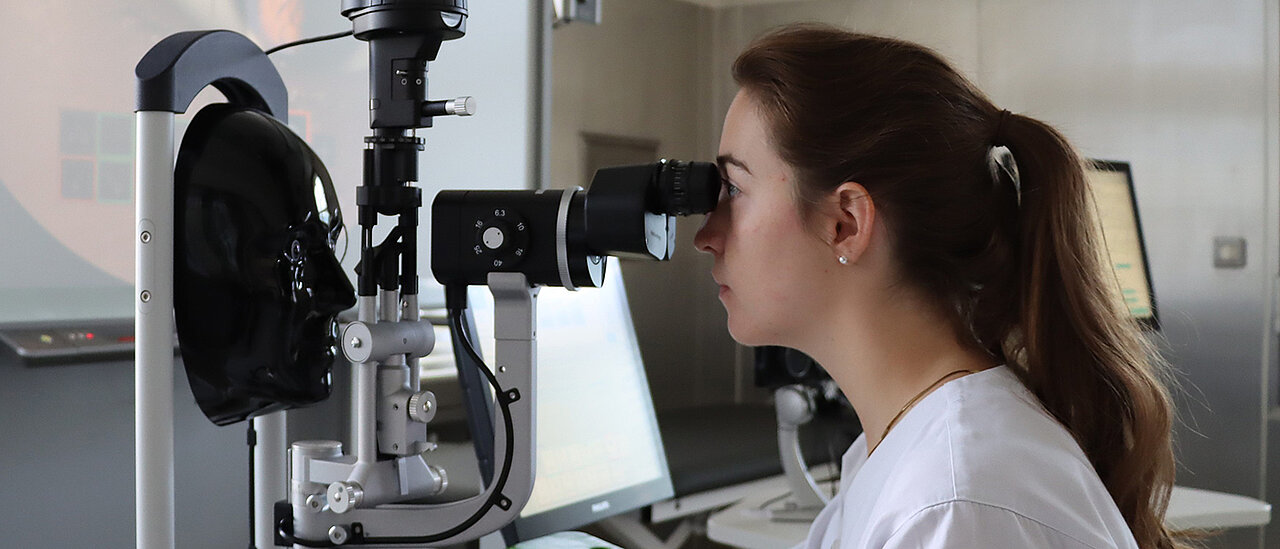
For ophthalmologists, the slit lamp is what the stethoscope is to internists: an essential basic instrument used in almost every examination. Thanks to its high magnification and slit-shaped illumination, which allows the eye to be examined layer by layer, the slit lamp enables the examination of numerous structures within the eye. For example, the slit lamp can be used to diagnose scratches or infections of the cornea, cataracts of the lens, or diabetic retinopathy or age-related macular degeneration of the retina. It also provides crucial information in cases of inflammation of the iris (iritis) or injuries caused by foreign bodies.
Inspiring students to pursue ophthalmology
It is therefore all the more important that junior doctors practise examinations using the slit lamp as part of their training and that medical students develop an appreciation for ophthalmology during their studies. “But how are we supposed to inspire students to take an interest in our speciality if there isn’t enough time available for teaching at the slit lamp?” asks Dr Andreas Berlin, a private lecturer at Würzburg University Hospital (UKW). Compared to the stethoscope, slit lamps are not only a scarce resource, but it is also very time-consuming to operate the device and to train the next generation in its use and inspire their enthusiasm for it.
Students often learn how to carry out the examination directly in the day-to-day clinical setting. However, the clinical schedule is often very tight, leaving only limited scope for structured guidance and practice. Furthermore, the teaching of examination techniques depends heavily on the individual tutors. There is therefore a great need for structured, standardised training opportunities.
EyeSi simulators for slit-lamp examination and fundoscopy
Andreas Berlin is now addressing this issue thanks to support from the Dr Herbert Brause Foundation, Roche Pharma and Bayer Pharma, as well as funding from the UKW Eye Clinic. The senior registrar at the Würzburg Eye Clinic championed the purchase of two devices that simulate key eye examinations. Specifically, an EyeSi Slit Lamp for training in slit-lamp examinations and an EyeSi Indirect Simulator for indirect fundoscopy have been installed at the teaching clinic at the UKW. Indirect fundoscopy, also known as ophthalmoscopy, involves examining the back of the eye – that is, the retina, the choroid, the blood vessels and the optic disc. This examination is considered one of the most difficult basic examinations, as it is visually unfamiliar, motorically complex and difficult to teach – particularly without structured training opportunities.
With the EyeSi Indirect Simulator, students learn to recognise retinal diseases such as diabetic retinopathy, retinal detachments or age-related macular degeneration in a realistic manner and to practise the corresponding diagnostic procedures.
“Both simulators combine real hardware – the Haag-Streit slit lamp and the Heine head-mounted ophthalmoscope – with virtual reality. Learners receive objective feedback and can practise specific examinations repeatedly without placing a burden on day-to-day clinical practice,” says Berlin.
Teaching practical skills and enhancing theoretical knowledge
The specialist has now developed a concept for a summer and winter school, in which interested students and those starting their careers can learn and practise the most important examinations in ophthalmology using the simulators at the teaching clinic at the UKW. Using an additional real Haag-Streit slit lamp, participants can examine one another and apply the virtual reality experience, at least, to healthy people. “Those who learn the same things in a structured and standardised way will also be able to cope in everyday practice. Then we, as senior doctors, know that we can rely on the practical skills and theoretical knowledge of the next generation,” says Andreas Berlin. “Because even if I know how to examine the eye, I won’t see what there is to see if I don’t know what might be there.”
First Würzburg Summer School for Ophthalmology in September
The first Summer School for Ophthalmology will take place from 10 to 12 September 2026 – exclusively for medical students from Würzburg.
Over the three days, participants can look forward to fascinating lectures, high-end simulator training on the Eyesi® simulators for slit-lamp examinations and indirect ophthalmoscopy, as well as intensive hands-on workshops – all under the personal guidance of experienced and dedicated ophthalmologists. Through one-to-one discussions, medical students will gain honest insights into everyday clinical practice, various career paths and the fascination of one of the most innovative fields in medicine.
Discover the diversity of ophthalmology and experience why precision, technology and teamwork make this speciality so unique.
Additional images