
Three months, two countries and many new perspectives
07/21/2026Two students from the University of Würzburg spent three months each in Sri Lanka and Indonesia. With support from the DAAD and the Professional School of Education, the trainee teachers carried out research there for their admission theses.
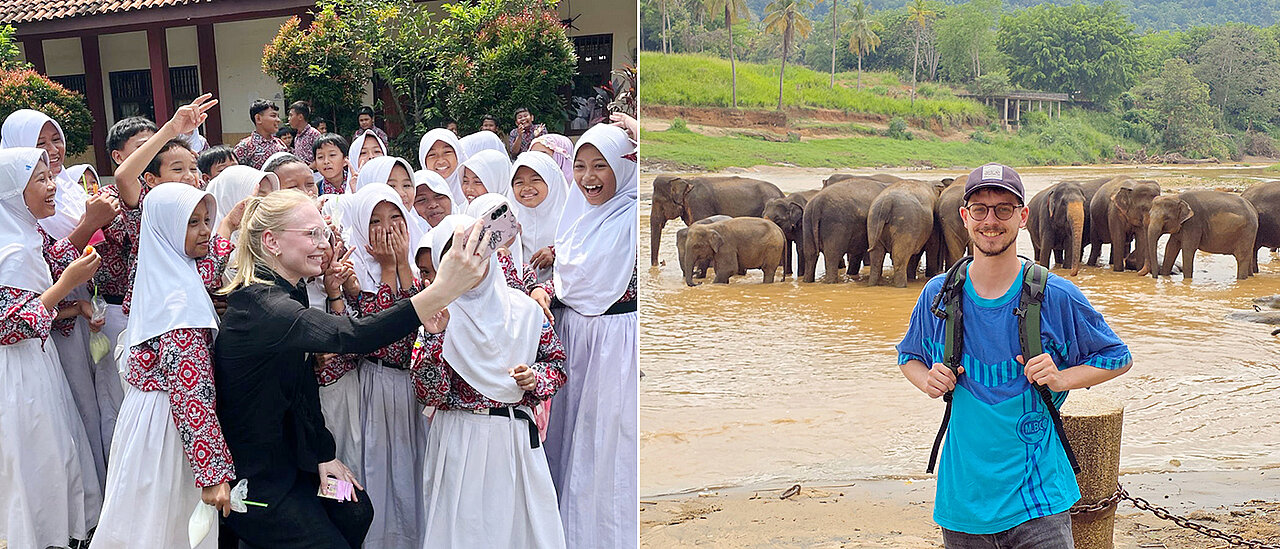
Mathias Pietsch and Hannah Fork are studying to become teachers at the University of Würzburg; until recently, they had spent three months travelling in Sri Lanka and Indonesia respectively. However, this was not a holiday. Instead, the pair carried out research projects for their "Zulassungsarbeit" (admission theses).
They were supported in this by a DAAD scholarship through the “Global Teacher Education plus” project run by the Professional School of Education (PSE). This scholarship is designed to enable students to gain insights into other education systems and undertake small-scale research projects on the ground.
Maike Madera, GoTEd+ and Erasmus project coordinator at the PSE, interviewed the pair upon their return.
Hannah, where did you go?
Hannah: I spent three months studying at Universitas Negeri Semarang (UNNES) on the island of Java in Indonesia, where I had the chance to get to know a different culture whilst also making progress with my research.
What is your research about?
My master’s thesis focuses on an international comparison between Indonesia and Germany regarding the use of digital technology in primary school maths lessons. However, the stay offered me far more than just the opportunity to carry out academic work: I was able to experience the Indonesian education system at first hand and gain valuable experience for my future career as a teacher.
How did that work in practice?
For example, during my stay I was able to attend various courses at the faculty and experience everyday university life in Indonesia first-hand. I also had the opportunity to visit several schools and conduct interviews with teachers. These conversations provided me with valuable insights into everyday teaching and enriched my academic work. My stay was complemented by two programmes – one for international students and one organised by the Faculty of Mathematics – which enabled me to gain numerous new experiences, both professionally and personally. All in all, it was a great combination of theory and practice.
And what about you, Mathias: how did your time abroad go?
Mathias: I went to Sri Lanka for three months so that I could not only discuss the internationalisation of teacher training in theoretical terms, but also help shape it in practice. I made intensive use of my time there for field research for my "Abschlussarbeit" in Geography. My topic is: ‘Learning Abroad: Planning a Large-Scale Geography Teaching Excursion to Sri Lanka”. For me, the appeal of the stay abroad lay in testing the theoretical planning directly on the ground, experiencing geographical and socio-cultural characteristics first-hand, and preparing the whole thing in a practical way for my future teaching.
How far have you got with planning this field trip?
The key outcome of my research is a well-rounded concept for a 14-day field trip, designed to highlight the country’s stark contrasts to future students. Visits to Puttalam, Nuwara Eliya and Weligama, for example, focus on land and resource use: Here, salt pans, tea and cinnamon plantations stand in direct contrast to organic farming, and one can observe structural change when comparing modern, export-oriented prawn farms with traditional subsistence fishing. In Ratnapura, we take a look at the region’s famous wealth of gemstones and delve into the methods of extraction and processing used locally. Culture, history and religion are also given due attention through temple visits in Anuradhapura and an analysis of the colonial legacy, including the current gentrification in the coastal town of Galle. The trip is rounded off with a visit to the University of Peradeniya near Kandy to foster academic exchange with local students and lecturers.
Where did you stay, Hannah?
Hannah: I was accommodated in the International Dormitory, a hall of residence for international students. It’s home to exchange students, interns and students who are completing their entire degree at UNNES. Getting to know campus life was just as formative for me as the insights I gained into my studies. The daily interaction with people from a wide variety of countries constantly opened up new perspectives and made my time away from the university an enriching experience too.
And how did you spend your free time?
The sprawling UNNES campus offers plenty of opportunities to keep active in your free time. Sports facilities for tennis, football and baseball, as well as a swimming pool, are located right on the grounds. A shuttle bus that transports students around the campus is particularly handy, which is a welcome relief given the high temperatures. Another special experience for me was taking part in a sports course featuring traditional Indonesian dances, which allowed me to get to know the country’s culture in a whole new way.
I’m sure there were some challenging situations too?
Mathias: The path to this concept was indeed not without its stumbling blocks. Even the start of the project was extremely nerve-wracking: due to the escalating geopolitical situation and the war in the Middle East, the planning was thrown into disarray, meaning I had to postpone the entire trip at very short notice – initially indefinitely, but ultimately by just one week. Once I was there, I faced the next hurdle. Despite the country’s small size, it was difficult at first to narrow down the planned locations in a meaningful way and to establish contacts that went beyond the typical tourist itinerary and offered deeper, academic insights. And to be perfectly honest: even the tropical climate, with its constant heat and humidity, combined with my heavy luggage, was a real ordeal on some days.
Hannah: At first, I found the tropical temperatures and the adjustment to a completely different food culture particularly hard to get used to. Although I quickly learnt to appreciate Indonesian cuisine, it took me a while to get used to the new eating habits and the climate. Over time, however, a lot of it became second nature, so I was able to enjoy the country’s diversity more and more.
What has left a particularly lasting impression on you?
Hannah: As well as all the new experiences, it’s the people of Indonesia who will stay with me most of all. I’ve rarely encountered such openness and warmth. Many people greet you with a smile, are curious, take an interest in other cultures and strike up a conversation easily. This hospitality had a special impact on my stay and ensured that I felt very welcome after just a short time.
Mathias: In the end, despite a few hurdles, the positive experiences definitely outweighed the negative ones. Everyday life was a complete change of pace. The overwhelming hospitality of the people also surprised me in a positive way; language barriers were rarely a problem, and you could gain a genuine, unvarnished insight into a wide variety of realities of life. For me, as a trainee teacher, this trip was incredibly valuable: thanks to the network I’ve built up, the field trip concept is no longer just a dry piece of paper, but a vibrant and ready-to-use opportunity for international exchange during my studies.
And what conclusions have you drawn from the experience, Hannah?
Hannah: Armed with all these experiences, I’ve returned to Germany enriched both professionally and personally. I was particularly impressed by the dedication of the teachers, who carry out their work with great passion despite often having to cope with very different circumstances. The joy they take in teaching and their motivation to support their pupils as best they can were clearly evident in many conversations and classroom visits. This enthusiasm reminds me of how important it is not only to have good conditions, but above all dedication, openness and a love of learning together. It is precisely these experiences that will guide me on my future path as a trainee teacher.
Thank you very much for the interview.
The PSE will once again be awarding DAAD scholarships through the GoTEd+ project in the 2026/27 academic year. Up-to-date information on this will be available here from October.
Contact
Maike Madera, GoTEd+ Project Co-ordinator at the Professional School of Education
T +49 931 31-83533, maike.madera@uni-wuerzburg.de
Additional images