
Three events at the Mineralogical Museum
02/24/2026The beginning of March is a busy time at the university's Mineralogical Museum: on Family Sunday, everything revolves around the solar system; there are also lectures on fossilised wood and the exploration of the moon.
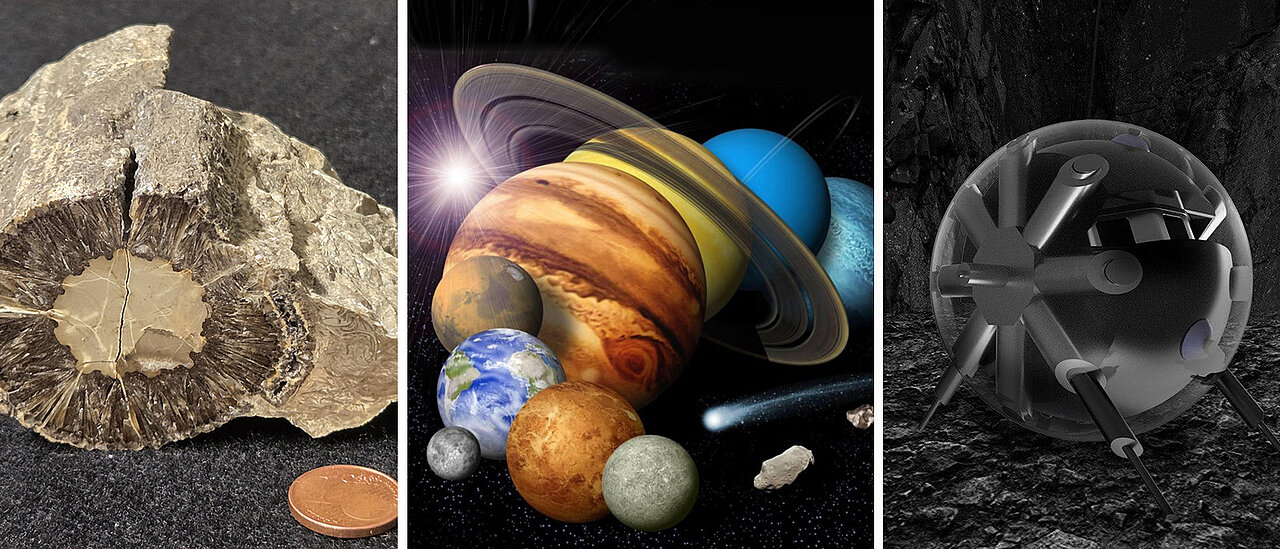
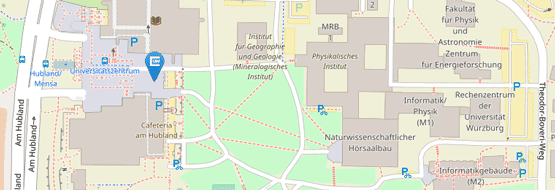
The series of events at the Mineralogical Museum on the Hubland Campus begins on Wednesday, 4 March 2026, at 7 p.m.: Joachim Lorenz from Karlstein will give the lecture "Fossil wood from the Main (catchment area)" that evening (in German). Admission is free; donations are possible.
When trees die and do not rot, their organic components are fossilised. This is also known as fossilised wood because the original structure of the wood remains fossilised. Fossilised wood can be found all over the world; in Germany, the Thuringian-Saxon regions and Rhineland-Palatinate are particularly well known for finds. The speaker will show that there are also large deposits in southern Germany, particularly in the sedimentary deposits of the Keuper, which were transported by the rivers Main, Neckar and Danube. After the lecture, there will be an opportunity to visit the museum and its display cases on fossilised wood.
Family Sunday: Discover our solar system!
Go on an exciting journey through our solar system and discover its planets and other celestial bodies: How long has the solar system been around and how old is the Earth? Has the Earth always had a moon? And what does a meteorite smell like?
Parents and children can find out all this and more at the Mineralogical Museum's Family Sunday on 8 March 2026 from 2 pm to 5 pm. Guided tours take place at 14:15 and 15:30.
Admission costs 4 euros per person aged 6 and over; families with more than one child pay 15 euros.
Lunar research: New paths in robotics
Jasper Zevering and Maximilian Gmöhling from the Robotics Chair at the University of Würzburg will give the lecture "New approaches to robotics in lunar research" (in German) on Wednesday, 11 March 2026, at 7 p.m. in the Mineralogical Museum. Admission is free; donations are possible.
Lunar research is in a state of flux. Driven by technological innovations, increasing commercialisation and a new experimental approach by international space organisations such as ESA (European Space Agency) and NASA (National Aeronautics and Space Administration), completely new perspectives are opening up - especially from the point of view of robotics.
The presentation will focus on robotic systems that combine scientific, technological and economic objectives. The speakers will show how fields of activity in space travel are being redefined and why a rethink is taking place in research. Using the spherical robot Daedalus as an example, the Würzburg researchers will describe how lunar caves are to be mapped in the future, for example to search for resources such as water ice. They will also present optical cameras for the non-invasive analysis of moon rocks.
After the lecture, interested parties can visit the special exhibition "Moon Impact - How the Moon was formed" in the museum. The exhibition has been extended until 3 May 2026.
Weblink
Mineralogical Museum of the University of Würzburg