
How teachers set change in motion
03/03/2026Pupils can also think and act in a sustainable and socially entrepreneurial way. A new anthology shows how teachers can teach them these skills.
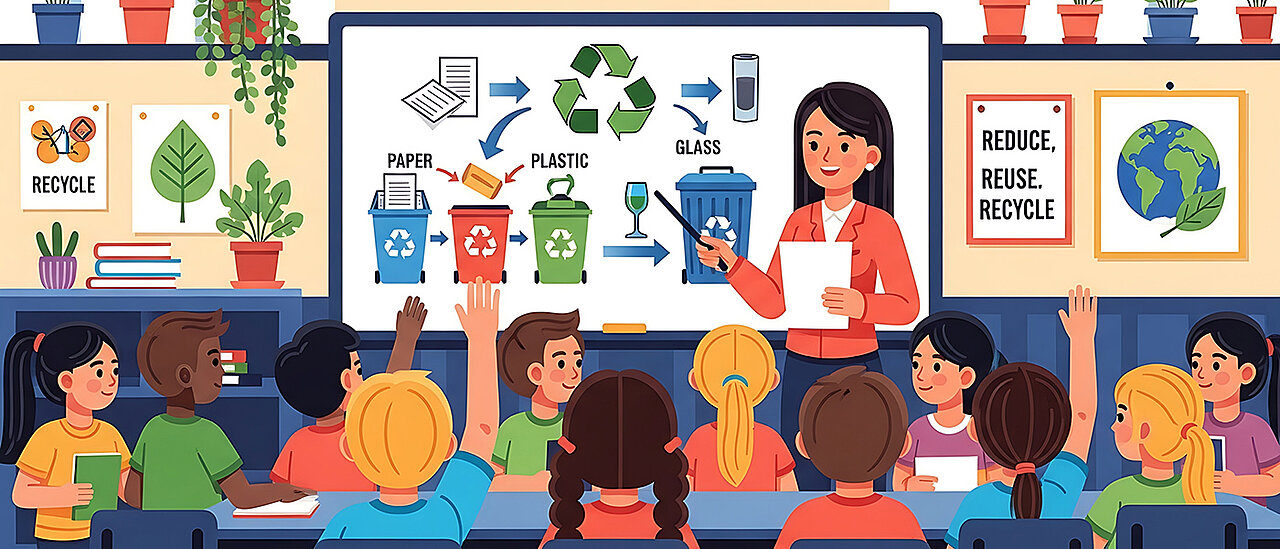
Climate change, scarcity of resources and social inequality: the challenges currently facing humanity are huge. It is therefore important to enable young people to play an active and responsible role in shaping their future. The training of future teachers has an important role to play here.
This is precisely where a newly published anthology comes in. Its title: "Lehrkräftebildung für nachhaltige Entwicklung. Bildung für nachhaltige Entwicklung und Social Entrepreneurship Education verknüpfen" (Teacher training for sustainable development. Linking Education for Sustainable Development and Social Entrepreneurship Education). The volume was produced as part of the "Teachers as Changemakers (TaC)" project at Julius-Maximilians-Universität Würzburg and Otto-Friedrich-Universität Bamberg. It brings together conceptual developments in German-speaking countries and shows how Education for Sustainable Development (ESD) and Social Entrepreneurship Education (SEE) can be systematically interlinked.
Developing answers to the questions of our world
The central idea is to see teachers as "changemakers", i.e. to see them as creators of learning spaces in which pupils analyse social challenges and independently develop solutions. "With this anthology, we are educating and supporting prospective teachers to engage with ESD and SEE during their studies so that they can later develop answers to the questions of our world with pupils in their profession," explains Professor Thomas Trefzger, Director of the Professional School of Education at the University of Würzburg and one of the editors of the anthology.
The volume makes it clear that ESD and SEE not only complement each other, but also develop a special synergy in their combination: While ESD focuses on guidelines, competences and problems of sustainable development, which are also anchored in curricula and educational policy guidelines, SEE expands this perspective to include concrete learning goal-related and methodological-didactic elements. In this way, sustainability-related competences are translated into action-oriented, socially entrepreneurial thinking and acting, which in turn creates added value for others in a way that is oriented towards the common good and innovation.
"Future skills" as a central task of schools
The volume is also dedicated to the concept of "future skills". These will become increasingly important in the coming years, ranging from intercultural competences to problem-solving skills and digital competences. They are seen as crucial for the future professional success of young people.
"The anthology successfully addresses the topic of 'future skills', which the OECD sees as a central future task for schools," emphasises Dr Matthias Erhardt, Managing Director of the Professional School of Education. The combined approach of ESD and SEE thus offers a practical framework that strengthens responsible thinking as well as entrepreneurial and socially innovative competences.
The contributions from academia and practice shed light on theoretical principles, empirical findings and specific teaching and learning formats. At the same time, the volume documents an intensive collaboration between various experts. "Working with many dedicated colleagues from all over Germany has visibly deepened our network and transformed numerous ideas into viable concepts," says Dr Moiken Jessen, co-editor of the anthology.
About the joint project "Teachers as Changemakers"
The joint project "Teachers as Changemakers" at the Universities of Bamberg and Würzburg aims to strengthen teachers as active co-creators of sustainable development and to structurally anchor corresponding concepts in teacher training. At the University of Würzburg, the start-up support at the Service Centre for Research and Technology Transfer and the Professional School of Education are involved in the project.
Further information
The anthology has been published as an open access publication by wbv Media. The editors are Anna Benning, Moiken Jessen, Karl-Heinz Gerholz, Miriam Hess, Matthias Erhardt and Thomas Trefzger. It can be downloaded here free of charge.
More information about the project
Contact
Dr Korinna Thiem; Department 1.5 Service Centre Research and Technology Transfer,
T +49 931 31-89957, korinna.thiem@uni-wuerzburg.de