
Bavaria’s Minister for Digital Affairs praised JMU’s strength in AI research
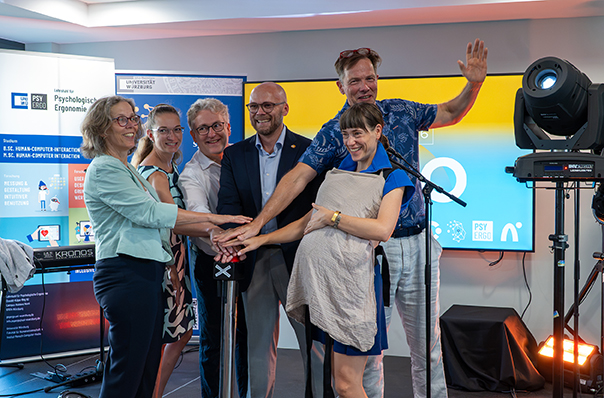
07/28/2026A showcase of technical achievements, a symbol of the spirit of research and a networking platform: the University’s Summer EXPO 2026 demonstrated just how capable Würzburg is as a centre for AI.
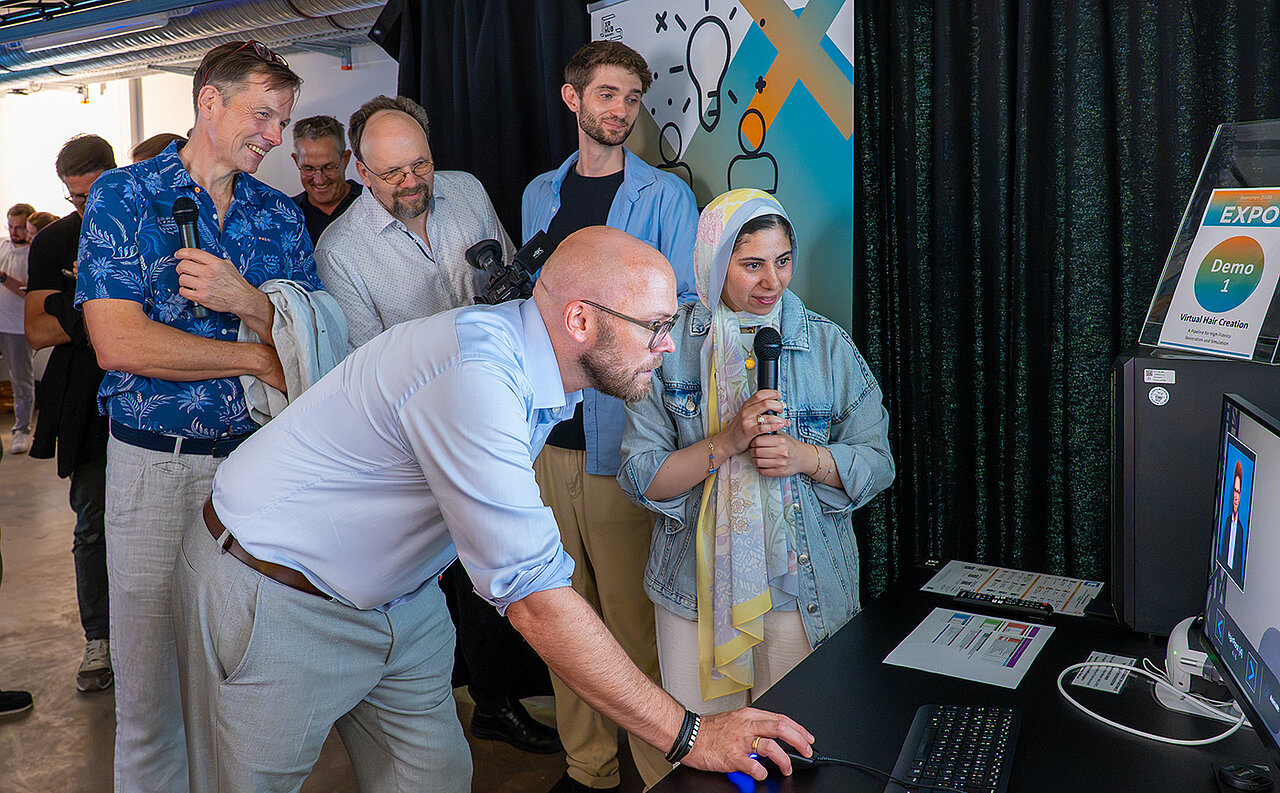
Julius-Maximilians-Universität Würzburg (JMU) stands out in international rankings as one of the world’s leading centres for research and development in Extended Reality (XR) combined with Artificial Intelligence (AI): “Cutting-edge research in these fields isn’t taking place just anywhere in the world, but right here in Würzburg,” emphasised Bavaria’s Minister for Digital Affairs, Fabian Mehring, in his opening address at the launch of the Summer EXPO 2026. With top rankings in Germany and Europe, as well as first place in the global comparison, JMU is setting new standards in this field.
At the Centre for Artificial Intelligence and Data Science (CAIDAS) on the Hubland North Campus, the Minister praised the outstanding commitment of the numerous students and researchers present: “You are a global beacon and a flagship for research in this field!”
JMU as a flagship in XR/AI research
At the annual Summer EXPO, anyone interested can explore research projects and dissertations in the fields of AI and XR, engage in conversation with students, researchers, alumni and partners from business and politics, and find out about the use of AI in science and teaching at the Würzburg campus: “JMU is in the process of embedding AI and related technologies at the heart of all sectors – in teaching, learning and the organisation of academic life,” said Professor Marc Erich Latoschik, Head of the Chair of Human-Computer Interaction at JMU.
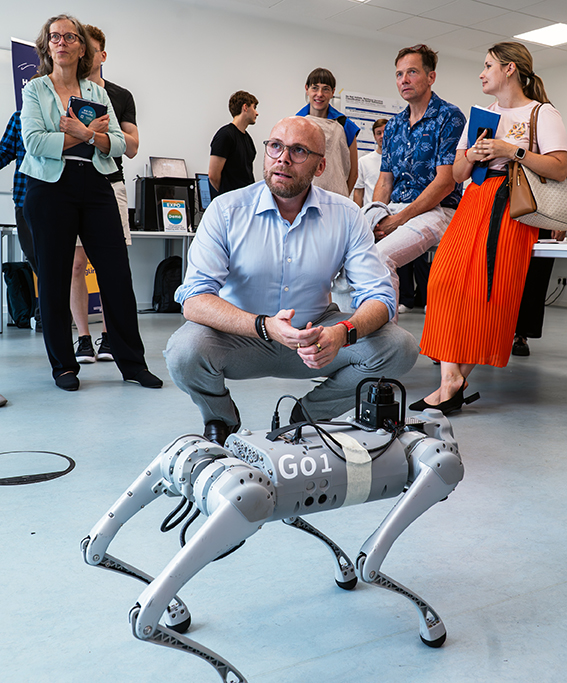
As an example of an AI application in higher education, Würzburg-based researcher Lewe Lorenzen demonstrated his app ‘Pussel’ to the EXPO guests. The programme was developed during his Master’s degree in Human-Computer Interaction at the Chair of Psychological Ergonomics at JMU. ‘Pussel’ analyses complex academic texts and reproduces them in a simplified form, whilst remaining scientifically accurate. ‘This helps students like myself who have dyslexia and for whom reading is a challenge. In a study, we demonstrated that Pussel significantly reduces stress levels among users,” says the developer. Pussel also enables users in research or journalism to familiarise themselves easily with complex subject areas outside their own field of expertise.
Research and AI in the scientific process
According to Professor Carolin Wienrich , the use of AI in academia is often criticised too hastily. She emphasised: “It is people who create knowledge! AI can help to convey and apply it. And if we harness these synergies in a positive way, we gain a tangible benefit for society,” says the head of the Chair of Psychology of Interactive Systems at JMU.
As an example of its application, she demonstrated AI-supported video training sessions for challenging conversational situations. “We all face difficult conversations from time to time, whether in a relationship, at work or even in unfamiliar situations,” explained the professor. “Here, we train AI systems using scientific findings so that they act as particularly challenging conversation partners. This allows people to practise dealing with such conversational situations. The AI provides personalised tips and expert feedback.”
Building bridges between science, business and the public
The Summer EXPO is designed not only to spark enthusiasm for technology, but also to bring people and the spirit of research together: “This is where students, researchers, alumni, partners from business and politics, and guests come together. They are all united by a curiosity about new ideas,” said JMU Vice-President Doris Fischer. “Many of our alumni are now applying the knowledge they gained at the university in companies, research organisations and institutions both at home and abroad.”
Take Dr Maximilian Landeck, for example, who completed his PhD in Human-Computer Interaction at JMU. He now works in research and development at MA Lighting International GmbH in Waldbüttelbrunn, a company that develops lighting systems for event stages. “I took the spirit of research with me from the university and am now working on projects with JMU students, amongst other things, to simplify the control of highly complex lighting systems using AI and virtual representations.”
Fascinating insights into pioneering research
With over 50 projects spanning the fields of human-computer interaction, artificial intelligence, extended reality and psychology, the JMU Summer EXPO 2026 clearly demonstrated the innovative strength of Würzburg as a centre of science.
At the same time, it provided a networking platform for students, researchers and representatives from business and politics, and underlined the importance of interdisciplinary collaboration and the support of early-career researchers as the foundation for the digital future of science and society.
Award-winning student projects
At the EXPO, students were recognised for their work.
From the Games Engineering degree programme:
- Samuel Kienle: Surrounded
- Adham Salem and Julian Fambach: GrandMA’s Muscle Memory
- Marie Schramm: Trigger Rush
- Daniel Gottschalk: Real and Virtual Robots in Games
From the field of Human-Computer Interaction:
- Nicole Dering: Diversity, Equity and Inclusion Training in Virtual Reality with Intelligent Virtual Agents
- Nathalie Weger: One Screen, Many Eyes: A Research-through-Design Study of Communication in Robot-Assisted Surgery
Participating institutions and partners
Numerous departments and institutions at JMU were involved in the design and presentation of the Summer EXPO 2026, including research groups from Human-Computer Interaction, Psychology of Interactive Systems, Chair of Psychological Ergonomics, Games Engineering, Theory of Machine Learning, Robotics, Computer Engineering, Satellite Communication and Radar Systems, Reinforcement Learning and Computational Decision-Making, Natural Language Processing, Socially Interactive Agents and the Computer Vision Laboratory.
The event was made possible thanks to the support of: XR HUB Bavaria, the Mainfranken Centre for Digital Innovation (ZDI), MA Lighting, the technology company Körber, the Human Dynamics Centre at JMU, the Faculty of Human Sciences at JMU, and the Institute of Computer Science at JMU.
Additional images