
Understanding physics and technology through cars and eggs
06/16/2026Teacher training students at the University of Würzburg have developed learning stations for a school science day. The aim was to spark pupils’ enthusiasm for STEM subjects through collaborative experimentation.
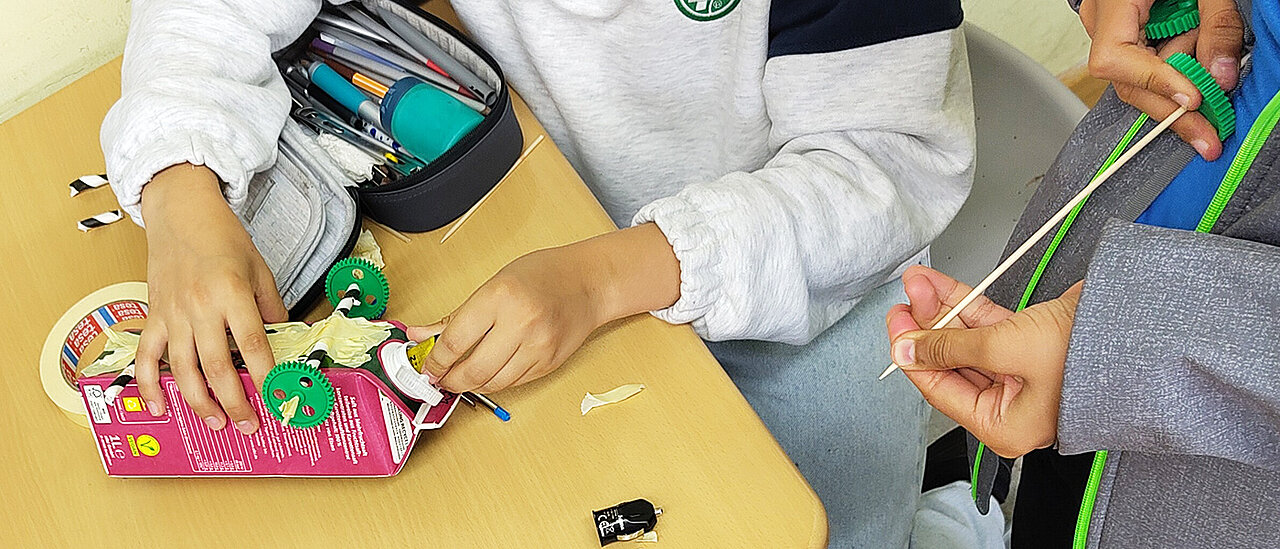
Building car models that roll as far as possible, and fitting eggs with impact protection that allows them to survive a fall unscathed – all using just a few everyday materials: This was the challenge faced by around 40 pupils from Jakob-Stoll-Realschule during Research Day on 9 June 2026. The tasks had been developed by teacher training students at the University of Würzburg.
They had spent weeks preparing for this in the seminar ‘Hands on: Planning and Supporting a School STEM Action Day’ – a seminar offered by the university as part of the ‘Teachers as Changemakers (TaC)’ project. The students’ task was to work in groups to design STEM learning stations where pupils could experience and understand STEM phenomena through a high degree of independent activity and a spirit of inquiry. STEM stands for Science, Technology, Engineering and Mathematics.
“Practical experiments relating to the children’s everyday lives form an important foundation for understanding scientific or technical topics. And this also boosts motivation to engage with STEM topics in the long term and to stop seeing them as impenetrable,” says Dr Korinna Thiem, coordinator of the TaC project at the University of Würzburg’s Research & Technology Transfer Service Centre, explaining the importance of such research days.
Several stages to a successful prototype
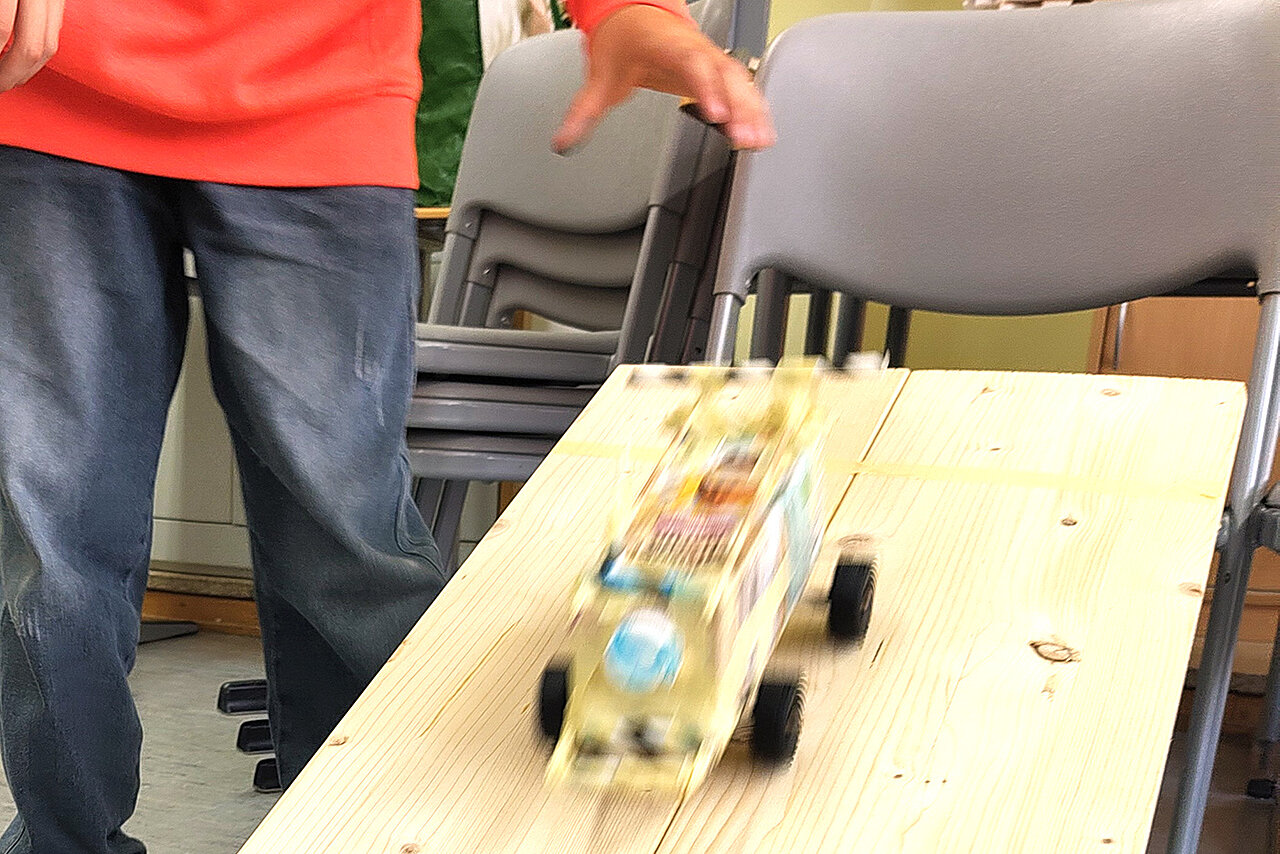
At the ‘Car Building’ station, everything revolved around axles and wheels. The task was to construct a vehicle from Tetra Paks and a few everyday materials that would drive down a ramp as straight as possible and then roll a long way.
During the first construction phase, many creative vehicles were created, including a three-wheeled car and a spider car that drives up walls. Rear spoilers, number plates and other decorations were, of course, a must. First, the children tested their prototypes and deduced which features enabled the car to drive down the ramp quickly and in a straight line. And indeed: the refined vehicles from the second construction phase met the criteria of ‘straight’ and ‘fast’ significantly better.
In a third step, the children methodically investigated how the distance between the axle and the ground, different types of wheels and also different surfaces affect the distance covered. Some assumptions were confirmed – cogwheel-type wheels get caught in the carpet, cars with rubber wheels are fastest on smooth surfaces – and some were disproved. “This allowed the children to learn in a playful way what role friction plays in the movement of a vehicle, when it is desirable and when it is not,” says Maja Freymuth, a project assistant at the Professional School of Education, summarising the children’s learning experiences.
The relevance to the children’s everyday lives was obvious: why do cars have soft rubber tyres and inline skates have hard ones? How could you move a car on ice? And what would happen if we replaced our bicycle tyres with wooden discs?
Bags as parachutes and sponges as shock absorbers
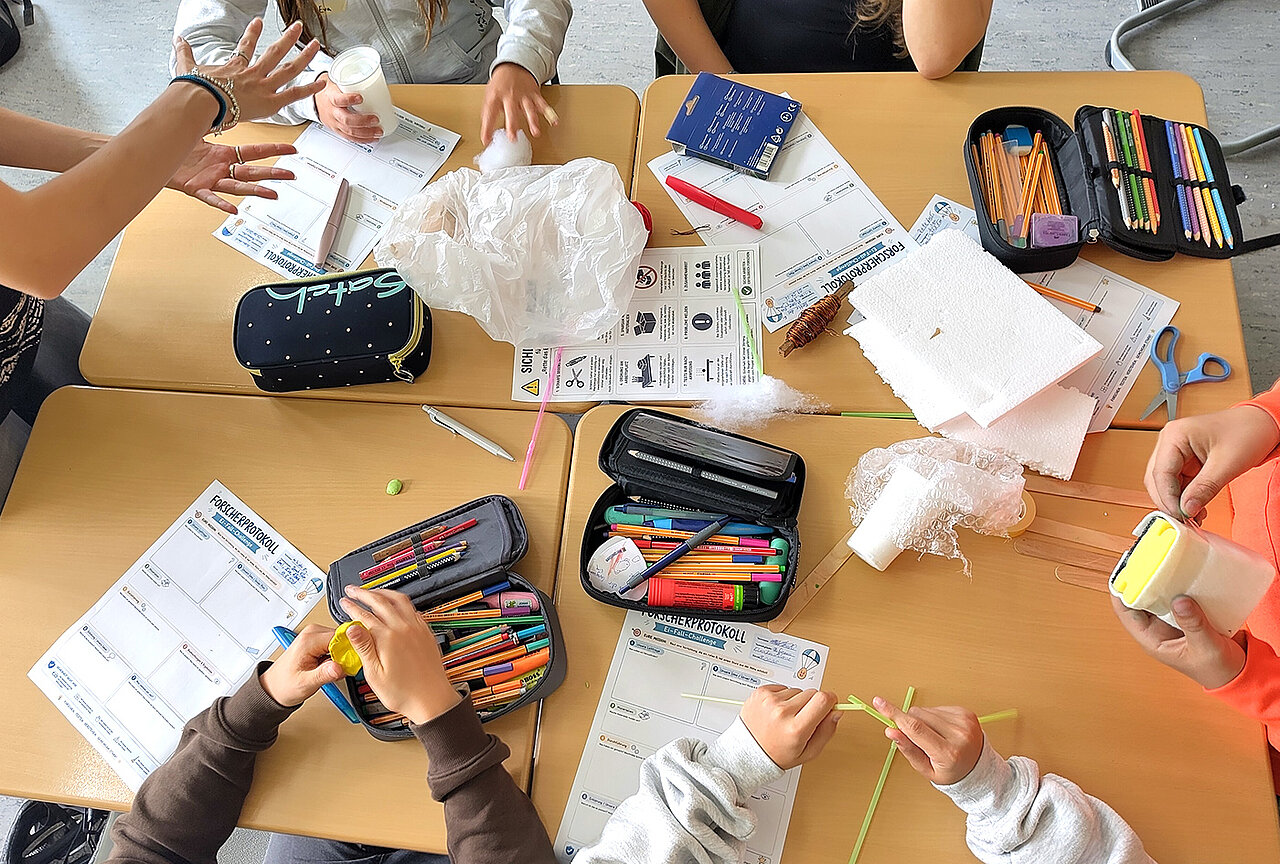
Inventive spirit and clever solutions were called for at the ‘Egg Experts’ station: the task was to protect an egg so that it would survive a fall from the first floor unscathed. Unlike at the car-building station, the children had unlimited materials at their disposal here. However, the sustainability of the design was also a criterion for building the protective device.
Teams worked hard on their designs: whether using plastic bags as parachutes, bubble wrap and sponges for shock absorption, or sturdy protective structures made of cardboard – the children drew on their everyday knowledge, developed creative ideas and combined different strategies. This resulted in numerous individual solutions to the same challenge. It was particularly exciting to drop the structure from the first floor and unwrap the egg afterwards. The children were on the edge of their seats, hoping that their egg had remained undamaged. In most cases, they were able to cheer: seven out of nine groups had managed to protect the egg sufficiently!
The research day was framed by a joint introduction and a joint reflection.
“Teachers as Changemakers (TaC)” is a joint project between the Universities of Würzburg and Bamberg. It aims to bring social entrepreneurial thinking and action into schools through teachers and trainee teachers acting as multipliers, thereby bringing about lasting change in the world of tomorrow. At the University of Würzburg, the Start-up Support Unit at the Service Centre for Research and Technology Transfer and the Professional School of Education are involved in the project.
Contact
Dr Korinna Thiem; Service Centre for Research and Technology Transfer, T +49 931 31-89957; korinna.thiem@uni-wuerzburg.de
Additional images