
Stefan Silbernagl: The University Archives have catalogued the Professor's papers
06/23/2026A researcher’s life in 21 boxes: anyone who opens the lids of the archive boxes in the University Archives will encounter the spirit that drove Stefan Silbernagl, a professor of medicine, for more than 20 years.
Over the decades, ‘Der Silbernagl’ has passed through the hands of countless medical students. This refers to the standard opus "Textbook of Physiology", which was co-authored by the Würzburg Professor Stefan Silbernagl (1939–2025).
Work on the book was not the professor’s only publishing activity. He was also a member of the editorial board of the specialist journal "Physiologie". Meeting minutes, manuscripts, plans for future issues: the Würzburg University Archives has now catalogued what went on behind the scenes in this role.
The documents form part of the extensive academic estate which the University Archives took over from the Institute of Physiology following the death of the renowned physiologist. Time and again, the archives team handles such estates left by members of the university community, processes them and makes them accessible to researchers.
Renowned kidney and membrane researcher
Stefan Silbernagl held the Chair of Physiology at the Faculty of Medicine from 1981 to 2004. His research focused on renal and cell physiology. He received numerous honours for his outstanding achievements; in 2015, JMU awarded him the "Bene merenti" Medal of Merit in gold. For eleven years, the professor served as spokesperson for a DFG Collaborative Research Centre investigating signal transduction and mass transport across membranes.
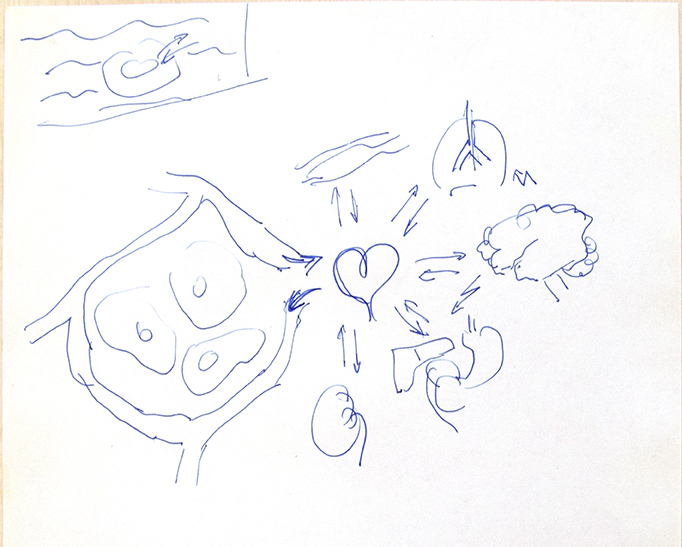
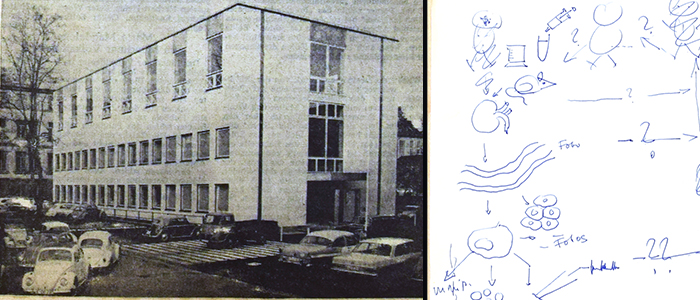
His estate contains, amongst other things, hand-drawn sketches relating to this field of research, in which he illustrated the processes taking place at cell membranes. Also worth seeing: a photo album compiled by staff from the institute and the university building authority to mark the completion of the institute’s extension in 1963. The picture on the first page shows the new building, and its car park features several popular car models of the time.
Currently 50 estates in the University Archives
It took the University Archives team three months to catalogue the physiologist’s estate. The result fills 21 archive boxes, each about the size of a shoebox. This makes the Silbernagl estate one of the more extensive in the archive – most of the other 50 estates currently held consist of significantly fewer items and often fit into an A4 folder.
The Silbernagl collection comprises laboratory notebooks containing experimental analyses, folders with lecture manuscripts, minutes of meetings and conferences, documents relating to the chair, materials on the German Physiological Society and photographs. Correspondence with universities and other institutions both in Germany and abroad demonstrates the extent of Silbernagl’s international network.
Preserving university history
When processing estates, the archive staff carefully examine every single item. They then pack everything into folders and boxes made of acid-free material so that it will stand the test of time, and create a digital catalogue that makes it easy to locate the documents. In this way, they facilitate a wide variety of research projects and preserve a piece of the university’s history.
Web link: Würzburg University Archives
Additional images