
Digital simulation against climate change
03/31/2026As a hotspot of climate change, Würzburg faces particular challenges. Countermeasures are made more difficult by a lack of planning tools. A multidisciplinary project is working on a digital solution.
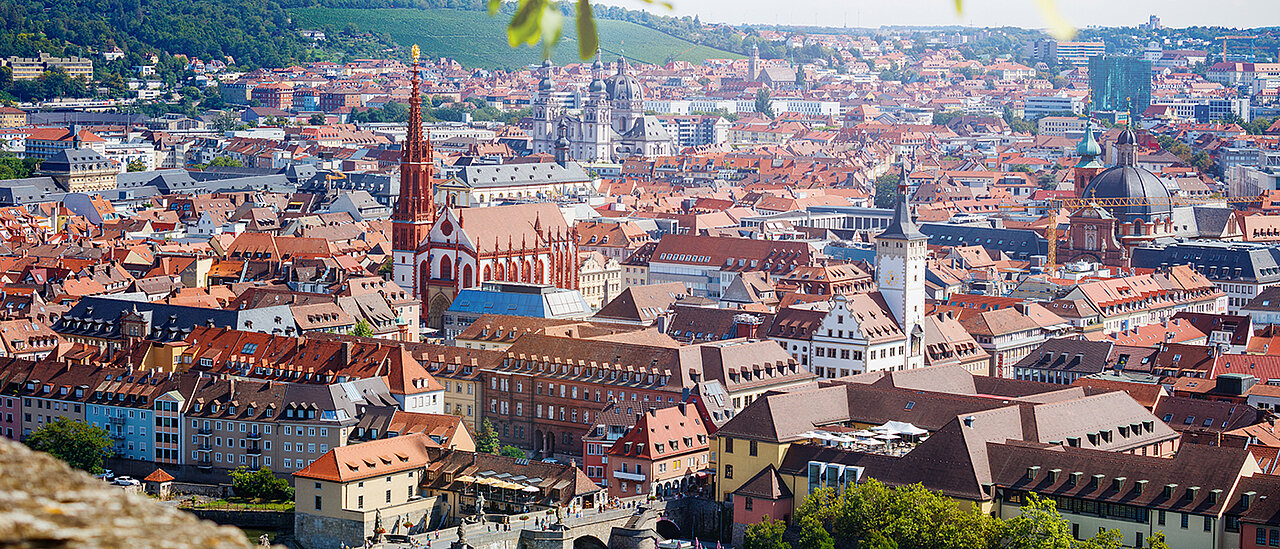
Climate resilience is becoming increasingly important in modern urban planning, especially when it comes to adapting to extreme weather events, reducing risks and applying ecosystem-based approaches.
One problem: measures often have to be planned in a resource-intensive and precise manner using existing planning tools and capacities. The solution: a digital planning tool with an integrated urban climate model. This is exactly what is currently being developed at Julius-Maximilians-Universität Würzburg (JMU). In the SMART-TWIN project, three chairs are developing the PALM-4U urban climate model in collaboration with the City of Würzburg. The project is led by Professors Heiko Paeth (Climatology), Andreas Hotho (Computer Science) and Tobias Ullmann (Earth Observation).
As an extension of the existing digital twin of the city of Würzburg - which comprises extensive 3D data sets and tools for automatically analysing various data - the project aims to enable the city of Würzburg and cooperating planning offices to evaluate the urban climate impact of urban planning in a time- and cost-efficient, flexible and user-friendly manner.
The European Regional Development Fund (ERDF) has been funding SMART-TWIN with EUR 1.35 million over three years since October 2025.
Würzburg as a hotspot for climate change
Würzburg is a hotspot of climate change in Central Europe and is characterised by a striking urban heat island - favoured by the dense development and the low proportion of greenery. This makes the city the perfect location for the pilot study for the innovative approach.
The project combines AI and big data technologies with a novel combination of scenario levels in the digital twin. In addition to real or potential construction measures, changes to the green and blue infrastructure - i.e. green spaces and bodies of water - can be assessed in terms of their impact on the urban climate under different weather conditions in the present and future. The effects of possible extreme weather events can also be simulated.
This makes planning processes more precise, faster and more cost-effective. Not only municipal companies and offices will benefit, but also other Bavarian cities on their way to climate resilience and sustainability. The project is to be transferred to the latter in the long term.
Multidisciplinary approach to the goal
The three JMU chairs are working closely together. The climatology department is responsible for adapting and operating the PALM-4U urban climate model and for developing and integrating the various scenarios.
The remote sensing team uses satellites and drones to thermally map the urban area in order to validate the urban climate model more comprehensively.
The data science team is working on AI algorithms to improve the model's performance.
SMART-TWIN is being carried out in collaboration with the City of Würzburg under the leadership of the Building Department (Civil Engineering and Transport Department, Geodata and Surveying Department) and the Environment and Climate Department (Climate and Sustainability Unit). Their extensive experience with the city's Digital Twin, including the complex data sets and planning processes relevant to urban climate, play a central role. The project is also working with 20 small and medium-sized enterprises from the urban planning sector.
ERDF and ESF at the University of Würzburg
The researchers were supported by the Service Centre for Research and Technology Transfer (SFT) in submitting and preparing the project application. The SFT advises JMU researchers on applying for European ERDF and ESF funding. The term ERDF stands for European Regional Development Fund and ESF for European Social Fund. These funds are the EU's most important instruments for strengthening economic, social and territorial cohesion.
Contact
Prof Dr Heiko Paeth, Climatology working group, Tel: +49 931 31-84688, e-mail: heiko.paeth@uni-wuerzburg.de