
A search among ten quadrillion DNA molecules
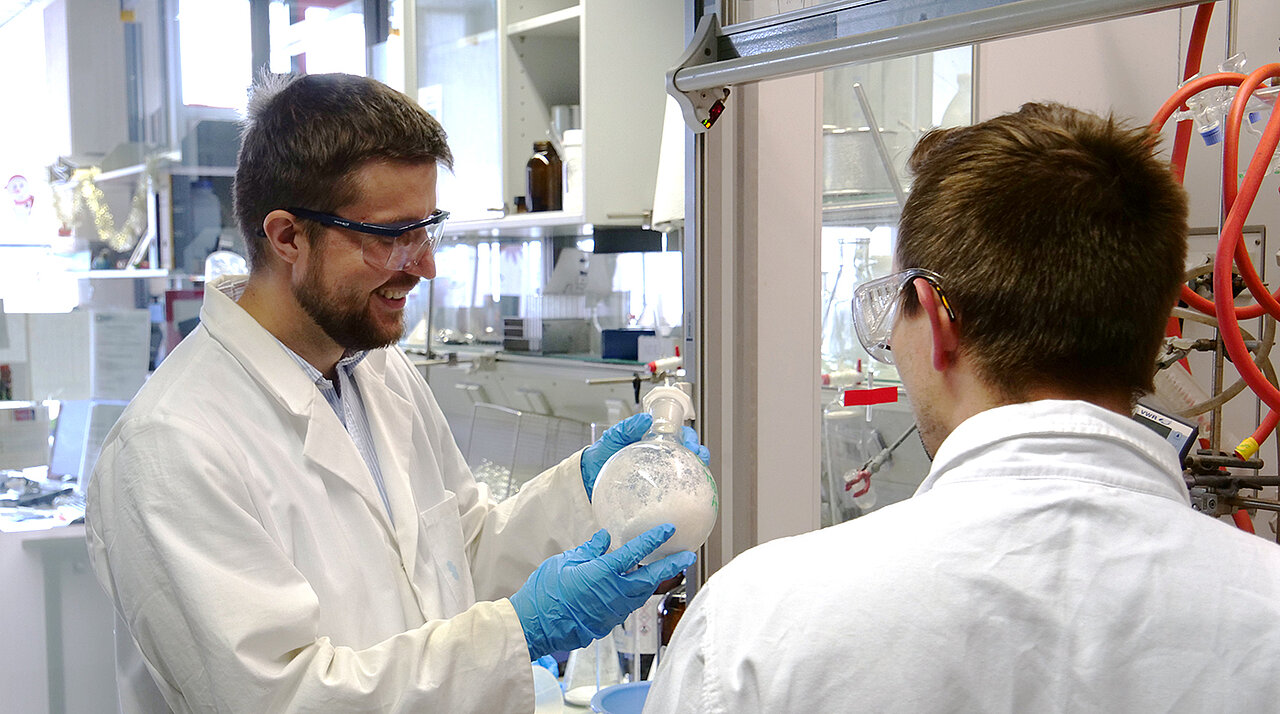
05/26/2026DNA molecules as sensors for new drug discoveries: this is the focus of Dr. Martin Volek’s research. The chemist is currently at the University of Würzburg on a Humboldt Fellowship.

Deoxyribonucleic acid (DNA) carries human genetic information. It serves as a repository for genetic traits in the cell nucleus and contains the blueprint for protein synthesis in cells. But DNA can do even more: it can also catalyse chemical reactions.
This potential of nucleic acids (RNA, DNA) was discovered in 1980 by the American chemist Thomas Cech. Shortly thereafter, researchers developed a method called in vitro selection or otherwise artificial evolution that makes it possible to identify molecules of RNA or DNA that can catalyse specific chemical reactions.
Dr. Martin Volek’s research is based on in vitro selection method. The scientist, who is originally from the Czech Republic, is currently a visiting researcher in the research group of Professor Claudia Höbartner, head of the Chair of Organic Chemistry I at Julius-Maximilians-Universität Würzburg (JMU). His stay is made possible by a fellowship from the Alexander von Humboldt Foundation.
A sensor for distinguishing between DNA modifications
The goal of Dr. Volek´s project is to isolate DNA molecules, which will be able to distinguish between methylated and un-methylated state of two bases of DNA (Cytosine and Adenosine). “If I am successful, this will give us tools how to better study DNA methylation enzymes. DNA methylation is crucial epigenetic modification. Mistakes and dysregulation in DNA methylation are often linked to cancer”, explains Volek.
Catalytic DNA molecules are like a Swiss army knife, says the Humboldt Fellow. The molecules are not a cure, but they could increase the chance for survival. The challenge of the project lies in finding the right DNA molecule. “In a typical in vitro selection experiment, we start with ten million times a billion of random DNA molecules. In the end, we want just one DNA molecule, but with the desired catalytic function”, says Volek
The research group of Professor Höbartner has used in vitro selection to isolate first methyl transferase ribozyme – an RNA molecule, which is able to methylate another RNA molecule. Moreover, they have also isolated DNA molecules, which were able to detect RNA methylation. “The knowledge and the track record is already in the group, which gives me hope for the research,” says Volek.
A successful search
Martin Volek has already demonstrated at the Czech Academy of Sciences that the search for catalytic DNA molecules can be worthwhile. By using in vitro selection, he discovered two DNA molecules capable of generating fluorogenic and colorimetric signals. “I named one Aurora, after the Roman goddess of twilight, and the other Apollon, after the Roman god of light. Aurora emits purple light and Apollon generates yellow colour,” explains the Humboldt Fellow.
Moreover, Dr. Volek built a sensor that harnesses the property of Aurora. He focused on an enzyme (Nsp15) from the coronavirus (SARS-CoV-2). The Aurora sensor was inert, but if the enzyme was present in the solution, Aurora produced purple light. This sensor was later used to find the inhibitors of the enzyme in high-throughput screening, where thousands of small molecules were tested. These inhibitors could serve as the basis for new antiviral drugs. According to the chemist, Aurora and Apollon could also help in development of a new generation of virus tests.
About the Humboldt Fellow
Martin Volek was born in Pilsen (Czech Republic). He earned his Ph.D. in molecular biology from Charles University in Prague. While still a student, Volek began working in the Institute of Organic Chemistry and Biochemistry at the Czech Academy of Sciences, where he shifted his research focus from cell biology to chemical biology.
The reason for his change of field was Volek’s fascination with the origins of life and the RNA world hypothesis: “I’m fascinated and still puzzled by the fundamental question. How was life as we know it created and how did it look at the early beginnings of Earth?” According to the RNA world hypothesis, at one point of the evolution, the life was based purely on catalytic nucleic acids. “For this reason, I find isolation of new catalytic nucleic acids so fascinating. It gives us some clues for this ultimate puzzle of life”, says the scientist.
Martin Volek has received several awards for his doctoral study on Aurora and Apollon, including the 2025 Česká hlava (Czech Head) Prize in the natural sciences category. This is considered the highest scientific honour in the Czech Republic.
Martin Volek has been at JMU since April 2025. His Humboldt Fellowship began on October 1, 2025, and will run for two years.
Contact
Dr. Martin Volek, Chair of Organic Chemistry I, T +49 931 31-86091, martin.volek@uni-wuerzburg.de
Additional images