
Science Slam 2026: Girl Power on stage
11/24/2026A T-Rex, 4,000-year-old music and a climate lawsuit in court: at the Science Slam 2026, six female scientists and one male scientist presented their research to a sold-out audience. The dinosaur took the prize.
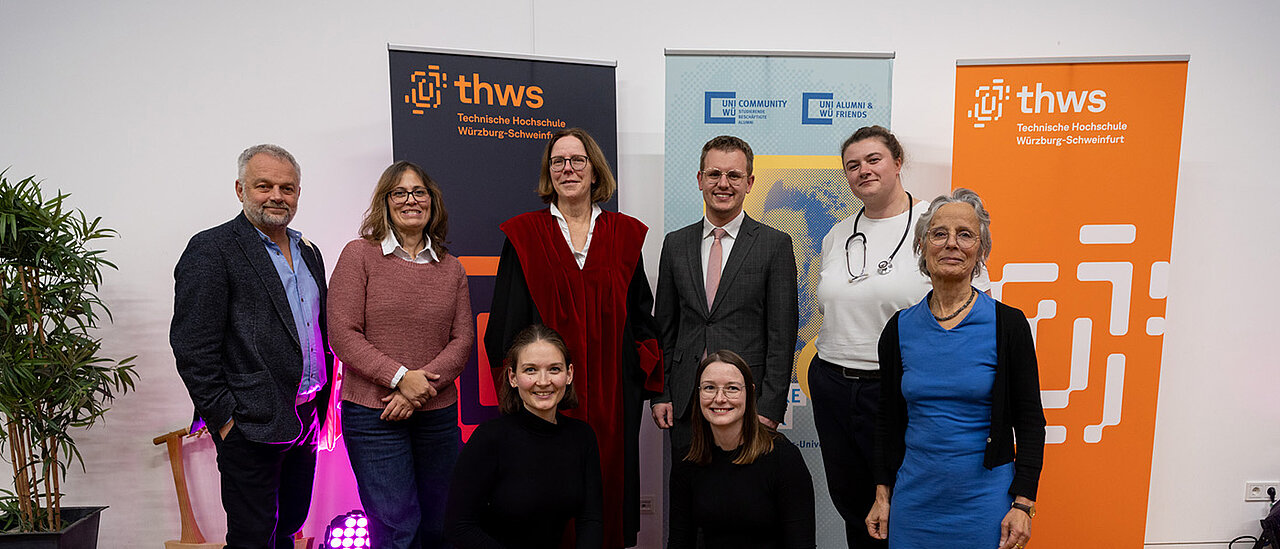
Science on stage, explained in an accessible way and with a good dose of humour: at the Science Slam 2026 on 13 November, the audience enjoyed an evening of unusual insights into a wide variety of research fields. The joint event organised by the Julius-Maximilians-Universität Würzburg (JMU), the University of Applied Sciences Würzburg-Schweinfurt (THWS) and the City of Würzburg was once again sold out.
There was already a first in terms of the line-up: for the first time in the history of the Würzburg Science Slams, there were six female scientists and just one male scientist on stage. Their topics ranged from music archaeology and cardiac diagnostics to climate litigation, chronic inflammatory bowel diseases and suicide prevention.
Dr Isabell Ramming, last year’s winner, kicked things off. She presented her winning entry from 2025 once again and even brought along a bacterium so that the audience could come into direct contact with it.
A musical journey to ancient Mesopotamia
What did music sound like 4,000 years ago? Professor Dahlia Shehata, an alumna of the University of Würzburg now based in Heidelberg, provided an answer to this question. She specialises in the music of ancient Mesopotamia and, as part of her research, studies cuneiform texts on clay tablets, amongst other things. By deciphering these, she succeeded in reconstructing notes and melodies from around 4,000 years ago. Using musical instruments she had brought with her, she brought this millennia-old music back to life for the audience.
Professor Frank Schwab from the University of Würzburg demonstrated that even serious topics are suitable for a Science Slam. He addressed the question of what role the media play in dealing with suicide risk and how they can contribute to suicide prevention.
Climate offenders in court
Can companies be held liable for the consequences of climate change? Professor Eva-Maria Kieninger from the University of Würzburg explored this question. Together with her assistant, she staged a fictional court case against the so-called ‘carbon majors’. This term refers to around 100 companies responsible for a significant proportion of global greenhouse gas emissions. The focus was on whether, and under what conditions, these companies can be held accountable for climate damage.
From the legal arena, the focus then shifted to medical training. In her presentation ‘Please take a deep breath … you might just be healthy!’, Susanna Götz from THWS introduced digital learning applications. Using cardiac diagnostics as an example, she demonstrated how trainee doctors can practise auscultating the heart with the aid of Extended Reality (XR). This involves combining real and virtual environments.
Dr Daniela Tausch described just how exhausting it can be when you can hear but do not understand everything. The Würzburg alumna, who is herself affected by hearing loss, took the audience on a journey – both personal and humorous – through the world of misunderstandings, tinnitus and cochlear implants. Her talk highlighted just how much work the brain does when it comes to hearing and understanding.
A T-Rex takes the prize
Jessica Kümmel from Würzburg University Hospital provided what was arguably the most unusual performance of the evening. Dressed in a dinosaur costume, she explained – under the title ‘When a T-Rex drives a sports car: a treatment for chronic inflammatory bowel disease’ – what happens in the body in conditions such as Crohn’s disease and ulcerative colitis.
Using numerous images, she illustrated how the immune system in the gut can become unbalanced. At the same time, she presented a promising research approach: the use of the body’s own cells to regulate the immune system, which could help treat chronic inflammatory bowel diseases in the future. Her blend of scientific content, humour and an unconventional presentation style won over the audience: Jessica Kümmel won the Science Slam 2026.
Experiencing science and nurturing young talent
JMU alumnus Johannes Keppner hosted the evening. The THWS media team handled the technical aspects.
As well as offering insights into current research topics, the evening had another positive outcome: the proceeds from ticket sales funded 2.5 Germany Scholarships. In this way, the audience’s enthusiasm also benefited student support.
Anyone wishing to attend the next Science Slam can already make a note of the date: on 12 November 2027, the motto in Würzburg will once again be ‘Clear the stage for science!’
Information on the next Science Slam and other events at the University of Würzburg is available via the university’s network.