

How a cloning fish avoids genetic decay
03/17/2026Amazon mollies manage to maintain a healthy genome even without sexual reproduction. A new study, in which a team from the University of Würzburg was involved, shows which mechanisms are responsible for this.
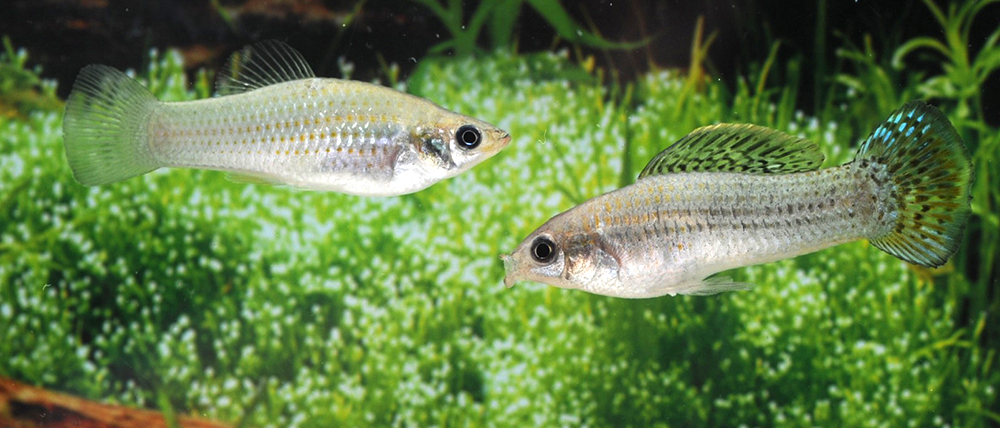
Amazon mollies(Poecilia formosa) are a remarkable species: all individuals are female and reproduce by cloning themselves. Although the females must mate with males of related species to initiate reproduction, the DNA of the males is not integrated into the offspring.
According to evolutionary theory, this unusual reproductive strategy should actually lead to the accumulation of harmful mutations in the genome over time and ultimately jeopardise the survival of the species. Nevertheless, Amazon mollies have existed for over 100,000 generations - which raises the question of how their genome remains healthy.
Publication in Nature
An international research team has now discovered how this unusual fish species avoids its "genetic decline". The first author of the study published in the journal Nature is Dr Edward Ricemeyer, a bioinformatician at LMU Munich; Professor Wesley C. Warren (University of Missouri) and Professor Manfred Schartl were responsible for the study. Until a few years ago, Schartl held the Chair of Physiological Chemistry at the University of Würzburg's Biocentre; he is currently continuing his research as a senior professor.
Their results show that Amazon mollies keep their genome intact through a genetic mechanism called gene conversion. This helps to eliminate harmful mutations without the usual recombination.
Gene conversion allows natural selection to continue to work
"In sexually reproducing species, recombination during reproduction helps to separate harmful mutations from beneficial ones so that natural selection can remove harmful variants," explains Manfred Schartl. In this process, the genes of the parents are recombined to create unique gene combinations. This increases the genetic diversity of the offspring and at the same time reduces the risk of genetic defects becoming established.
This mechanism is absent in a clonal species such as the Amazon molly. According to Schartl, only fish, amphibians and reptiles have asexual reproduction as a natural reproductive mechanism, as is the case with Amazon mollies. Of the total of around 45,000 species of "lower" vertebrates, asexual reproduction is only known in around 100 species.
Harmful mutations are overwritten
Using high-resolution genome sequences of numerous individuals, the researchers looked for signs of an accumulation of mutations and for the evolutionary factors influencing the genome. Instead of the expected genetic decay, they found numerous indications of gene conversion, a process in which a DNA sequence is copied over another, similar sequence. This process allows damaged gene variants to be replaced by intact copies.
"Gene conversion can effectively overwrite harmful mutations with healthy copies of the same gene," explains Edward Ricemeyer. This means that natural selection can also remove harmful mutations in a clonally reproducing line. However, this mechanism was not completely unknown: "Gene conversion is a mechanism that was discovered as early as 1930 and also occurs in sexually reproducing organisms, namely in meiosis," explains Manfred Schartl.
A genome that behaves more like a sexual species
The team's analyses suggest that gene conversion enables the spread of beneficial variants and the elimination of harmful mutations from the population, thus helping to maintain the overall integrity of the genome. "This was surprising, as clonal genomes are normally thought to decay gradually," says Ricemeyer. Instead, the research team discovered evidence that this species has a mechanism that keeps the genome remarkably functional.
The results suggest that despite their asexual reproduction, Amazon mollies retain some of the evolutionary advantages normally associated with sexual reproduction. "This fish appears to have the best of both worlds - the genetic health normally associated with sexual reproduction without needing the DNA of a male to reproduce," says Wesley C. Warren.
Insights into one of the biggest questions in evolution
The study not only explains the long-term success of Amazon mollies, but also provides answers to a fundamental question in evolutionary biology: Why are organisms that can only reproduce asexually more widespread than one would expect, even though they are relatively rare? "Our results show that evolution may have more ways of maintaining the health of the genome than previously thought," says Ricemeyer. The study of unusual systems such as Amazon molluscs helps science to understand the fundamental forces that shape genomes across the entire evolutionary tree of life.
Original publication
Gene conversion empowers natural selection in a clonal fish species. Edward S. Ricemeyer, Nathan K. Schaefer, Kang Du, Irene da Cruz, Susanne Kneitz, Rafael D. Acemel, Darío G. Lupiáñez, Rachel A. Carroll, Rosie Drinkwater, Manfred Schartl & Wesley C. Warren Nature (2026). https://doi.org/10.1038/s41586-026-10180-9
This text is largely based on the press release of the Ludwig-Maximilians-Universität München