
Consortium seeks breakthrough in nuclear clock technology
09/01/2026A new European research consortium, including scientists from Würzburg, wants to develop a radically new, ultra-precise reference for time and frequency: a compact nuclear clock based on thorium-229.
Quantum technology will shape the future of mankind, and Europe aims to play a leading role in its development. This is the goal of QuantERA, a transnational research funding network supported by the European Union.
The project ResonaTHOR – Resonator-based nuclear optical frequency reference, which has now been funded by QuantERA, brings together a European consortium led by Thorsten Schumm at TU Wien (Austria).
The partners aim to lay the foundations for a chip-scale nuclear clock that could one day provide extremely stable timing signals for communication networks, navigation, power grids, financial systems, fundamental research, and quantum technologies.
Participating teams are headed by Charles Roques-Carmes at ISTA (Austria), Lino M. C. Pereira and Sandro Kraemer at KU Leuven (Belgium), Kasper Van Gasse at Ghent University/imec (Belgium), Adriana Pálffy-Buß at the University of Würzburg (Germany), and Pascal Del’Haye at the Max Planck Institute for the Science of Light (Germany).
Precise timekeeping is important in many areas
Modern society depends on precise timekeeping. Mobile networks, navigation systems, data centres, power grids, high-frequency trading, and secure communication all rely on synchronised clocks.
In many cases, this synchronisation is supported by satellite-based timing signals such as GPS or other global navigation satellite systems. However, these signals can be affected by technical failures, interference, deliberate jamming, or spoofing.
Compact, highly stable local clocks could therefore make critical infrastructure more resilient by maintaining an accurate time reference when external signals are unavailable or unreliable.
Harnessing the unique properties of thorium-229
ResonaTHOR aims to take an important step towards this goal by exploiting the atomic nucleus of thorium-229. Unlike conventional atomic clocks, which use transitions in the electrons surrounding an atom, a nuclear clock relies on a transition within the atomic nucleus itself. This nuclear transition is expected to be exceptionally stable and less sensitive to many environmental disturbances.
Thorium-229 is unique because its nuclear transition can, in principle, be accessed using laser light, making it a promising basis for a new frequency standard.
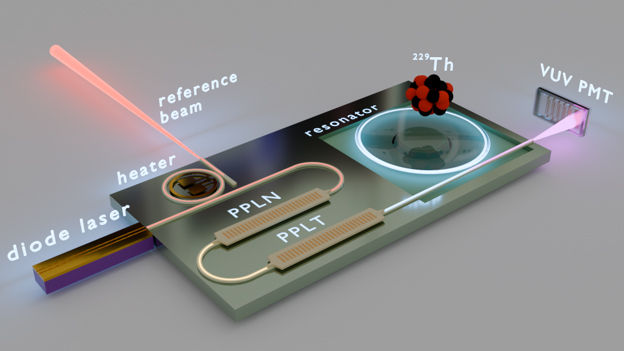
The main challenge is that thorium-229 nuclei interact only very weakly with light. As a result, they are difficult to excite and read out efficiently. ResonaTHOR addresses this challenge by placing thorium-229 in tiny optical resonators known as whispering-gallery-mode resonators. In these structures, light circulates repeatedly around the resonator - much like a whisper travelling beneath the dome of a cathedral. By enabling repeated interaction between the light and the thorium nuclei, the project aims to greatly enhance the signal while reducing both the amount of radioactive material and the laser power required.
The consortium will pursue two complementary approaches: thorium-229 will be implanted into high-quality crystalline resonators, while resonators will also be fabricated directly from thorium-doped crystals. In addition, the project will investigate laser concepts that avoid some of the most complex aspects of current vacuum-ultraviolet laser systems. This could pave the way for smaller, more robust, and ultimately integrated devices.
Würzburg theory for the nuclear clock
The consortium, coordinated from Austria, combines expertise in nuclear physics, nanophotonics, materials science, laser technology, and integrated photonics. Together, the researchers are developing concepts and platforms to efficiently couple thorium-229 to light, with the long-term goal of realising compact, ultra-precise nuclear clocks.
Among the German partners, the team at Julius-Maximilians-Universität Würzburg, led by Professor Adriana Pálffy-Buß of the Faculty of Physics and Astronomy, contributes theoretical research on nuclear excitation, collective emission, and the quantum dynamics of thorium nuclei coupled to resonators.
Together, the partners aim to move nuclear-clock research from recent proof-of-concept demonstrations towards a practical, compact, and deployable photonic platform. If successful, ResonaTHOR could establish a new class of quantum technologies based on nuclear states of matter: compact, robust, and ultra-stable optical references that can operate outside highly specialised laboratory environments.
“With ResonaTHOR, we can investigate fundamental questions of light–matter interaction at the level of atomic nuclei while also paving the way for an entirely new generation of highly precise time references,” says Adriana Pálffy-Buß. “I am particularly excited to further develop, together with our European partners, the theoretical foundations for coupling thorium-229 nuclei to optical resonators.”
Part of the European QuantERA mission
Developing this technology in Europe is of strategic importance. Research on thorium-229 nuclear clocks has been driven to a considerable extent by European groups; the next step is to transform this scientific leadership into technological capability.
By bringing together nuclear physics, materials science, photonics, laser spectroscopy, and quantum theory across several European institutions, ResonaTHOR will strengthen Europe’s position in precision metrology and quantum technology. At the same time, it will train a new generation of researchers in a field with substantial scientific and industrial potential.
The project is part of QuantERA’s mission to support ambitious cross-border research in quantum science and technology.
About QuantERA
QuantERA is an international funding network supported by the European Commission. It brings together more than 40 research funding organisations from over 30 ountries. QuantERA’s mission is to support ambitious, cross-border research in quantum science and technology.
Contact
Prof. Dr. Adriana Palffy-Buß, X-ray quantum optics group, University of Würzburg, E-Mail: adriana.palffy-buss@uni-wuerzburg.de