
Reservoirs as archives of their environment
06/02/2026Sediments in reservoirs are veritable time capsules: they show how contaminated the environment was and still is with pollutants. Würzburg researchers are now investigating the situation in five reservoirs in the Eifel region.
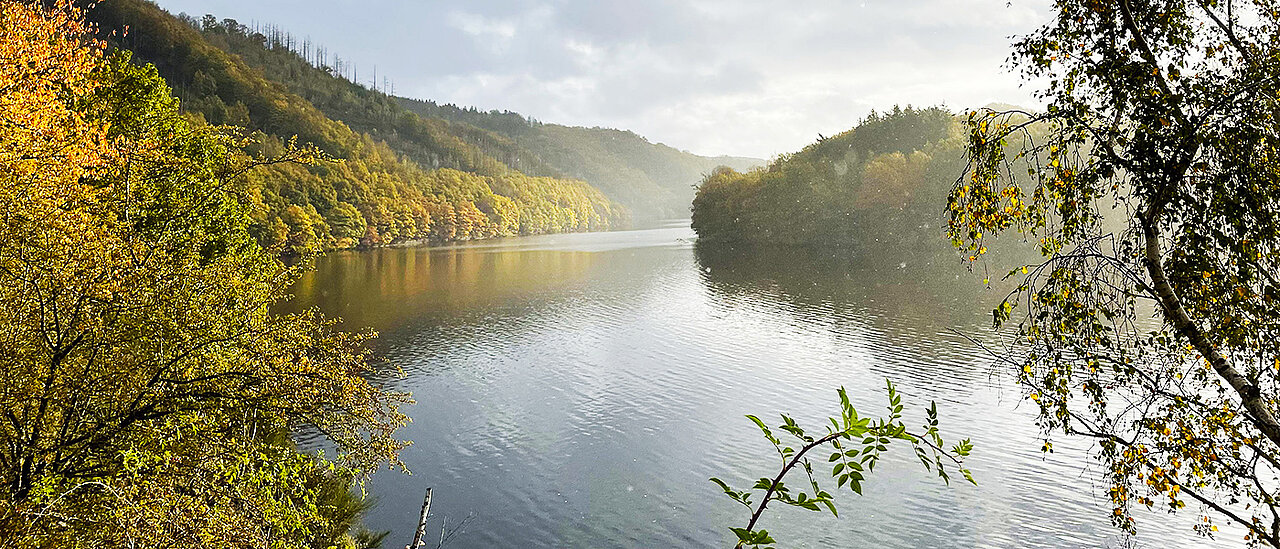
Reservoirs not only store water, they also archive the pollutant and heavy metal load of their immediate surroundings - from the time they are commissioned. Sediments in the reservoirs therefore provide a glimpse into the past: "If sediment flows downstream with the current, it settles in the reservoir. In most cases, what gets in there doesn't come out again," says Professor Georg Stauch.
The holder of the Chair of Geomorphology at Julius-Maximilians-Universität Würzburg (JMU) is leading a new project with Alexander Esch from the Wasserverband Eifel-Rur since 1 June 2026, which is taking a closer look at five reservoirs as landscape archives. The researchers will receive more than 310,000 euros from the German Research Foundation for a period of three years.
Measurements down to the centimetre
For their investigations, the researchers are taking a look at the lake bed: They carry out the drillings in autumn and summer, as this is when the water levels are at their lowest. "We will also be in close dialogue with the operators. If necessary, they can lower the water level further manually," says Clara Bormann, project team member at the JMU Chair.
Why the water level is crucial: The team drills manually at the drained bottom of the reservoirs. The drill cores can be up to eight metres long. "We use a core scanner from the University of Cologne to analyse the layers in high resolution down to the centimetre and thus obtain information about the pollutant and heavy metal contamination," explains Professor Stauch.
In addition, the amount and different types of microplastics in the sediments are to be analysed in collaboration with the University of Applied Sciences Dresden. The investigations will focus on environmental changes over the last 100 years. The cores are dated with caesium-137, an isotope produced almost exclusively by humans. C14 dating (radiocarbon method) is also used.
Additional research in village chronicles helps to assign a found or no longer existing element to a historical event. "In a previous project, we found a layer of microplastics that we were able to trace back to a fire at a nearby factory," says the JMU professor.
However, positive effects such as a decrease in pollutant levels due to more consistent environmental legislation from the 1980s onwards and stricter environmental regulations for businesses were also recognisable, according to Stauch. Regional trends and individual events, such as the closure of a nearby smelting works, could also be recognised. Accordingly, the team is also interested in the extent to which the proximity of a reservoir to nature or settlements influences the pollution levels.
Not just a look into the past
The researchers are also looking to the present: "We are using a terrestrial laser scanner to create 3D models of the reservoirs, which we are expanding with each subsequent deployment," says Bormann. This allows the team to measure how much sediment accumulates over the course of the project, including with regard to potential flood events caused by heavy rainfall.
"The project aims to highlight regional trends in pollutant and heavy metal pollution and show how helpful environmental legislation can be in truly protecting nature. We can provide measurable evidence of this," says Stauch. At the end of its term, the project will be extended to other regions.
Further information on the project can be found on the project website at the Chair of Geomorphology.
Contact
Prof Dr Georg Stauch, Head of the Chair of Geomorphology, Institute of Geography and Geology, georg.stauch@uni-wuerzburg.de