
150,000 euros for the city of the future
11/17/2026The Wittenstein Foundation, the Vogel Foundation Dr Eckernkamp and the Universitätsbund Würzburg have awarded the 2026 Würzburg Research and Transfer Prize to the URBAN:Pulse project at the University of Würzburg.
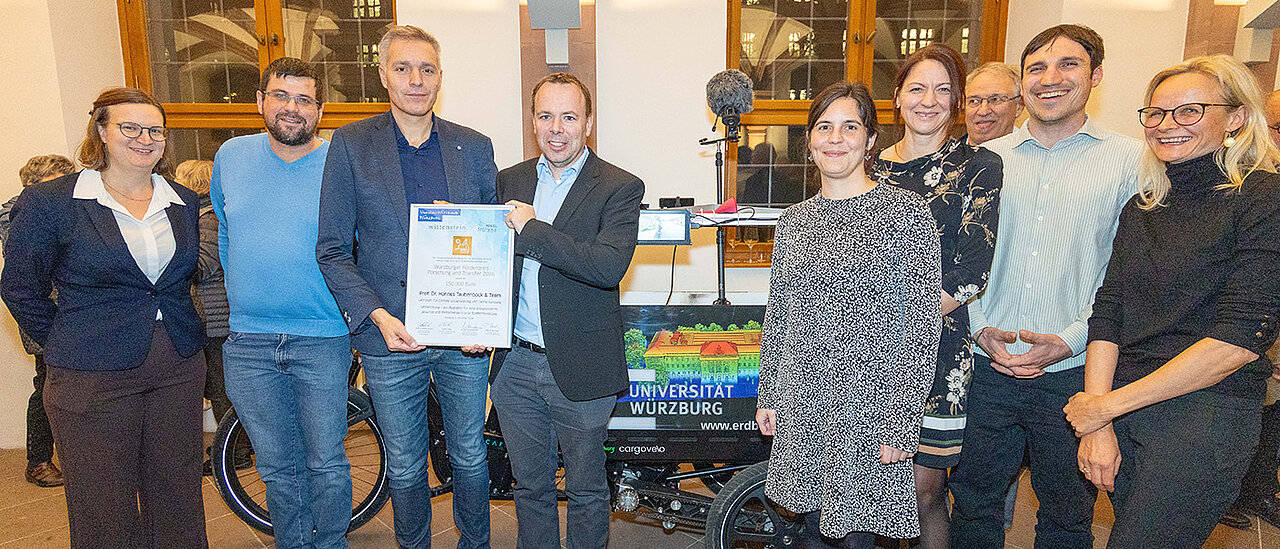
The interdisciplinary research project, led by Professor Hannes Taubenböck, is to receive funding of 150,000 euros. The aim of the project is to lay the scientific foundations for climate-resilient, healthy and people-centred urban development.
With this funding award, the participating foundations support particularly innovative research projects that combine scientific excellence with social impact. The award recognises projects that translate scientific findings into practical applications and develop solutions to the challenges of tomorrow.
How cities affect people
How do heat, noise, green spaces or traffic flows influence people’s well-being? Which places encourage social interaction, physical activity and participation, and which ones cause stress or a sense of insecurity? The URBAN:Pulse project addresses these questions. Researchers from various disciplines are working together to investigate how people perceive their urban environment and how this affects their health and quality of life.
“First we shape our buildings, then the buildings shape us,” says project leader Hannes Taubenböck, quoting the British politician Winston Churchill. People shape their cities, yet at the same time the built environment influences their behaviour, their well-being and their social interactions. The aim of URBAN:Pulse is therefore to gain a better understanding of which urban spaces work well for different people and how cities can be designed to be more conducive to good health.
Surveying the city from new perspectives
To reveal these interrelationships, the project combines a wide range of different data sources. Satellite data captures the built and natural urban environment. Sensors measure temperature, air quality and noise levels. Wearable sensors document people’s stress responses in urban spaces, whilst other methods provide insights into perceptions, movement patterns and individual experiences.
Linking this data enables a new perspective on the interactions between people and the city. This fosters a comprehensive understanding of which environmental factors promote quality of life and where action is needed.
The findings are intended to support local authorities in orienting urban development even more specifically towards people in future. Whether it be greening, shading, traffic calming or new land-use concepts: decisions can be assessed on the basis of sound data, and their impact better estimated. Particular attention is also paid to population groups whose needs have often been inadequately reflected in traditional planning data.
The research team intends to use the prize money to carry out a new measurement campaign and test innovative approaches to data collection and analysis. The findings are not intended to remain solely in scientific journals, but to be directly incorporated into urban planning and social practice.
Research with a social impact
The Würzburg Research and Transfer Award is jointly presented by the Wittenstein Foundation and the Vogel Foundation Dr Eckernkamp. The aim of the funding is to put interdisciplinary research into practice and to enhance its benefits for society and the economy. In 2026, the prize money was increased to 150,000 euros.
“The major societal challenges of our time can only be solved through an interdisciplinary approach. URBAN:Pulse brings together different scientific perspectives, thereby laying the foundations for more liveable, healthier and more resilient cities. It is precisely this combination of excellent research and societal benefit that we wish to strengthen with this award,” says Dr Manfred Wittenstein, Chair of the Board of Trustees of the Wittenstein Foundation.
The project is supported by a broad-based research consortium. In addition to researchers from the Julius-Maximilians-Universität Würzburg, partners from the German Aerospace Centre (DLR), the Karlsruhe Institute of Technology (KIT) and the Friedrich-Alexander Universität Erlangen-Nürnberg (FAU) are also involved. Together, they are working to further develop Würzburg as a real-world laboratory for data-driven and people-centred urban development.