
Renaissance architecture in Lower Franconia
06/16/2026A recently published book by the Würzburg art historian Stefan Bürger provides an overview of architectural culture in Lower Franconia between the Peasants’ War and the Echter era. On 1 July, he will present his work during a guided tour.
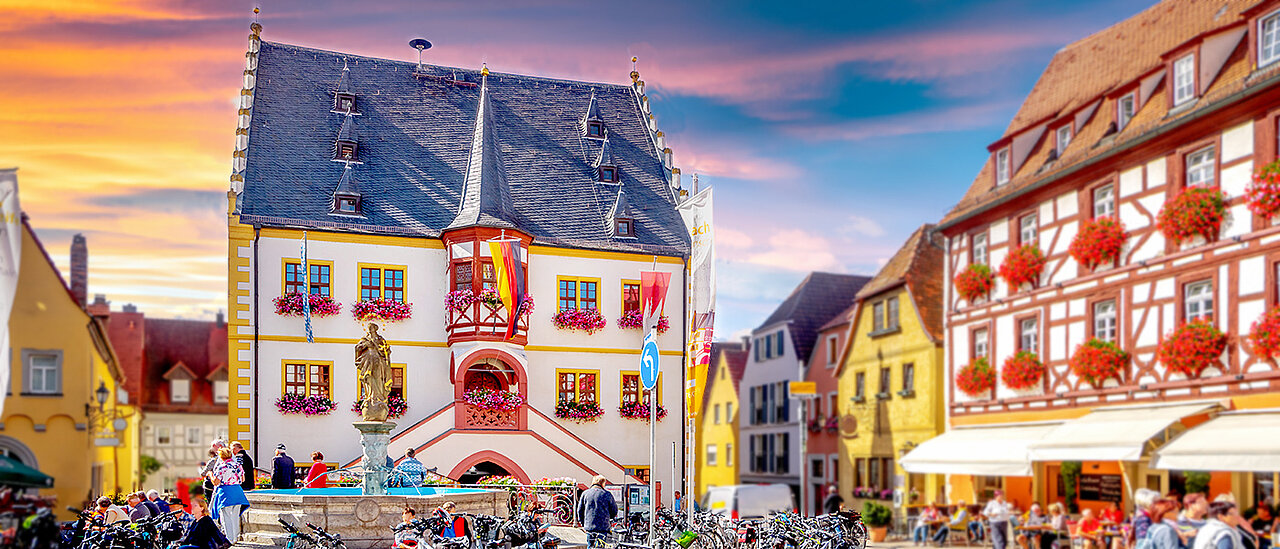
The Princely Residence at Marienberg Fortress, Volkach Town Hall, Aschach Castle near Bad Kissingen: these are all examples of early Renaissance architecture in Lower Franconia. A new book, recently published by Echter Verlag, examines these and many other buildings: “Frühe Renaissancebaukunst in Unterfranken. Ein Überblick zur Baukultur zwischen Bauernkrieg und Echterzeit 1525 bis 1573" (Early Renaissance Architecture in Lower Franconia. An Overview of Architectural Culture between the Peasants’ War and the Echter Era, 1525 to 1573). The author is Stefan Bürger, Professor of Art History at the University of Würzburg. The volume is dedicated to the art historian Dr Verena Friedrich in recognition of her wide-ranging academic, social and voluntary activities.
“The architectural culture of the 16th century was strongly influenced by events of the 1520s,” says Bürger, describing the time frame of his account. Numerous monasteries, castles and palaces were destroyed during the Peasants’ War of 1525 and had to be rebuilt. “In the process, building became a means of exercising power during times of confessional and political reorganisation among feudal landowners,” explains the art historian.
Innovations such as the letterpress printing opened up new possibilities for the transfer of architectural culture and artistic styles. “The architectural vocabulary of northern Alpine architecture expanded its architectural spectrum to include influences from the Italian Renaissance,” says Bürger.
Public guided tour and book launch on 1 July
What this meant for Lower Franconia is made clear in Stefan Bürger’s book. The work has been published as a special edition in the series “Quellen und Forschungen zur Geschichte des Bistums und Hochstifts Würzburg” by Echter Verlag and will be presented to the public in early July by Stefan Bürger, Alexandra Rumpel and Miriam Lüer.
On Wednesday, 1 July 2026, the three authors invite to a guided tour followed by a book presentation. The tour begins at 4.00 pm at Würzburg’s Grafeneckart (meeting point: Vierröhrenbrunnen), where the building’s bay window will take centre stage. The group will then move on to the cathedral cloister to view the cathedral school portal; this will be followed by the book presentation at the Burkardushaus from around 5.30 pm.
Participation is free of charge, but registration with the Würzburg Domschule is required. The registration deadline is Wednesday, 24 June 2026.
About the speaker
After completing an apprenticeship in a trade, Stefan Bürger first studied restoration before switching to art history. In October 2014, he was appointed to the Chair of Medieval and Early Modern History at the Institute of Art History at the University of Würzburg.
His research focuses on the art of the late Middle Ages and the early modern period, as well as medieval building techniques and organisation, and the architecture of mendicant orders; furthermore, architectural iconology, spatial sociology and mediality, fortress architecture and heritage conservation.
The book
Stefan Bürger: Frühe Renaissancebaukunst in Unterfranken. Ein Überblick zur Baukultur zwischen Bauernkrieg und Echterzeit 1525 bis 1573. Echter Verlag, series ‘Quellen und Forschungen zur Geschichte von Bistum und Hochstift Würzburg’, special publication. 472 pages. Hardback €74.00 (D) / €76.10 (A). Member price: €59.00 (D) / €60.70 (A). ISBN 978-3-429-06866-0
Contact
Prof. Dr Stefan Bürger, Institute of Art History, T: +49 931 31-84650, stefan.buerger@uni-wuerzburg.de