
Prize for good teaching awarded to Katharina Ebner
04/21/2026Katharina Ebner inspires her students with innovative methods of theological research – such as the critically reflective use of AI. For this, she has now been awarded the Prize for Excellence in Teaching.
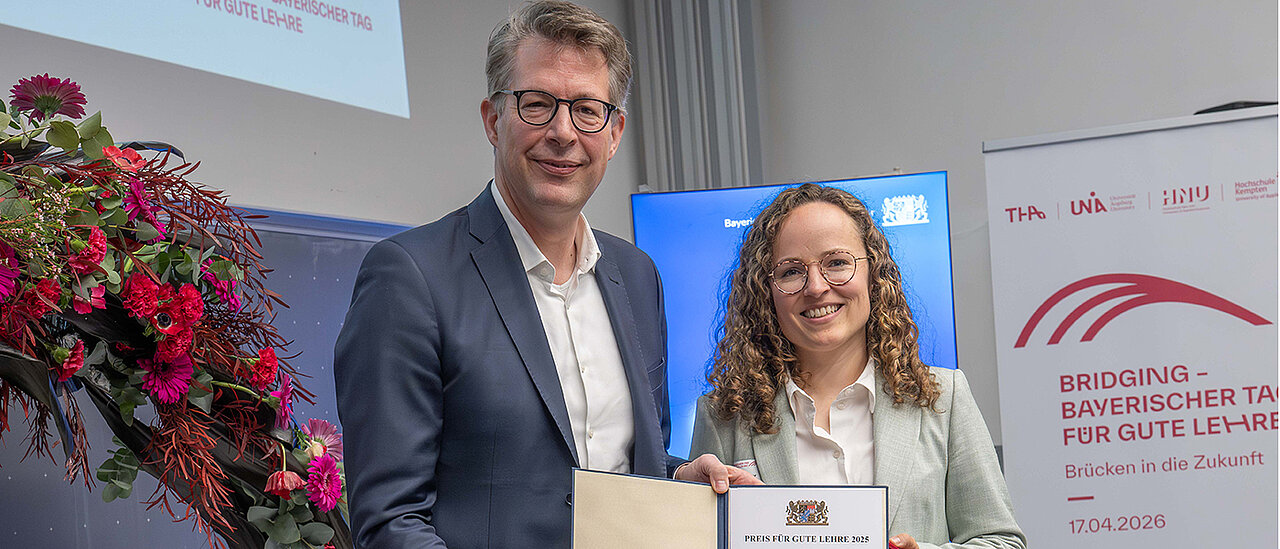
Last Friday, 20 prizes for good teaching ("Preis für gute Lehre") were once again awarded as part of the Bavarian Day for Good Teaching. This year's award ceremony took place at the Technical University of Applied Sciences Augsburg. The State Ministry of Science and the Arts uses the prize for good teaching to promote excellent quality in university teaching. At the award ceremony, Minister of State Markus Blume said: "Good teaching is the heartbeat of science. Where teaching is committed and passionate, it generates curiosity, courage and vision. Excellent teaching is the basis for excellent research - one cannot thrive without the other. Science thrives on convincing communication."
One of this year's prizes went to Würzburg theologian Dr Katharina Ebner. Her teaching style combines different methods, is experimental, reflective and sustainable. As a teacher, it is important to her to be a contact person and learning guide. In this way, she creates a lively and respectful learning environment at eye level. This has been confirmed to her by students at Julius-Maximilians-Universität Würzburg (JMU) in numerous evaluations.
Enthusiasm for research and personal development
For Katharina Ebner, "theology is the academic study of God and questions of faith from a committed perspective: I am convinced that theology as an academic discourse must be committed to life-serving and philanthropic religious practice; and for this it must be conceptually critical and sensitive to power." This is reflected in the content of her moral theology courses, but for her it is also a question of her own attitude.
The teaching award not only honours didactic methods and concepts, but also teachers who "convey their own enthusiasm and [shape] personalities with genuine dedication and impressive creativity," Blume continues.
Research-based teaching and AI
Katharina Ebner's courses are regularly organised according to the principle of research-based teaching. Students initiate their own research projects based on the topic of the course and carry them out independently. One outstanding example: a group of students investigated "Christfluencers in social media" long before the topic appeared widely in the media. They also invited a Christfluencer, who explained her content in a practical way, how she creates it and what influence it has on her followers.
Katharina Ebner also experiments with various tools in her courses, including AI-supported writing. In essays, students were able to answer tasks with the help of AI, but they also had to submit their documents, such as the prompts used. This makes it possible for the teacher to test both subject-specific and digital skills and to practise the confident use of new, still-developing tools such as AI.
As a teacher, Katharina Ebner takes a back seat here and sees herself more in the role of a mentor. In the past, this has included smaller film projects and essays, as well as an article in a specialist journal. Ebner is actively involved in promoting young academics.
The prize for good teaching
The prize for good teaching is awarded each year to 20 outstanding university lecturers and is endowed with 5000 euros each. Since this year, a recognition prize has also been awarded for exemplary teaching by lecturers. The prize for good teaching is intended to incentivise teaching to take an equal place alongside research and to keep it up to date.
About Katharina Ebner
Katharina Ebner studied Catholic theology, German studies and philosophy in Munich and London. She was a research assistant in Bonn. Since moving to Würzburg, she has headed the junior research group "Herrschaft". Her research focuses on dealing with experiences of social crisis, power and the abuse of power as well as gender-sensitive perspectives on power relations.