
Where your smartphone becomes a microscope
10/27/2026Necessity is the mother of invention: if you have to bring all your own equipment with you to carry out research in a museum, you might well end up using your smartphone as a microscope.
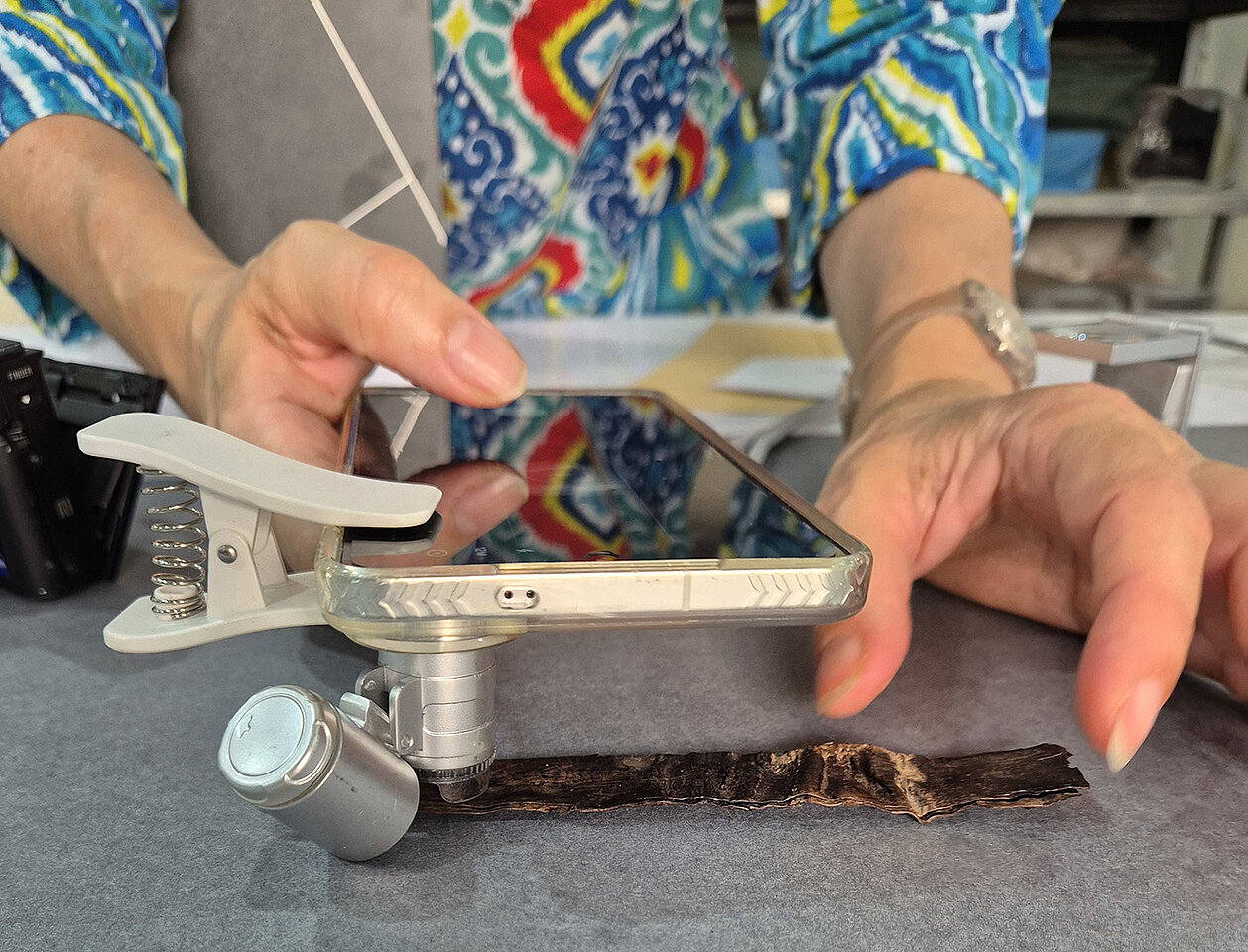
The story behind this special image: Kathrin Holz, a professor of Indology, was on a research trip to Pakistan. At the Peshawar Museum, she examined historical manuscripts dating from the seventh century: texts written in the Proto-Śāradā script, preserved on small pieces of birch bark.
“We wanted to examine 250 objects and only had a week,” says Kathrin Holz. That’s why it was initially important to quickly screen which of the objects were actually inscribed and which were worth a closer look. “As we had to bring all the necessary equipment with us, we used the smartphone camera for this – it took up very little space in our luggage.”
Handwriting difficult to read
Screening the tree bark with the naked eye would not have worked: many pieces are relatively dark because they have survived a fire at some point in their history. And on the charred pieces, the handwriting is barely legible.
In the Proto-Śāradā Project, Kathrin Holz’s team is investigating the origins and early development of the Proto-Śāradā script. To this end, inscriptions and administrative documents from north-western India are being systematically collected, analysed and digitally edited. The project is funded by the German Research Foundation (DFG).
You can find more special images and stories here. Do you have a striking photograph from the laboratory, fieldwork or archives that you would like to share with the public? Please get in touch with the JMU press office. We’d be happy to help.