
Parkinson’s chatbot undergoes safety testing
11/03/2026Neurologists in Würzburg analysed more than 2,000 conversations with the Parkinson’s chatbot jAImes. The results show how reliable the AI assistant is and why ongoing monitoring remains important.
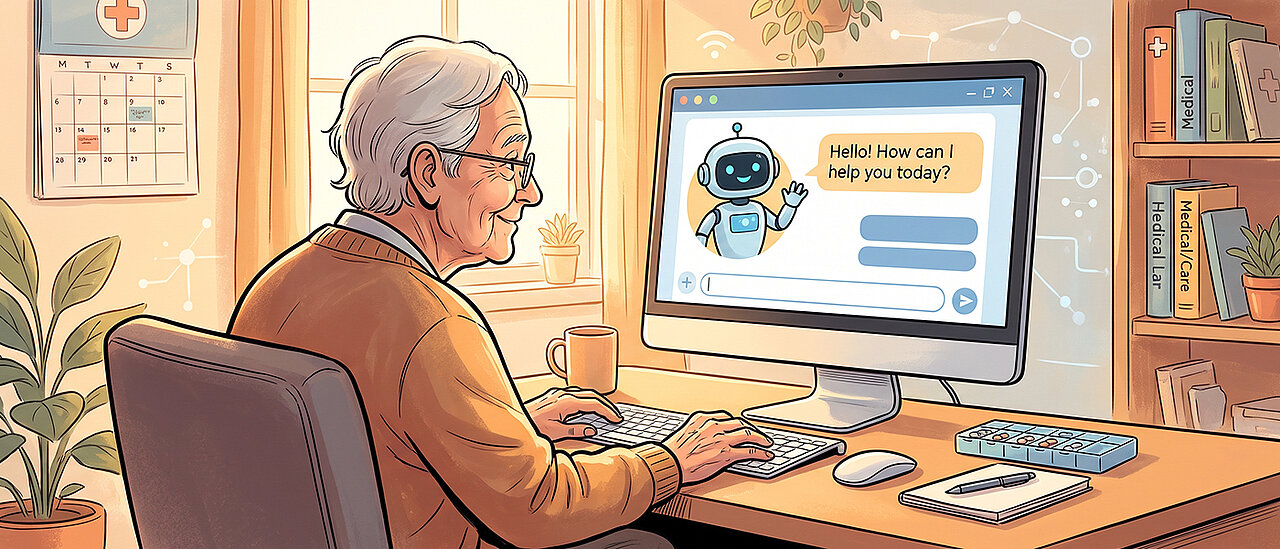
We’ve all been there: you’re sitting in front of your doctor, with a dozen questions, but not enough time to ask them all; you don’t pluck up the courage, you forget half of them, or you can’t quite remember the answers properly. Whilst traditional search engines such as Google or conversations with AI-powered chatbots like ChatGPT can provide helpful information about an illness, they can also draw the wrong conclusions or trigger unnecessary anxiety.
The biggest drawback, however, is that users disclose highly personal health data online without knowing exactly how their information is processed, stored or used later on. There is no medical confidentiality here.
Verified knowledge instead of random internet searches
But what if the AI assistant were not commercially driven, the conversation were anonymous, the questions could not be linked to either a name or an account, and the answers were, moreover, exclusively scientifically evaluated? This idea was conceived three years ago by Professor Jens Volkmann, Director of the Department of Neurology at Würzburg University Hospital (UKW) and a board member of the Parkinson’s Foundation, and Dr Florian Lange, Funktionsoberarzt in Neurology at UKW.
Since then, ‘jAImes’ has been developed – an AI chatbot for Parkinson’s. Its name combines the first name of the British doctor James Parkinson, who first systematically described the disease in 1817, with ‘AI’, the abbreviation for Artificial Intelligence.
The AI assistant was technically developed by the Berlin-based information scientist and AI expert Ssaman Mardi – founder of the smardis.tech platform, which offers AI solutions that comply with data protection regulations. The project was funded by the Parkinson’s Foundation, which also hosts jAImes, effectively providing it with a home. Florian Lange has been and remains responsible for feeding the system with knowledge – that is, for its scientific curation – and is supported and supervised in this by his colleagues from the UKW and the Parkinson’s Foundation’s advisory board.
As a result, jAImes draws exclusively on verified sources of information and receives constant scientific updates. To continuously monitor conversations for potential safety issues, the team developed CARE-LLM – a method that enables problematic responses and risks to be systematically identified on the basis of real conversations.
Most responses are convincing – but errors remain possible
The team has now demonstrated just how reliable jAImes actually is, following an analysis of the first 2,000 conversations comprising more than 6,000 messages, published in the journal "The Lancet Regional Health – Europe". “We were initially interested in whether jAImes provides incorrect medical information, overlooks risks or makes problematic or potentially dangerous recommendations,” says Florian Lange, before immediately allaying concerns: “It generally does not.”
Apart from the positive feedback from more than 90 per cent of users, the automated assessment of the 2,035 conversations held within the first 129 days following the chatbot’s launch on 11 November 2025 also yielded positive results. 88.6 per cent of the chatbot’s responses were rated as good. 11 per cent were rated as partially appropriate and only 0.4 per cent as inappropriate.
Conversations that stood out were subsequently reviewed by neurologists. In addition, the experts carried out a random sample review of 100 conversations that the automated system had previously rated as good. In doing so, they identified four further cases containing clinically critical errors. “This included, for example, a case where a medicine was confused with another,” says Lange.
As jAImes is not designed to provide medication recommendations, this poses no risk to users. The chatbot is only permitted to list the medicines available for specific ailments and to recommend that the user discuss this with their doctor.
Why safety must be continuously reviewed
What concerns Lange is a conversation in which a person expressed suicidal thoughts. In this one instance, the chatbot did not trigger the intended appropriate response for crisis intervention. “We have closed this and other gaps with jAImes 2.0,” Lange assures us. Nevertheless, the safety of jAImes continues to be systematically reviewed. Lange would have liked to contact the person, but that is the price of anonymity.
“With our study, we demonstrate in principle that a chatbot specifically tailored to a medical topic can certainly provide helpful information. However, even with an AI system that draws on verified sources of information, errors can occur. This makes a process for continuously monitoring conversation histories all the more important,” concludes Jens Volkmann. He and his team are currently receiving daily enquiries about jAImes. Interest in the smart assistant is coming from both other countries and other specialist fields.
“The exciting thing about our AI assistant is that it can be used in many other medical specialities, such as heart failure, cancer or dementia,” says Volkmann. “The chatbot has enormous potential.”
Of course, an AI chatbot cannot replace medical advice. However, not all concerns can be addressed during the limited time available in consultations, and many questions only arise afterwards – for example, in the evenings, at the weekend or between appointments. jAImes, for example, provides patient and expert assistance round the clock to help patients navigate the complex healthcare system, and supports them in applying for a care level or medical aids. “This gives us time during consultations to focus on other issues,” says Lange.
What the chatbot reveals about patients’ needs
The initial analysis of the conversations has once again highlighted to the team which other issues, apart from the classic symptoms, are of particular concern to patients. “The questions asked via the chatbot are highly interesting from a healthcare perspective,” reports Lange. “My consultations mainly focus on movement disorders. Yet patients confide in jAImes about numerous other symptoms, ranging from cognitive impairments and sexual dysfunction to sleep problems, hallucinations and psychiatric issues.”
The neurologist concludes from this that he needs to ask far more questions about quality of life during his consultations. The Parkinson’s Foundation has also already responded and is adapting its information material accordingly.
“With jAImes, we’re taking the first step towards a digital ecosystem for people with Parkinson’s. Our aim is to bring together reliable information, guidance and access to research in one place. As our next module, we are developing a trial finder to help patients find suitable clinical trials,” says Dirk Woitalla, Chair of the Parkinson’s Foundation’s Executive Board.
Anyone wishing to chat with jAImes can find the AI assistant on the Parkinson’s Foundation’s homepage.
On 17 November at 6 pm, Ssaman Mardi will also be presenting how the jAImes chatbot works in an online seminar organised by the Parkinson’s Foundation. Further information.
Publication
Florian Lange, Ssaman Mardi, Tobias Binder, Martin M. Reich, Thorsten Odorfer, Jens Volkmann, ‘Real-world use and evaluation of a generative AI chatbot for Parkinson’s disease information: a prospective observational study’, The Lancet Regional Health – Europe, Volume 70, 2026, 101866, ISSN 2666-7762, https://doi.org/10.1016/j.lanepe.2026.101866