
New semester just around the corner
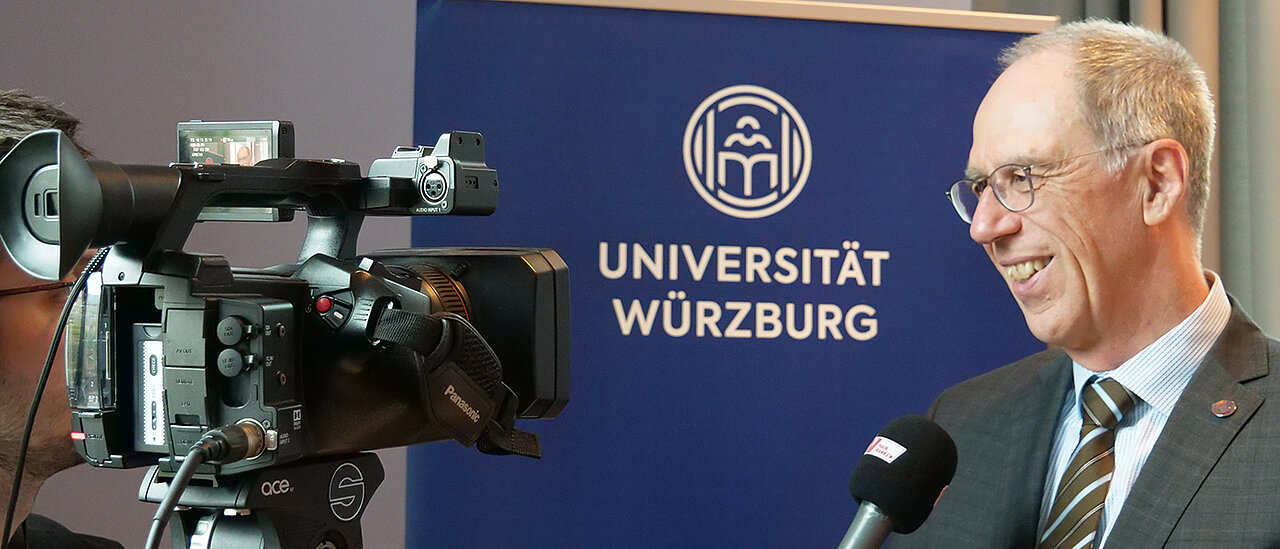
10/13/2026Lectures for the winter semester 2026/27 begin at the University of Würzburg on 12 October. At the annual press conference marking the start of the semester, President Paul Pauli provided updates on current developments at the university.
A total of 24,796 students are currently enrolled at Julius-Maximilians-Universität Würzburg (JMU) (as of 8 October 2026). By comparison, the figure shortly before the start of lectures last year was 25,295. The slight decline is mainly due to the lingering effects of the near-absence of school-leavers with the Abitur qualification in Bavaria in 2025.
However, the figures for first-year students show that the situation is already improving. So far, 3,093 new students have enrolled for the winter semester, an increase on the previous year, when the figure stood at 2,736 at a comparable point in time.
As in previous years, student numbers are expected to continue rising until 1 December, the official reference date for determining the number of new students. Including the 607 new students who enrolled in the summer semester of 2026, JMU expects to welcome almost 4,000 new students in the 2026/27 academic year.
According to the latest figures, 15,257 female students and 9,480 male students are enrolled at JMU. A further 59 students have not specified their gender. The proportion of female students is therefore 61.5 per cent, remaining virtually unchanged from the previous year.
So far, 3,371 international students have enrolled, accounting for 13.6 per cent of the total student population – an increase of almost two percentage points.
Popular subjects: Law, economics and business administration, medicine, and teacher training programmes traditionally attract particularly high numbers of students. A total of 5,159 students are currently enrolled in teacher training programmes at JMU, slightly fewer than a year ago.
New degree programmes launched
Several new degree programmes are being introduced at the University of Würzburg for the winter semester 2026/27. All of them are Master's programmes, some of which can also be taken as additional qualifications alongside another degree.
The Master's programme in Classics complements the Bachelor's programme of the same name, which was introduced in the winter semester 2024/25. Once again, the focus is on classical antiquity – the world of the ancient Greeks and Romans. And it is not just the subject matter that is steeped in history: the programme is also taught in the historic Würzburg Residence.
With Emerging Educational Technologies for Science Technology Engineering Mathematics STEM (EET4STEM), JMU is introducing a new elite Master's programme. Supported by the Elite Network of Bavaria, it offers outstanding study conditions, combining excellent academic supervision with additional learning opportunities. Students training to become teachers and those from computer science-related disciplines develop digital educational technologies for STEM subjects and work on bringing these innovations into schools.
The new Master's programme in Entrepreneurship & Innovation also places a strong emphasis on practical applications. How do you successfully establish a business? How can you drive innovation within a company? And what should be considered when planning business succession? The new programme at the Faculty of Business Management and Economics addresses these questions in cooperation with regional partners from the start-up community.
Traditionally, the humanities have placed human beings at the centre of their investigations. The new Environmental Humanities programme turns this perspective around. Its central question is: How does human culture affect other living organisms and ecosystems? Numerous academic disciplines explore this issue from a wide range of perspectives.
Our world is becoming increasingly fast-paced and unpredictable. How can theology provide guidance in times like these? This is the question explored by the English-taught Master's programme Theology for a World in Transformation. Catholic theology is approached as a critical and self-critical academic discipline, and applicants do not need to have previously studied theology at Bachelor's level.
Between disappointment and pride
In academia, setbacks and successes often go hand in hand. On 2 October, JMU was unsuccessful in its bid to become a University of Excellence. Following the initial disappointment, the university is now looking ahead. It intends to continue pursuing the strategy "Empowering for Change", developed during the application process, and to carefully evaluate the feedback from the review panel. For President Paul Pauli, pride in what the university has achieved outweighs the disappointment. JMU can also continue to count on the strong support of the Bavarian State Government.
Just how outstanding research from Würzburg can be was impressively demonstrated on 5 October: Würzburg Professor Georg Nagel was awarded the Nobel Prize in Physiology or Medicine. Together with Professor Peter Hegemann and Professor Karl Deisseroth, he received science's most prestigious award for his research into optogenetics. This marks the 15th Nobel Prize in JMU's long history. It is a particularly special honour for the university, as Nagel spent more than 20 years in Würzburg as a professor and senior professor, beginning in 2004.
University prepares to celebrate its anniversary
In 2027, JMU will celebrate the 625th anniversary of its founding in 1402. The celebrations will begin with an opening ceremony on 14 February 2027, which will also mark the opening of the new Museum of University History. Numerous events will take place throughout the year under the motto "Ideas That Change the World. Since 1402".
New corporate design unveiled
A new logo, new colours, and new typefaces: JMU has modernised its visual identity. The aim is to strengthen the university's profile in the competition to attract students, researchers, and research funding. After more than 20 years, the previous bracket-shaped logo is being replaced by a circular design inspired by the university's first rectorate seal, dating from 1410.
The new visual identity was developed following an extensive, participatory brand strategy process aimed at sharpening the university's profile and identity. This process also produced a new motto: "Truth. Knowledge. Transformation. Since 1402".