
New chair: More animal welfare in research
03/24/2026With a new chair, the University of Würzburg aims to further improve conditions in a sensitive area: Laboratory animal science and animal welfare. Professor Jan Baumgart is taking over as head.
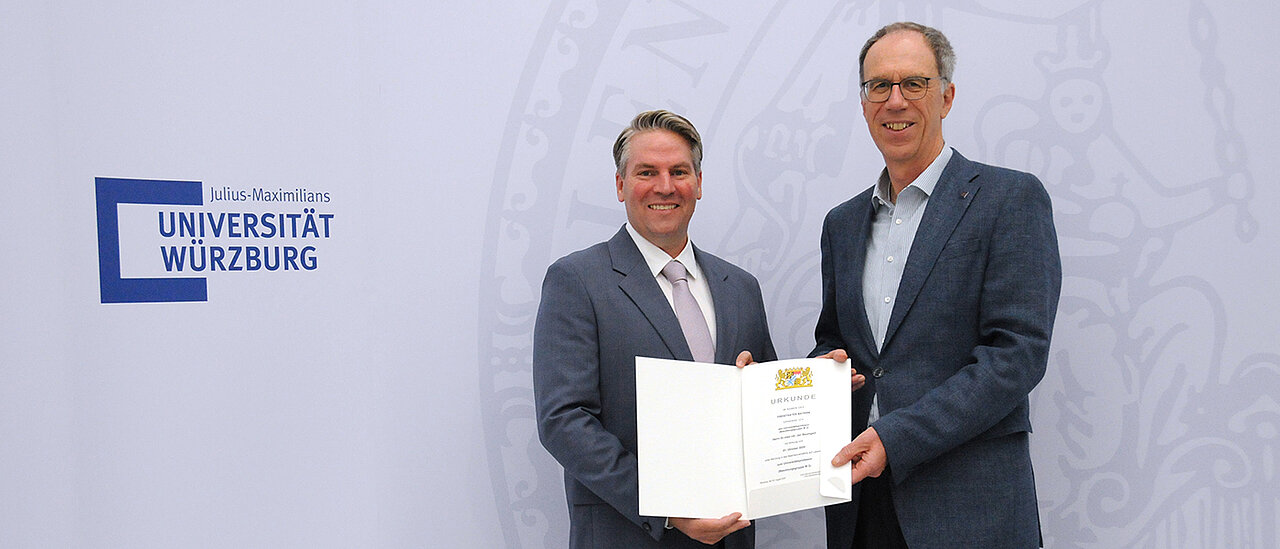
"My work takes place in a critical specialist area where the highest demands are placed on constantly improving conditions," says Professor Jan Baumgart. The veterinarian is an expert in laboratory animals and their protection.
Since the winter semester 2025/26, he has headed the newly created Chair of Animal Welfare and Laboratory Animal Science at Julius-Maximilians-Universität Würzburg (JMU). His aim is to further improve the conditions for laboratory animals - such as species-appropriate husbandry and conscious use - at the JMU.
Focus on the 3R principle
Refine, reduce, replace is an ethical principle for researchers who work with laboratory animals. The University of Würzburg already works according to this principle; Jan Baumgart would like to further strengthen this area. "Currently, animal experiments are still essential in biomedical research, for example. I see it as my task to support my colleagues in implementing the 3Rs principle as best I can," says the new professor.
Researchers often lack the networks in the field of animal welfare that are necessary to follow the latest developments and apply them themselves. The approaches are varied: "We can adapt the type of animals used in animal experiments, for example. Instead of mammals, it is now often possible to use fish, flatworms or flies," explains Baumgart.
Support and own research
In his own research, Jan Baumgart is looking at how laboratory animals can be better kept and prepared for experiments. "Experimental animals can also be trained. This reduces their stress and certain steps - such as sedation - can be omitted. Ultimately, the animal experiment becomes less stressful for the individual animal and fewer animals are needed."
Baumgart wants to pass on this knowledge. Thanks to his extensive contacts in animal welfare, he wants to offer researchers various opportunities to exchange ideas. The establishment of a working group, lectures and training courses are intended to provide external perspectives, alternative approaches and opportunities for collaboration. Co-operation with the University Medical Centre in Mainz, where Baumgart previously worked, is also planned.
From Mainz to Würzburg
He has already successfully established such a system in the Rhineland-Palatinate state capital. Promising foundations have already been laid in Würzburg. Professor Nicolas Schlegel, whose work with organoid models represents an alternative to animal testing, has been working at the University Hospital of Würzburg (UKW) for around a year.
Replace - the third "R" - is also the focus at the Fraunhofer Translational Centre for Regenerative Therapies. Under the direction of Professor Florian Groeber-Becker, cell-based tissue models and test systems are being developed here that can replace animal testing.
The possibilities are therefore many and varied; artificial intelligence also has the potential to make animal testing more efficient and less invasive. AI models and technical upgrades such as sensor technologies can help to monitor the health and general condition of animals and improve their welfare in a targeted manner. In addition to ongoing research into alternatives and improvements, Baumgart sees one thing in particular as irreplaceable in dealing with animal testing: Transparency. "It is extremely important to me to always show that we are not hiding anything. As researchers, we have to be extremely aware of the sensitivity of the topic of animal testing. We need the highest standards, which we constantly review, improve and also make available to the public."
The CV of the new professor
Jan Baumgart studied veterinary medicine at the Free University of Berlin between 2001 and 2007. He then worked as a research associate at the Max Delbrück Centre for Molecular Medicine and the Berlin-Brandenburg Centre for Regenerative Therapies at Berlin's Charité hospital. In 2011, he also qualified as a specialised veterinarian for laboratory animal science in the German capital.
From 2010 to 2013, Baumgart was Head of Experimental Animal Husbandry at the Department of Microscopic Anatomy and Neurobiology at the Mainz University Medical Centre, followed by its Translational Animal Research Centre (TARC). Baumgart held this post until September 2025.
During this time, he also completed his doctorate ("Establishment of in-utero electroporation of the central nervous system in the C57BL/6 mouse model", 2015) and his veterinary specialisation in animal welfare (2019). From August 2021 to September 2025, Baumgart also held the professorship for laboratory animal science at the University of Mainz before moving to Würzburg.
Jan Baumgart has been and continues to be active in many other roles relating to animal welfare and laboratory animals. For example, as chairman of the committee of the Society for Laboratory Animal Science for scientists specialising in laboratory animal science or as animal welfare officer at the Rhineland-Palatinate Research Institute for Forest Ecology and Forestry.
Contact
Prof Dr Jan Baumgart, Chair of Laboratory Animal Science and Animal Welfare, Tel: +49 931 201-44063, e-mail: jan.baumgart@uni-wuerzburg.de