
How extracurricular STEM activities can inspire lasting enthusiasm
11/17/2026The Wittenstein Foundation is providing 600,000 euros in funding for a new research project at the M!ND Centre at the University of Würzburg. Over the course of four years, the project will investigate the impact of extracurricular STEM activities on young people.
Whether it’s robotics workshops, experiment days or school science labs: across Germany, there is a wide range of activities designed to inspire children and young people to take an interest in maths, computer science, natural sciences and technology (STEM). Against the backdrop of an ongoing shortage of skilled workers and weaker PISA results, this extracurricular STEM education is becoming increasingly important.
But which programmes are particularly effective in achieving their goals? And what do children and young people take away from them? What motivates them to perhaps pursue a STEM career later on?
Making the success of STEM programmes measurable
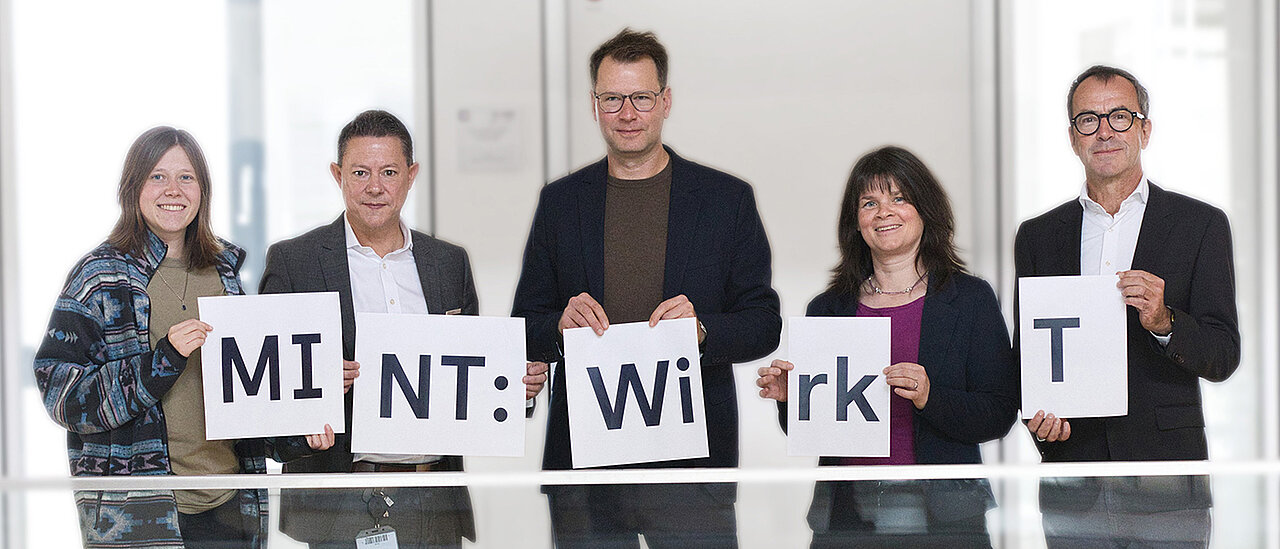
These are the questions being investigated by the new research project “MINT:WirkT” at the M!ND Centre at the University of Würzburg. The name stands for “Impact mechanisms and participant perspectives of extracurricular STEM programmes”. The Wittenstein Foundation is funding the project with 600,000 euros over four years.
“Many initiatives have clear objectives, such as sparking interest or introducing career fields. However, there has so far been a lack of systematic accompanying research to investigate whether and how these objectives resonate with participants,” explains Dr Markus Elsholz.
Elsholz is the managing director of the M!ND Centre – the Centre for the Didactics of Mathematics, Computer Science and Natural Sciences at the University of Würzburg. The two researchers leading the new research project also work there: PhD student Clara Großmann and impact manager Dr Brenda Pfenning, who brings with her many years’ experience in impact-oriented out-of-school educational work.
The team aims to identify which framework conditions and pedagogical concepts are particularly effective in inspiring children and young people to take an interest in STEM subjects.
Surveys of education stakeholders and participants
To this end, the study combines two perspectives: in the first phase, the research team will interview the stakeholders themselves about their intentions and approaches. Through these interviews, the two researchers aim to find out what the organisations hope to achieve with their target groups and how they design their programmes with their specific objectives in mind.
In the second phase, the participating children and young people will be surveyed using a standardised questionnaire. They will be asked to provide information on how they experienced the respective programme – including in relation to the intended objectives – and whether, from their perspective, it helped them, for example, with career guidance.
The Würzburg team hopes that this will help them identify which features of these programmes are particularly significant. “When it comes to sparking an interest in a technical career, this can be done, for example, through a talk or a guided tour of the training company,” explains Markus Elsholz. However, it is equally conceivable that young people might spend a day working in a company themselves or talking to apprentices. The study could provide insight into which approach is more effective in reaching them.
According to Elsholz, the aim is not to give individual initiatives a blanket ‘good’ or ‘bad’ rating. Rather, the results are intended to provide indications as to which approaches are particularly promising for which objectives. However, it is not possible to deduce with certainty from a single survey alone whether an initiative actually brings about a specific change.
From Bavaria to the whole of Germany
The project began on 1 October 2026 and will run for four years until September 2030. The surveys will initially begin in Bavaria, where the team will seek to establish cooperation with regional networks at the first Bavarian STEM Summit in mid-November. Thanks to well-established networks such as the Bavarian STEM Network and comparable nationwide networks, the tool is subsequently set to be rolled out across Germany.
The project builds on the ongoing ‘DynaMINT’ research project, which is also funded by the Wittenstein Foundation – in this case with around one million euros. The University of Würzburg is thus continuing its successful partnership with the Foundation to strengthen young people’s orientation within the STEM world in the long term.
Quotes from those involved
Dr Sascha von Berchem, Managing Director of the Wittenstein Foundation: “With this project, the Wittenstein Foundation is continuing to address an important issue alongside some fantastic partners. We are certainly looking forward to insightful findings and interesting discussions along the way.”
Prof. Dr Thomas Trefzger, Head of the MIND Centre: “We want to show how extracurricular STEM activities can truly inspire young people and foster a lasting interest in mathematics, computer science, natural sciences and technology. Our research helps to highlight the best ideas – so that young talents can discover their strengths and shape their own futures.”
Contact
Dr Markus Elsholz, T+49 931 31-82734, markus.elsholz@uni-wuerzburg.de
Links