

Making light effects visible in a quadrillionth of a second
03/31/2026Dr. Vishnu Krishnan shines light on nanocrystals to investigate their optical properties. Currently he is a Humboldt fellow at the Chair of Physical Chemistry I at the University of Würzburg.
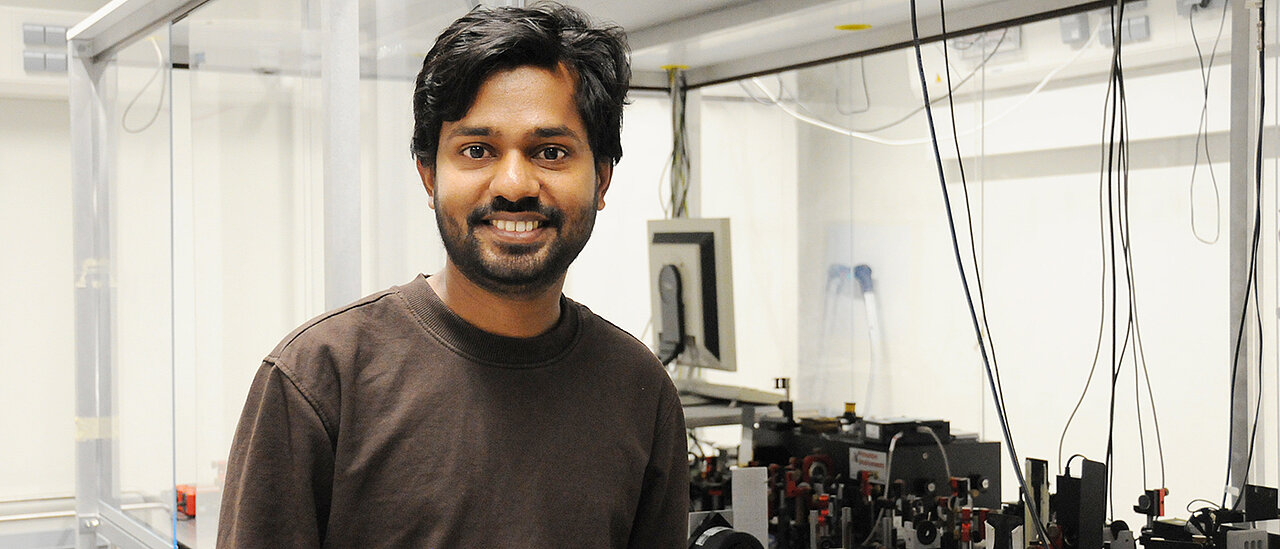
For Dr. Vishnu Krishnan, chemistry is comparable to cooking: “I have a recipe and hope that the desired result comes out in the end, whether it’s the cake in the oven or the chemical reaction in the lab,” says the scientist.
The Indian researcher is currently at the Julius-Maximilians-Universität Würzburg (JMU) on a fellowship from the Alexander von Humboldt Foundation. He is conducting his research in the group led by Professor Tobias Brixner, head of the Chair of Physical Chemistry I.
“Dr. Krishnan brings new expertise in the field of nanomaterials, which he also prepares himself to a high standard,” says Brixner. With his experience, the visiting researcher thus perfectly complements the group’s focus on laser methods.
How light interacts with nanocrystals
In his research, Krishnan focuses on arrays of semiconductor nanocrystals that, when combined, form larger crystal structures. These are primarily found in optoelectronic devices, such as modern televisions, displays, and photovoltaic systems.
“In my experiments, I’m primarily interested in how light interacts with the crystals, what colour they emit, and how the colour can be controlled by adding chemicals,” the visiting researcher explains. For his experiments, he uses multidimensional electronic spectroscopy, a technique that can track ultrafast coherent and incoherent processes in materials in real time.
“When arrays of nanocrystals are excited with intense light, they can exhibit collective light-emission effects such as superfluorescence, one of the central phenomena I seek to explore,” Krishnan says. Professor Tobias Brixner’s research group at JMU specializes in advanced multidimensional spectroscopic techniques capable of tracking these ultrafast processes in real time.
Recent methodological advances by the group have enabled the extraction of uncontaminated signals in ultrafast spectroscopic measurements, overcoming long-standing challenges associated with higher-order signal contributions. Building on these developments, Krishnan aims to apply multidimensional electronic spectroscopy to investigate collective emission phenomena in nanocrystal arrays. This offers both high temporal and spectral resolution in a time span of femtoseconds, e.g. in a quadrillionth of a second.
“This allows us to observe and analyse the superfluorescence within the crystal even more precisely,” said the chemist. Understanding these mechanisms result in low-cost, compact coherent light sources capable of entangled multiphoton emission, key components for applications in quantum technologies.
About the person
Vishnu Krishnan grew up in the southern Indian state of Kerala. He studied chemistry at the universities of Kozhikode and Hyderabad. Krishnan completed his doctorate at the Indian Institute of Science Education and Research Thiruvananthapuram (IISER TVM).
His Alexander von Humboldt Foundation fellowship at the University of Würzburg began on March 1, 2026, and will last for two years.
Contact
Dr. Vishnu E. Krishnan, Institute of Physical and Theoretical Chemistry, Faculty of Chemistry and Pharmacy, T +49 931 31-84433, vishnu.krishnan@uni-wuerzburg.de