

Living with wolves: Würzburg studies show ways forward
04/07/2026The return of wolves is causing conflicts. Two new dissertations from the University of Würzburg show how humans and wolves can coexist in the future.
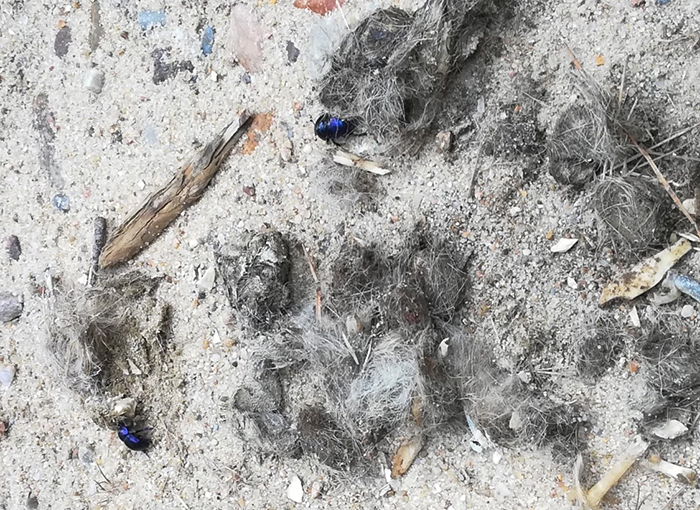
Wolves are once again living throughout Germany. Most territories are located in Lower Saxony, Brandenburg, Saxony, Saxony-Anhalt and Mecklenburg-Western Pomerania. "According to the current monitoring data for 2024/25, there are around 219 packs, 43 pairs of wolves and 14 individual animals living in Germany," it says on the federal government's website.
However, the return of wolves is causing problems, especially for livestock farming. In addition, the potential for conflict with parts of the population has increased.
Against this backdrop, the Federal Council decided at the end of March 2026 to include the European grey wolf(Canis lupus) in hunting legislation. This will give federal states where there are large numbers of wolves the opportunity to control the population through hunting.
Hunting is only a strategy for coexistence
"Hunting wolves is just one of many strategies for managing coexistence with large carnivores," says Professor Michaele Fenske, Head of the Chair of European Ethnology/Empirical Cultural Studies at the University of Würzburg.
Under her leadership, research on wolves was carried out at the Würzburg department as part of the DFG funded project "The Return of Wolves. Cultural anthropological studies on the process of wolf management in the Federal Republic of Germany". Fenske's team co-operated with a Swiss sister project as well as with researchers in Finland, the Netherlands, Norway, Poland, Portugal and Russia.
Within the context of Würzburg environmental humanities studies, doctoral students Irina Arnold and Marlis Heyer investigated what the return of wolves does to people. Their exemplary research areas were the federal state of Lower Saxony and Lusatia.
Dissertations argue in favour of a change of perspective
The two researchers' dissertations were recently published. They argue in favour of a change of perspective that opens up new ways of living together with wolves.
- Irina Arnold's book "Wo Schafe arbeiten...und Wölfe leben" (Where sheep work...and wolves live) looks at the practices of sheep farms in Lower Saxony in the 21st century. The author focusses on the complex learning processes that have become necessary in sheep farms due to the return of wolves. Close to the everyday lives of the shepherds and their flocks, she captures the challenges and presents approaches for a more conflict-free, cross-species coexistence.
- In her volume "Wölfe erzählen", Marlis Heyer examines how the return of wolves is accompanied by narratives and helps to shape them. Heyer explores questions about the coexistence of humans and wolves and uses various theories to examine the possibilities and limitations of narrative research beyond humans.
Both works follow the approach of multispecies studies: Wolves, sheep, dogs, plants and landscapes enrich their analyses with perspectives beyond those of humans. "The dense descriptions also invite reflection on co-existence with wolves beyond shooting licences," says Michaela Fenske.
Both studies are available online free of charge as pdf files (in German)
Irina Arnold: "Wo Schafe arbeiten und Wölfe leben. Eine Multispezies-Ethnografie niedersächsischer Schäfereien", Würzburg 2025
Marlis Heyer: "Wölfe erzählen. Eine Ethnografie vielartiger Narrative der Lausitz", Berlin 2026