
Knauf prizes for four young researchers
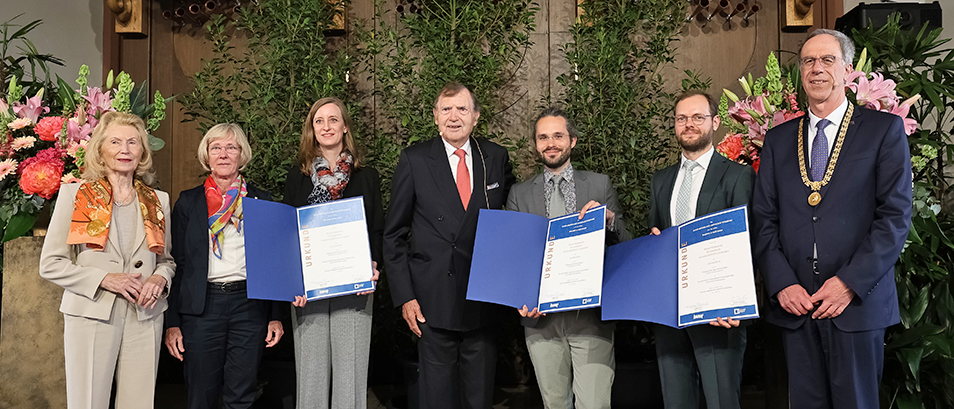
05/12/2026Erik Frank, Anton Freund, Mona Garvert and Christof Weiß receive the Baldwin and Inge Knauf Sponsorship Awards 2026, each endowed with 50,000 euros, for outstanding achievements.
Erik Frank
Biologist Dr Erik Frank receives the "Baldwin und Inge Knauf-Förderpreis" (Baldwin and Inge Knauf Sponsorship Award) in the field of life sciences and medicine. He was unable to attend the award ceremony at the foundation festival because he had to carry out fieldwork in Spain that could not be postponed.
He was honoured for his outstanding and internationally acclaimed work on the evolution of social wound care in ants. With extraordinary scientific creativity, Frank combines approaches from behavioural ecology, microbiology and chemical ecology into an original and highly innovative research programme.
His work has shown for the first time that ants not only care for wounded conspecifics, but also treat them in a targeted manner and even amputate limbs to increase their chances of survival. These findings open up new perspectives on the mechanisms of social immunity in the animal kingdom and go far beyond classical zoology.
Erik Frank has an impressive publication record in leading international journals, a high level of scientific dynamism and an ability to initiate new collaborations and acquire third-party funding. At the same time, he is an outstanding science communicator who makes his research accessible to a wide audience. As such, he exemplifies a new generation of researchers who combine excellent science with social visibility.
Anton Freund
Junior Professor Anton Freund received the Baldwin and Inge Knauf Award in the field of natural sciences. He was honoured for his outstanding scientific achievements in mathematical logic. As a highly productive and visionary researcher, he already ranks among the European leaders in his field.
His work is at the interface of mathematical logic and theoretical computer science and makes fundamental contributions to central issues in these disciplines. His research is characterised by great depth, conceptual clarity and methodological innovation.
With an exceptionally high number of publications in leading international journals as well as his strong presence at renowned conferences and scientific events, Anton Freund achieved a high level of international visibility early on. His involvement in the organisation of important scientific formats also underlines his recognition within the specialist community. He epitomises in a special way the combination of analytical precision and visionary thinking that makes scientific progress possible.
Mona Garvert
Neuroscientist Mona Garvert received the Baldwin and Inge Knauf Award in the field of social sciences. The junior professor was honoured for her excellent and internationally highly visible research at the interface of cognitive neuroscience, psychology and medicine. In her work, she investigates the neuronal mechanisms of flexible learning and decision-making as well as their changes in mental illness.
Her research approach is particularly innovative: by combining high-resolution imaging techniques with mathematical models and behavioural experiments, she is able to analyse and understand complex cognitive processes on several levels.
The high quality and relevance of her research is reflected in her impressive publication output, high citation figures and the acquisition of significant third-party funding - including an ERC Starting Grant. In a short space of time, Mona Garvert has impressively demonstrated her scientific independence and positioned herself excellently internationally.
She is also committed to promoting gender equality and young researchers. Her work is exemplary of research that combines fundamental findings with high social relevance.
Christof Weiß
Music researcher Christof Weiß received the Baldwin and Inge Knauf Award in the field of humanities. The professor was honoured for his outstanding achievements in digital humanities and computational musicology. In his research profile, he combines musical expertise with computer science methods in a unique way, thus creating new approaches to analysing and understanding music.
His work on machine learning methods for processing music recordings, on the development of specialised algorithms and on their application in computer-aided music research is internationally visible and methodologically groundbreaking.
With an impressive number of high-ranking publications, he established himself early on as a leading voice in a highly specialised and interdisciplinary field of research.
In addition, Christof Weiß is particularly committed to the dialogue between disciplines and to communicating scientific content to a broader public. His research is exemplary for the productive combination of technology and culture and opens up new perspectives for the humanities in the digital age.